

June 30, 2026
SINGAPORE – Central kitchens, food caterers and restaurants saw the most food poisoning outbreaks in 2024 and 2025. A total of 55 were responsible for cases during this period.
The Communicable Diseases Agency (CDA) said this was because such operators had to handle and prepare large amounts of food, and then hold them for a period of time before serving. This increased the risk of contamination, which tended to affect a larger group of consumers, leading to gastroenteritis outbreaks.
With more food establishments moving towards a central kitchen model, including schools which have faced challenges in securing enough stallholders, the authorities are bracing themselves for potentially more outbreaks from such sources.
CDA is monitoring the situation, and if it detects an increase in outbreaks in any particular setting, it will work with its partner agencies to publish joint advisories or to conduct joint training for the relevant sector, said CDA’s food and vector borne division director Lalitha Kurupatham.
The agency investigated a total of 113 gastroenteritis outbreaks in 2024 and 2025.
About two-thirds were caused by bacteria or viruses which spread through contaminated food or water. About one-tenth of the remainder was caused by person-to-person, non-foodborne transmission, and the rest were either a mixture of sources or inconclusive after investigations.
Again, for the outbreaks caused by foodborne pathogens, the majority involved central kitchens, food caterers and restaurants, totalling 27 food establishments (64 per cent) in 2024 and 28 (76 per cent) in 2025.
Others stemmed from smaller food establishments such as hawker stalls, coffee shops and food stalls in school canteens.
Gastroenteritis refers to the inflammation of the stomach and intestines, often caused by infections by bacteria, parasites or viruses. Some bacteria cause gastroenteritis symptoms by releasing toxins.
The majority of foodborne illnesses cause acute gastrointestinal symptoms, including nausea, vomiting, diarrhoea and abdominal pain. There may be fever, but not in the case of toxin-producing organisms.
CDA said the top three foodborne pathogens which caused the food poisoning incidents here were the norovirus, salmonella and Clostridium perfringens.
To deal with outbreaks, CDA’s National Public Health Laboratory has started using gastrointestinal polymerase chain reaction (PCR) panels in recent years, increasing testing efficiency as this method can detect multiple pathogens in the samples collected within a few hours. This has greatly shortened the time needed to identify the pathogens in question, if any, compared with the traditional method of taking days to culture the bacteria in laboratories.
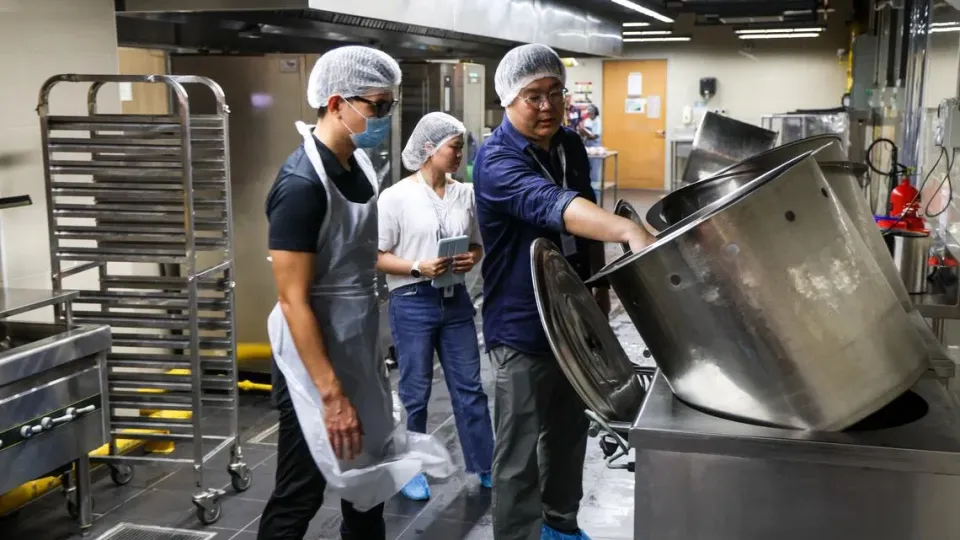
When possible outbreaks happen, CDA’s team of nine public health officials from its food and vector borne division conducts investigations. Their work includes inspection of the premises and its food handling processes.
Following CDA’s investigations, food handlers whose stool samples test positive for foodborne pathogens are temporarily suspended from their food handling duties by the agency. They will need two subsequent negative stool test results which are at least a week apart before their suspension is lifted.
Food operators found to have lapses may also face fines and have their business suspended.
For instance, Yun Hai Yao was fined $7,000 in July 2025 for its food safety lapses. This was after 171 people who consumed food catered from the Chinese eatery chain in July 2024 suffered gastroenteritis. Among them, 60 were hospitalised.
Stamford Catering Services was fined $8,000 in May 2026 after two gastroenteritis outbreaks in October 2024 and February 2025 which affected a total of 182 people who ate its food.
Lalitha advised members of the public to consume their food shortly after it is cooked. If not, the food should be stored within the safe temperature ranges – below 5 deg C or above 60 deg C, to keep it safe for consumption.
Food not kept in the safe ranges may be re-heated before being eaten, but she pointed out that the heat would only kill off pathogens. It would not be able to remove toxins which might have been released by them and could still lead to food poisoning.
“Try to eat your food fresh… You should not keep it out for long. So, store it in the fridge quickly and try to reheat your food before eating it,” said Lalitha.