

May 19, 2026
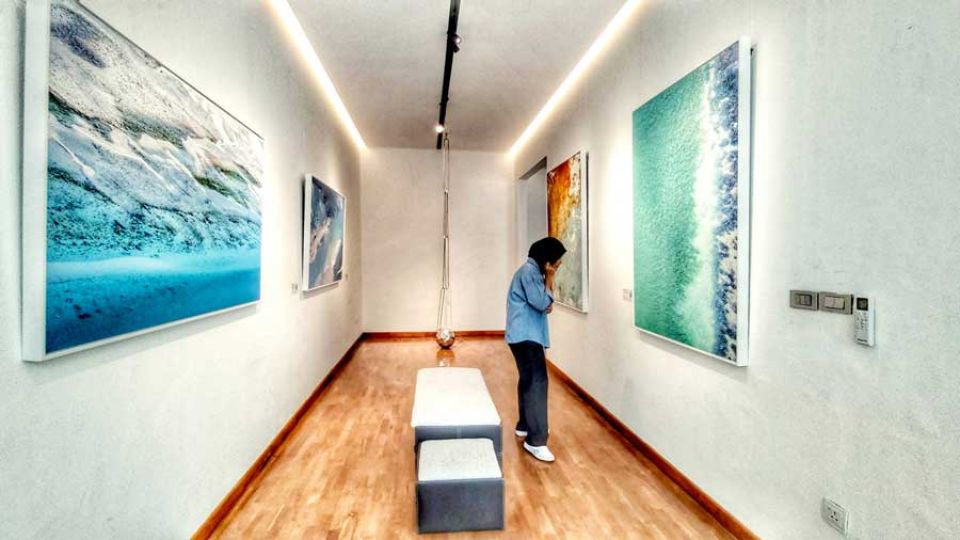
JAKARTA – One balmy morning in Kebayoran Baru, South Jakarta, the halls of NODE by ISA Art and Design felt like an oasis: Along the walls hung oversized photographs by American artist Diane Tuft, depicting icy blue glaciers and turquoise waters in striking detail.
At the far end, a stainless steel sculpture by South Korean jeweler and sculptor Allyson Jeong hung from the ceiling, a dimpled sphere anchoring it to the floor as its chain swayed gently, scattering glints of light across the room. Nearby, the metallic chime of Aaron Taylor Kuffner’s kinetic sculpture Gamelatron echoed softly through the space.
On view from April 24 to May 24, Unbound: Resonating Light pairs Jeong’s jewelry and installations with Tuft’s atmospheric photographs.
Landscapes on edge
“Everything you’re seeing [in these photographs] doesn’t exist anymore,” Tuft said during the exhibition opening.
The places remain, but the landscapes have changed dramatically due to ozone depletion, global warming and melting glaciers, transformations she has documented since 1998.
“In a world that is becoming increasingly digital, I hope [visitors] can feel the spatial energy of the metal and the light, and find their own sense of resonance in that space.” — Allyson Jeong
Originally from Connecticut in the Northeastern United States, Tuft studied mathematics at the University of Connecticut before moving to New York, where she became fascinated by “shapes and colors”, eventually turning to painting and photography. After raising three children, she enrolled in a formal art course at New York’s Pratt Institute.
Although she still paints in her studio, Tuft now prefers what she describes as painting with her camera, traveling to some of the world’s remotest regions.
She initially worked in black and white using infrared film. A turning point came in the early 2000s during an aerial shoot over the Great Salt Lake in Utah, when she noticed brilliant hues glowing across the landscape below. A microbiology professor later explained that the phenomenon was caused by heightened ultraviolet exposure from the Sun.
“That’s when I realized: Where else in the world do you find that much ultraviolet light? In places where there’s ozone depletion,” Tuft recalled.
The discovery reshaped her artistic direction, pushing her to use photography not only to capture natural beauty but also to highlight environmental destruction.
“I just want to make people aware of what’s going on,” she said.
Influenced by American painters Georgia O’Keeffe and Mark Rothko, Tuft transforms landscapes into abstract compositions of vivid colors and unusual forms through her photographs, taken from tripods, drones and helicopters.
One of the exhibition’s most striking works is Tuft’s Ultraviolet Reflections (2012), which captures ultraviolet light shimmering across jagged pressure ridges in Antarctica. Despite their beauty, the image evokes accelerating glacial melt and rising sea levels threatening coastal communities around the world.
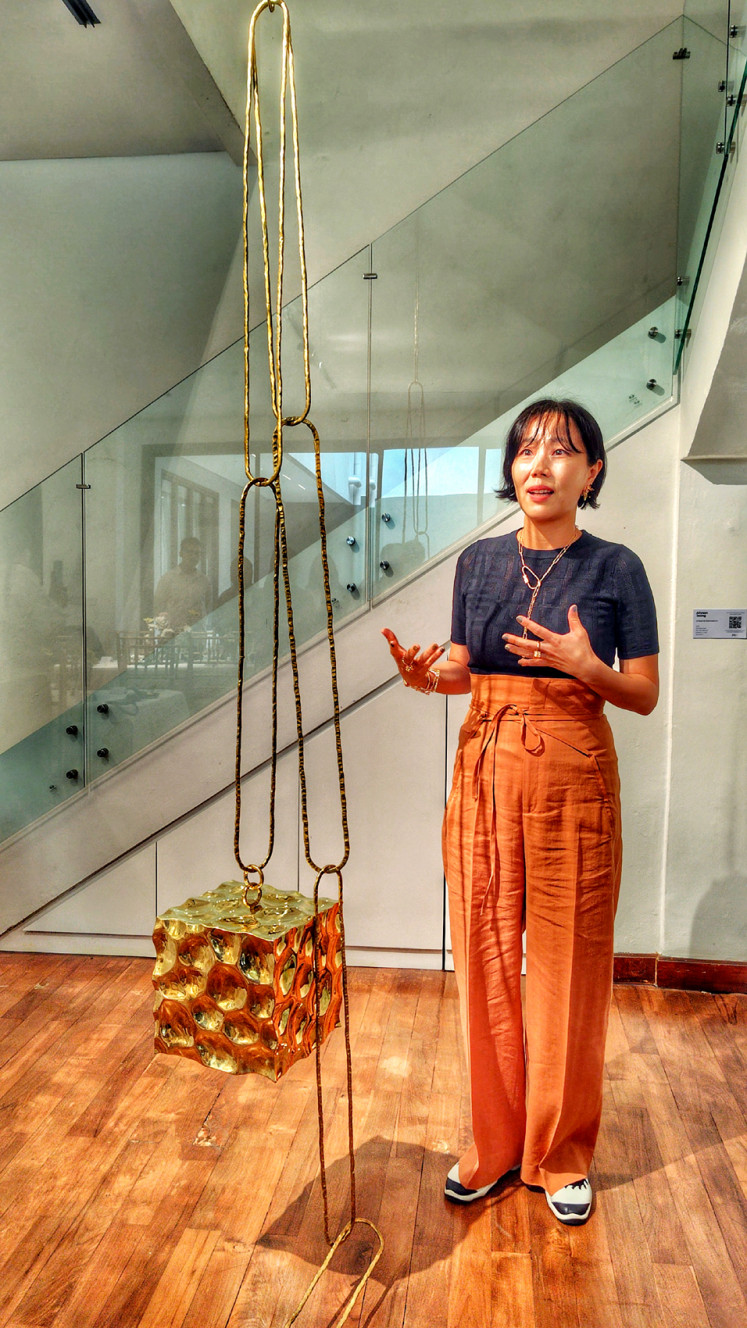
Spatial ornamentation: South Korean artist Allyson Jeong explains how she expands her jewelry pieces into installations by liberating the material into a larger space, standing alongside her brass sculpture ‘Unbound Adornment II’ (2024) on April 23, 2026, during the exhibition opening of Unbound: Resonating Light at NODE by ISA Art and Design in South Jakarta. PHOTO: THE JAKARTA POST
Tuft’s Scattered Epitaphs (2022) unfolds in swaths of yellow and earthen tones, interrupted by black pools formed by exposed minerals and chemical deposits in the Great Salt Lake. As the lake shrinks due to climate change, hazardous substances trapped beneath the water, including arsenic, are exposed.
“So now the lake has shrunk, the air and the dust that’s coming up has all these chemicals in it,” Tuft said, adding that many local residents had developed cancers or moved away.
Some visitors at the exhibition opening appeared struck by the tension between the photographs’ serenity and the devastation they depict.
“Her works look so calm, serene and beautiful, but behind them are so many sad stories,” said visitor Dio.
Metal in motion
At the center of the gallery amid several Gamelatron installations, a marble table displays Jeong’s gold and silver jewelry.
Trained at Seoul National University and the School of American Crafts in New York, the South Korean artist grinds and hammers precious metals into sculptural forms that balance symmetry and asymmetry.
Undulating triangles become bangles, circles of varying sizes link into necklaces and dimpled cubes fitted with studs transform into earrings that resemble miniature sculptures.
Jeong’s clientele include South Korean rapper G-Dragon and his mother as well as American artist Jeff Koons and Lithuanian soprano Asmik Grigorian.
In 2020 she expanded into sculpture, creating larger works that retain the artistic DNA of her jewelry.
“I create my pieces to expand,” she said at the exhibition opening on April 23. “It’s like liberating the material into a big space.”
Made primarily from brass and stainless steel, many of her sculptures are modular and foldable, allowing collectors to alter their configurations to fit a space.
“I always like to create something adjustable, like mobile sculptures,” said Jeone.
In an adjoining room hangs her Unbound Adornment II (2024), a brass sculpture inspired by the shape of a necklace. Looping chains descend from the ceiling, casting delicate shadows against a white wall before ending in a dimpled box hovering just above the floor.
“The title Unbound represents a release from constraints, both physical and conceptual,” Jeong said. “It refers to the idea of metal breaking free from its rigid nature to become something fluid and atmospheric.”
For this exhibition with Tuft, the word “unbound” also reflected how “light and matter are not tied to a single form but are constantly resonating and expanding”, she added.
Jeong said her inspirations often emerged from details of the human body as well as the art and fashion she encountered in daily life.
“Sometimes I get some inspiration at 2 a.m.,” she said. “I immediately get up and jot it down.”
Jeong hopes visitors will leave the exhibition feeling more connected to the physical world.
“In a world that is becoming increasingly digital, I hope they can feel the spatial energy of the metal and the light and find their own sense of resonance in that space,” she said.
Through their artistic perspectives, Jeong and Tuft remind viewers that beauty can draw people in and compel them to confront the fragile and shifting world around them.