

February 9, 2026
JAKARTA – Concerns surfaced over the country’s disaster preparedness and response following recent budget cuts to disaster mitigation agencies, further raising questions over funding priorities in disaster-prone Indonesia amid intensifying hydrometeorological and other hazard
Indonesia’s disaster mitigation efforts have been in the spotlight since critics noted the sluggish response from authorities to Tropical Cyclone Senyar-induced floods and landslides in northern Sumatra in November 2025, which killed more than 1,200 people and displaced hundreds of thousands more.
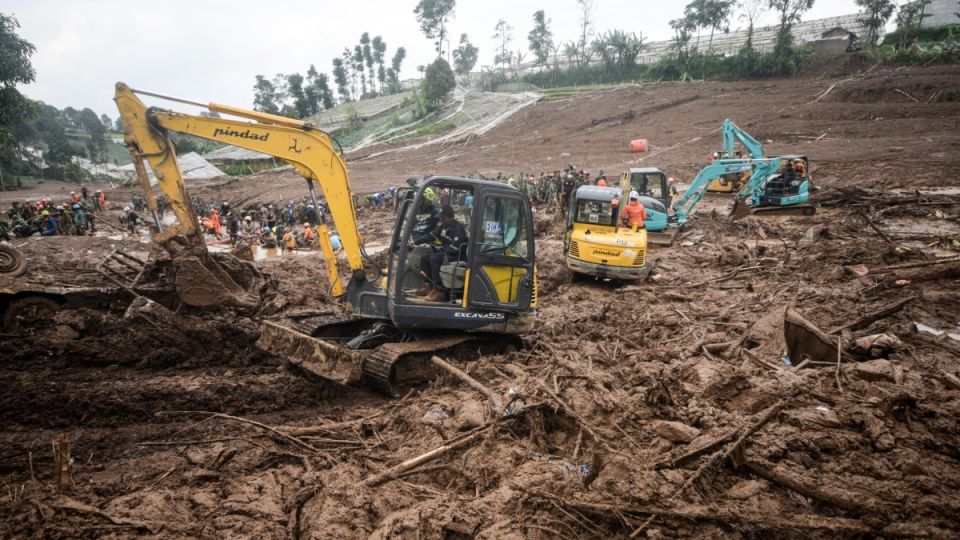
The country has also seen an intensified rainy season in the past few months that triggered floods, landslides and other hazards in various regions. Among the latest examples were landslide in Cisarua, West Bandung regency, West Java, where at least 74 have been confirmed dead and dozens of others missing.
Despite high exposure to disaster risk, agencies such as the National Disaster Mitigation Agency (BNPB) and the National Search and Rescue Agency (Basarnas) have seen their state budget allocation reduced for this year as part of austerity measures introduced in 2025 to fund President Prabowo Subianto’s flagship programs.
During a meeting with House of Representatives Commission VIII overseeing social affairs on Feb. 3, BNPB head Lt. Gen. Suharyanto told lawmakers that limited funding had been a major challenge to disaster mitigation in the country.
For 2026, the agency only got Rp 491 billion (US$29.1 million), a sharp drop from the Rp 2 trillion allocated from the state budget in the previous year. In the past five years, around Rp 19 billion of the total budget was allocated for disaster prevention efforts.
“Of course this is very limited, but we cannot simply complain and stop working,” Suharyanto told the legislature.
He added the agency had sought foreign loans to strengthen disaster prevention capacity, with President Prabowo approving a loan from Spain to support preparedness for wet hydrometeorological disasters, such as floods and landslides.
Commission VIII member Sigit Purnomo of the National Mandate Party (PAN) acknowledged BNPB’s concern, highlighting that disaster mitigation is costly but essential. He expressed support for BNPB to strengthen mitigation efforts.
Lack of prevention
Basarnas saw its budget reduced from Rp 1.55 trillion to Rp 1.4 trillion during a meeting with House Commission V overseeing infrastructure and transportation on Jan. 28. The figure is far below its Rp 2.27 proposal for this year’s budget.
Basarnas head Air Vice Marshal Mohammad Syafii accepted the decision, but pushed for many improvements to optimize the search and rescue efforts, such as the establishment of local offices of search and rescue agencies to allow quick responses.
Syafii previously warned the reduced budget would affect the agency’s communication systems, information technology as well as search and rescue operations.
While the Meteorology, Climatology and Geophysics Agency (BMKG) saw its budget raised from Rp 1.8 trillion in 2025 to Rp 2.57 trillion for this year, it said the figure would still be insufficient to modernize its earthquake and tsunami monitoring systems as well as weather radar infrastructure.
The reduced funding reflected the government’s narrow understanding of disaster mitigation, which only focuses on post-event response, said Eko Teguh Paripurno, head of National Development University (UPN) Yogyakarta’s disaster management study center.
“The government tends to see disaster management as rehabilitation and reconstruction needed only after a disaster occurs, so there’s little investment in prevention as well as improving readiness and early warning systems,” Eko said on Friday.
He added limited funding would weaken disaster management knowledge and capacity at regional and community levels, particularly in disaster-prone areas.
“If the state fails to invest in knowledge and capacity building from the national level down to communities,” Eko said, “it is effectively failing to protect its citizens.”
Priority issues
Amid growing climate risks, climatologist Erma Yulihastin of the National Research and Innovation Agency (BRIN) said Indonesia needs accurate climate prediction and modeling. But funding for research, including for collaborative projects between BMKG, BNPB and other institutions, is insufficient.
“So far, such collaboration has not been built strongly,” she said on Saturday.
Melva Harahap of the Indonesian Forum for the Environment (Walhi) questioned the government’s response priorities. She cited conditions in Aceh, where school reconstruction has not finished more than two months after the disasters, while Prabowo’s flagship free nutritious meal program continues in the region.
“The free meals program is already running while classrooms remain unfinished and students are forced to take turns studying in assembly halls,” she said on Friday.
“Why isn’t the budget for the free meals program redirected to more urgent needs such as reconstruction?” Melva continued, noting the situation reflected “a lack of seriousness by the state” in disaster management and response.