

September 26, 2025
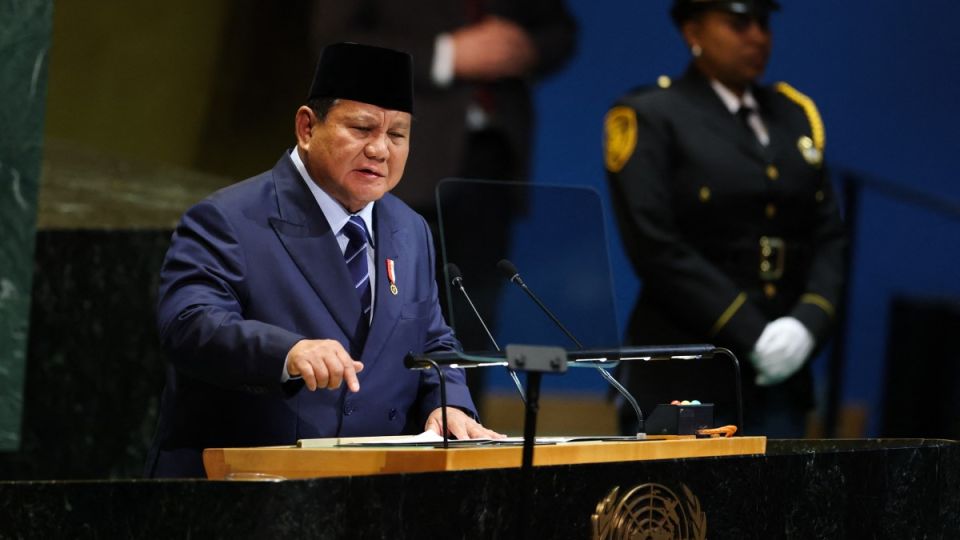
JAKARTA – President Prabowo Subianto stressed Indonesia’s commitment to multilateralism, peace and a two-state solution for Palestine during his debut appearance at the United Nations General Assembly (UNGA), delivering a fiery 19-minute speech that analysts saw as an attempt to position himself as a friend-for-all on the world stage.
All eyes turned to New York on Tuesday as world leaders gathered for the 80th UNGA general debate, the most closely watched session at the world’s largest multilateral forum, amid heightened global tensions over unresolved conflicts and crises.
Chaired by former German foreign minister Annalena Baerbock, leaders have been expected to focus mainly on UN reforms, the escalating climate crisis and Israel’s ongoing military operations in the Middle East, taking turns to deliver their country’s positioning over these key issues over the next week.
For the first time in a decade, Indonesia was represented at the general debate by its head of state, Prabowo, who secured the rare third speaking slot in the forum that traditionally opens with statements from Brazil and the United States.
Prabowo began his remarks by recalling Indonesia’s history of colonialism and poverty, drawing parallels to today’s global conflicts he said were marked by “suffering, genocide and blatant disregard for international law”. He then called for collective restraint and leadership to achieve peace across the world.
Jakarta stands ready to contribute politically, financially and in terms of security to achieving peace in Gaza or Ukraine, Prabowo said and pledged to send up to 20,000 Indonesian personnel to the UN peacekeeping operations upon the organization’s request.
“Thucydides warned: ‘The strong do what they can, the weak suffer what they must’. We must reject this doctrine. The United Nations exists to reject this doctrine. We must stand for all, strong and weak,” Prabowo said.
“We must act now. We must stand for a multilateral order where peace, prosperity and progress are not the privilege of a few but the right to all,” he added.
Prabowo spoke with apparent passion, at times hitting the UN podium to emphasize his point and attracting rounds of applause from the audience.
Claiming that Indonesia is “nearer than ever” to achieving the Sustainable Development Goals, and rice sufficiency, Prabowo also announced plans to send rice assistance to Palestine while positioning Indonesia as the future “granary of the world”.
Prabowo again reaffirmed Indonesia’s position on Gaza, echoing his earlier statement at the UN high level conference on the two-state solution, including by repeating his “guarantee [for] the safety and security of Israel” once Palestinian statehood was achieved.
Read also: Prabowo on tightrope for Palestine address in UN
“Two descendants of Abraham must live in reconciliation. […] Is this a dream? Maybe, but this is the beautiful dream that we must work together toward,” the President said at the end of his speech.
Friend to all
That Indonesia was finally represented by its leader is a long-awaited diplomatic relief for Jakarta, said analysts who celebrated Prabowo’s appearance as key in underlining the country’s commitment to multilateral cooperation despite disfavoring global trends.
Noting his remarks, analysts said the speech appeared to be Prabowo’s attempt to present himself as open to all nations and likely willing to seek pragmatic solutions, though they questioned how far this approach would advance Indonesia’s diplomatic strategy.
For example, Prabowo’s seeming insistence on negotiating with Israel by making pledges ensuring its security despite recurring domestic backlash and his portrayal of Indonesia as a future “hub” and source of solutions to key issues like food, energy and water security appeared aimed at presenting himself as a partner to all countries.
“The word choice indicated a willingness to open communications with Israel for instance,” international relations expert Ahmad Rizky M. Umar from the Aberystwyth University told The Jakarta Post. “He wants to appear as a friend on the world stage, though I’m not sure how this will reflect on the optics of Indonesian foreign policy.”
Since taking office last year in October, Prabowo has repeatedly emphasized that his administration will go by the “good neighbor” policy as the basis of its diplomacy, offering the proverb that “a thousand friends is too few, one enemy is too many”.
Read also: Prabowo in New York for UNGA after Osaka stopover
Yet Prabowo’s attempt to appear friendly may risk perceptions of inconsistency in Indonesia’s positions if overdone, analysts warned, particularly on sensitive issues such as Palestine.
“There were big rhetorics being presented, but they all amounted to ambiguity. It remains unclear what his practical strategies are, or how these big offers could be supported by Indonesia’s institutional capacity,” said international relations expert Radityo Dharmaputra from Airlangga University.
Amnesty International Indonesia executive director Usman Hamid criticized Prabowo for not using the term genocide and instead opting for “catastrophe”.
“The use of the word ‘catastrophe’ by the President to describe the situation in Gaza potentially absolves Israel’s accountability for the genocide. It’s key that the international community, including Indonesia, end this genocide and keep those responsible accountable,” Usman said.