

June 22, 2026
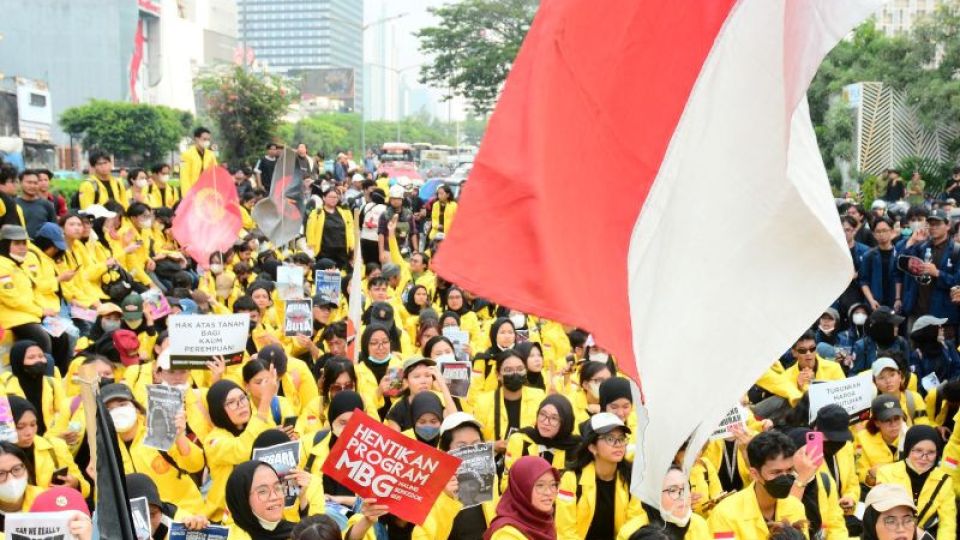
MEDAN – Students in major cities across the nation beyond Jakarta staged rallies this week to voice their opposition to various policies, from the encroachment of the Indonesian Military (TNI) into civilian affairs to the flagship free nutritious meal program.
In North Sumatra capital Medan, members of the Indonesian National Student Movement (GMNI) rallied on Wednesday in front of Military District Command (Kodim) 0201/Medan. They burned tires and unfurled a banner demanding the return of civilian supremacy.
Damses Sianturi, chairman of the GMNI’s Medan chapter, said the TNI’s current role had gone far beyond its primary role in national defense.
Damses also urged the military leadership to not allow the use of soldiers as a tool by those in power to intimidate civil society and fill civilian posts.
“These are the reasons why we are protesting in front of the Kodim 0201/Medan headquarters,” he said.
“We demand that the military return to the barracks and allow the military to return to its defense function, no longer dragged into the realm of government.”
Damses pointed to the TNI’s involvement in the free meals, Sekolah Rakyat (community school) and the Red and White Cooperative programs as the most jarring examples of military interference in civilian affairs.
There was no urgency for the military to be given space to control or manage these civilian programs, he emphasized.
“We are worried that the presence of the TNI in those programs will create pressure for civil society around those projects,” Damses added.
He particularly pointed to the basic military training required for certain posts in the government’s flagship programs, which meant those individuals automatically became part of the TNI’s Reserve Component, or Komcad.
In the free meals program, for example, all heads of nutrition fulfillment service units (SPPG) were required to undergo two-month basic military training and a month of managerial training. For the rural cooperatives program, managers had one month of basic training, followed by a 15-day management training course.
The GMNI also urged the government to cancel its plan to establish so-called territorial development infantry battalions (Yonif TP) in regencies and municipalities.
Damses said there was no clear strategic urgency for such battalions, which would only be an excessive burden on the state budget.
Kodim 0201/Medan commanding officer Lt. Col. Delli Yuda acknowledged the students’ right to convey their aspirations.
“However, according to regulations, TNI installations cannot be used as a place to hold demonstrations. The regulation banning military areas for demonstrations are still in force until now,” Yuda emphasized.
As regards the students’ 11 demands, he responded: “We will schedule a focus group discussion with students, so the discussion will be more comprehensive and based on data.”
Meanwhile in Bandung, West Java, some 1,200 students from various universities held the “Emergency Indonesia” rally on Wednesday.
They put forth seven demands that included reducing the price of fuel, stabilizing the rupiah’s exchange value, saving the state budget from wasteful spending and improving government communication, Kompas.com reported.
They also called for a thorough review of the free meals and the rural cooperatives program, repealing the new laws on the TNI and the National Police, evaluating incompetent ministers in the Red and White Cabinet, enforcing human rights and ending impunity.
Far-ranging demands
Also on June 17, students from the Muhammadiyah University of Yogyakarta (UMY) issued an eight-point demand during their rally at the Zero Kilometer Point Monument in the city.
Their demands included stopping imperialist wars and withdrawing Indonesia from the United States’ Board of Peace, which they said was not in alignment with the people’s interests and humanitarian principles.
They also called for ending government programs that did not benefit the people, such as the free meals and cooperatives program as well as the so-called national strategic projects (PSN), and lowering the prices of fuel and basic goods.
The UMY rally also urged a stop to: the appointment of active-duty and retired military and police personnel in strategic civilian posts and restoring the security institutions to their main functions; the criminalization of activists; land grabs and the exploitation of natural resources; and the commercialization of education.
It also demanded the realization of true agrarian reform and national industrial development, the prioritization of the state budget for health and education, guaranteeing freedom of expression and democratic rights and the development of education that was free, scientific and democratic.
The students also called for accountability from President Prabowo Subianto and Vice President Gibran Rakabuming Raka for policies that harmed the public or else resign from their positions.
Earlier on Monday, hundreds of students from the Indonesian Islamic University (UII) held a demonstration at Yogyakarta’s Zero Kilometer monument to voice similar demands, including stabilizing the rupiah. They also called out the new Police Law as undemocratic, as it had been passed without public consultation, and questioned the appointment of active police officers to civilian posts.
Elsewhere on June 15, students and activists held a rally in South Sulawesi capital Makassar to question the government’s management of the economy, particularly with regard to the rupiah’s plunging value against the greenback, fuel price increases and costly programs that were depleting the state budget. (nvn)