

June 11, 2026
NAYPYIDAW – The global energy crisis began after the US and Israel launched an attack on Iran on February 26, when Iran closed the famous Strait of Hormuz. The Iran-US war has caused energy demand problems and economic difficulties for many countries. Myanmar, like other countries in the region, is also facing these situations. For Myanmar, which imports more than 90 percent of its fuel for domestic consumption due to energy needs, the current fuel crisis is affecting all classes of people and is a challenge that will question the new government’s management.
■ Good policy results…
When analyzing the actions taken by officials to address the energy crisis, their strengths, weaknesses, and needs, the public’s views and opinions, and whether the government’s policies are good or bad, we must first talk about the positive results of energy policies.
In Myanmar, which is facing an energy crisis like many other countries around the world, the government launched a digital technology-based distribution system on March 12, and on March 27, it upgraded the system to sell a set amount of fuel for each vehicle.
Out of the 2,943 petrol stations across Myanmar, petrol stations in major cities such as Yangon, Mandalay, Taunggyi, and Nay Pyi Taw have started selling using the Bar Code/QR Code system, and are now also selling in other cities using the same system.
Private vehicles were allowed to purchase 35 liters of fuel per week, and rental vehicles and trucks were allowed to sell limited amounts of fuel based on the distance traveled.
The policy of distributing fuel digitally, using QR codes/bar codes, etc., to speed up distribution, and limiting fuel consumption to control fuel consumption, is working well and is correct. So now there is no more panic buying of fuel, and the government can say that it has stored up to 60 days of fuel reserves and fuel security, which is proof of that.
Myanmar imports about five million tons of fuel annually, costing around five billion US dollars. Imports of fuel from abroad account for about 33 percent of the country’s total imports. Fuel consumption per day averages over 3.5 million gallons. The government’s fuel consumption reduction policies and actions have now reduced fuel consumption to 2.5 million gallons per day, saving around two billion US dollars per year, according to data. The ministry also said that Myanmar currently has a fuel supply of about 60 days.
In addition, the Energy Minister recently visited China, where he was able to accelerate energy-related agreements between the two countries. They also agreed to relaunch the China-Myanmar Economic Corridor (CMEC), build new oil refineries, and cooperate on the security of existing pipelines.
He also went to Russia, where he signed a long-term oil and fuel supply agreement with Russia in April. On April 18, the Ministry of Electricity and Energy and the Russian Investment and Development Fund “RC Investments” agreed to promote the energy sector and provide long-term supplies of oil and petroleum products from Russia to Myanmar.
The three countries have also reached agreements to connect the Myanmar-China-Russia energy network and secure long-term access to petroleum products. It was a good policy to quickly connect with countries that were convenient for us and solve the energy crisis in the short and long term.
■ Energy crisis and bad policy
Before I talk about the bad energy policy, let me first talk about Myanmar’s per capita income.
In the last year of U Than Shwe’s rule, Myanmar’s per capita income was around $980. Under U Thein Sein’s rule in 2015, Myanmar’s per capita income was around $1,280, under the NLD, it was around $1,420, and now, according to the latest World Bank and International Monetary Fund reports, it is around $1,519 on average. According to the latest World Bank and International Monetary Fund reports, compared to neighboring countries, Thailand’s per capita income is around $8,110, Laos’s is around $2,400, Cambodia’s is around $2,900, and Bangladesh’s is around $2,911. (The annual per capita income of each country is shown in the table.)
When comparing the annual per capita income of Myanmar and the above neighboring countries, it can be seen that during the Than Shwe era, Myanmar’s per capita income was not very different from other countries except Thailand, while Cambodia and Bangladesh were below Myanmar.
In 2015, Laos and Cambodia surpassed Myanmar, and Bangladesh is not far behind. Before the COVID-19 pandemic, Myanmar was at the bottom of all of these countries in 2019. According to the latest figures, Thailand has a per capita income of about eight times that of Myanmar, while Laos, Cambodia, and Bangladesh have around or more than double that.
Given that Myanmar’s per capita income is lower than other countries in the region, it is necessary to study car purchases and prices on the other hand. This is very important when considering Myanmar’s energy policy, as energy policy and car imports are linked.
Another one is the Jasut project. Myanmar also faced an energy crisis in 2005. The Jasut project was implemented with the aim of overcoming that crisis. The Jasut project implemented by U Than Shwe started in 2005. What happened to that project was that hundreds of thousands of acres of farmland were confiscated by corrupt people. I heard that during U Than Shwe’s tenure, hundreds of thousands of acres of farmland were confiscated for the Jasut project due to corrupt military forces, government officials, administrative and civil officials, and the productivity of farmland decreased. In fact, when U Than Shwe spoke, he ordered the confiscation of waste land, vacant land, etc. and planting in those lands. At best, it would only be a waste of work, high costs, and a burden on the country. In reality, it would only harm the farmers and the people.
Before we get to the main issue of energy policy, let’s talk about the rising cost of transportation in Myanmar. The energy crisis has caused fuel prices to rise globally, and so have fuel prices in Myanmar. Before the crisis, fuel prices in Myanmar were just over 2,000 kyats per liter, but by mid-March, they had risen to over 3,500 kyats. Now, gasoline costs over 4,500 kyats per liter and premium diesel costs over 5,000 kyats per liter.
According to the Ministry of Energy, Myanmar’s gasoline prices are in the middle of ASEAN countries, and diesel prices are in the 7th place. It would be fair to say that gasoline prices are in the 5th place, and diesel prices are in the 7th place.
After the oil price hike in Myanmar, transportation costs have also increased, and commodity prices have also increased. The reason for this is that the fuel price has been reduced and the use of vehicles has been restricted to a full/partial system. In Thailand, fuel prices have increased, but the government is controlling prices and is taking measures to prevent them from rising too much. Myanmar and Bangladesh are the worst affected by the price hike.
In Thailand, the inflation rate is currently 2.89 percent, in Laos 10.2 percent, in Bangladesh 9.4 percent, and in Cambodia around 3 percent. In Myanmar, according to the World Bank and the International Monetary Fund, it is around 19 percent to 30 percent.
When you look at how much fuel prices have risen and how much commodity prices have risen in other countries, you can tell from the data that even though inflation rates are rising, commodity prices are still below ten percent.
The fuel crisis has caused Myanmar’s price hikes to increase, although they vary from region to region, with some goods rising by 30 to 40 percent. Oil prices are cheaper than in Southeast Asian countries, thanks to the government’s efforts to keep them cheaper by selling foreign currency. However, oil prices have more than doubled since before the fuel crisis, increasing trade costs and driving up commodity prices.
As mentioned above, Myanmar is more affected by rising prices than other countries, making it more difficult to pay for them. According to a report released by the WFP on May 18, the price of basic food items in Myanmar has increased by 18 percent.
“Currently, 1 in 4 people in Myanmar, or 12.4 million people, are currently facing acute hunger, while 3.7 million people are displaced by ongoing conflict. The prices of basic food items have risen by 18 percent nationwide, with increases of 38 percent in Magway Region, 32 percent in Kayin State, and 31 percent in Rakhine State,” the WFP said.
Last March, the most consumed rice, Ghismathasan, was only 85,000 won per bag, but now it is almost 100,000 won per bag.
Similarly, the price of basic food and consumer goods, such as onions, has gone from 2,500 to 3,000 kyats per kilo in March to 3,200 to 3,800 kyats per kilo now. Consumer goods have also risen in price due to rising transportation costs.
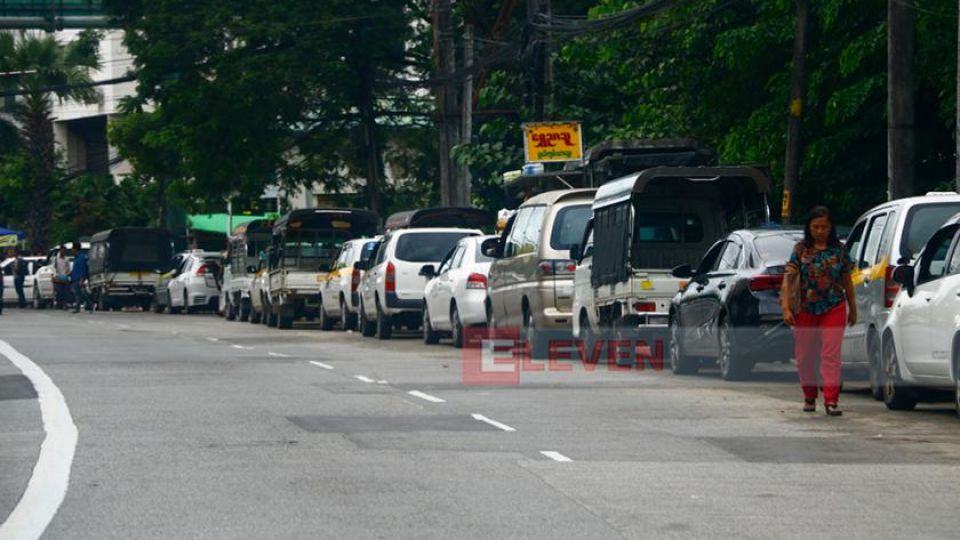
While most countries restrict fuel purchases with Coda, Myanmar’s use of a combined/uncombined system is questionable. Such restrictions have increased the cost of urban transportation and limited the use of vehicles, making it more expensive for those who have their own vehicles to use for transportation on a limited basis.
So, on the other hand, if we look at the other side, we will have to re-examine whether the country can really reduce its oil costs due to the full/non-full restriction in the fuel economy and fuel problem-solving policy. Since this system may have some impact on social life, we have already seen people criticizing it, and suggesting that it be amended or abolished. Whether this is a weakness in the fuel economy and energy policy, or whether it is good or bad, can be determined with data and public opinion. In other words, the bad things are the collapse of the transportation system and the full/non-full system.
And recently, rumors have been circulating about public vehicles. Some people have been spreading rumors on social media that they will scrap 20-year-old cars. This has caused a lot of concern among people. There are growing concerns that people will have to buy only EVs after they have been given 20-year-old cars.
In a country with a low per capita income like ours, it is not easy to replace EVs with gasoline cars. EV prices are more than double those in Thailand and three to four times higher than in countries like Cambodia. In such a situation, scrapping 20-year-old cars and replacing them with EVs is not practical. It cannot be done. The 20-year-old cars in Myanmar are cars imported during the Thein Sein era. One thing can be done. If we examine the cars registered in Myanmar for 20 years, they may be one. If we examine the cars imported in Myanmar in 2010, they may be one by 2030. If we use them in Myanmar for 20 years since they were registered, they may be one. Otherwise, if we scrap the 20-year-old production period, the middle class will have a lot of difficulties. The transport system may collapse. It may be similar to the Jasut project. Another thing is the 20-year-old system. When the 20-year-old system is implemented, the above policy is applied, just like the Jasut system. The police said that 1,000 vehicles were seized, but in reality, there were five times as many people who bribed traffic police. According to the investigation, for example, some people went out on even days when they were not driving, and even days when they were not. Some people sneaked out. According to a Facebook user who was spreading rumors on social media, he sneaked out. He used to spend 40,000 baht a day on a taxi. Instead, he drove his own car, so if he got caught once, he had to pay 15,000/20,000. He didn’t lose twice. He lost three times. Sometimes he got away on some days. Some days he sneaked out. In other words, bribery is based on the above policies, and under the current system, hundreds of thousands of acres of farmland were confiscated. Now, under the even/uneven system, there will be more bribery. That is why the current energy policy may have a weakness, the EV car problem, and the import of EV cars is also linked to the energy policy, It is being suggested that the use of vehicles with a fixed/unfixed system should be abolished.
Now, even importing 20,000 EVs a year is not enough. Now, people who want to buy EVs don’t need to buy 20,000 a year. It can be up to 30,000 or 40,000. For that, the government needs to allow more SKD cars to be imported. But there is no need to reduce taxes on EVs. There is no need to hurt the country’s tax revenue. Carefully examine SKD cars. Who are the people who sell them correctly? Maintain the price. If SKDs are not imported at 5,000/10,000 a year, the domestic EV price will not fall. If we can produce more, the price will fall. EV demand can be around 30,000 a year without having to deposit old vehicles. Now, there are enough people who will buy EVs. Some can’t even buy them when they want. So, there are only two things we need to do. Allow more SKD cars to be imported. If we build a factory and can’t produce 10,000 a year, the price will not fall. The government should maintain the price. There is no need to reduce taxes. There is no need to reduce taxes on SKDs either. We estimate that there will be many buyers if we import 20,000 or 30,000 a year. So instead of importing, there are at least 5 SKD car companies here. (1) Allow more imports. (2) Don’t need to reduce taxes or give exemptions so that the country doesn’t suffer from taxes.
■ How do they treat it?
In any case, there are good and bad sides. The reduction in fuel imports under energy control, the increase in fuel stocks from 40 days to 60 days, and the purchase of fuel through the QR system are all positive developments.
If it is bad, as mentioned above, inflation in Myanmar is rising. Other countries are also suffering from inflation, but Myanmar is suffering more than other countries. The inflation is also caused by the weakness of the vehicle usage system. This system causes the cost of transportation to increase. These need to be addressed as soon as possible. The main thing is that when prices rise, inflation occurs.
In order to further control fuel, we must take action against unscrupulous fuel traders and those who do not follow the rules, and we must strictly monitor fuel exports to rebel areas and areas where illegal natural resource extraction is taking place. We must monitor fuel exports to Kachin, Sagaing, Magway, Rakhine, and Chin, where armed rebel groups are present, to prevent illegal fuel from reaching these areas, and to eliminate bribery and corruption along the route.
US President Donald Trump has said that the Korean War lasted three years and the Vietnam War lasted seven years. The Iran war, which began in February, is still ongoing and the Strait of Hormuz has not been reopened. The future of the Iran war remains uncertain after Trump met with Chinese President Xi Jinping.
In the face of this difficult situation, various organizations such as the government, parliament, and the State Counselor Council have emerged, so it is necessary to find the right solutions to the fuel crisis and the good and bad of energy policies. The State Counselor Council will also make recommendations to the President on fuel, and the parliament will also discuss issues that will burden the public.
The main purpose of writing about the good and bad policies during the energy crisis is to urge responsible organizations to consider and implement solutions to ensure that the people are comfortable, the country receives the taxes it deserves, and the government’s crisis is resolved.