

December 8, 2025
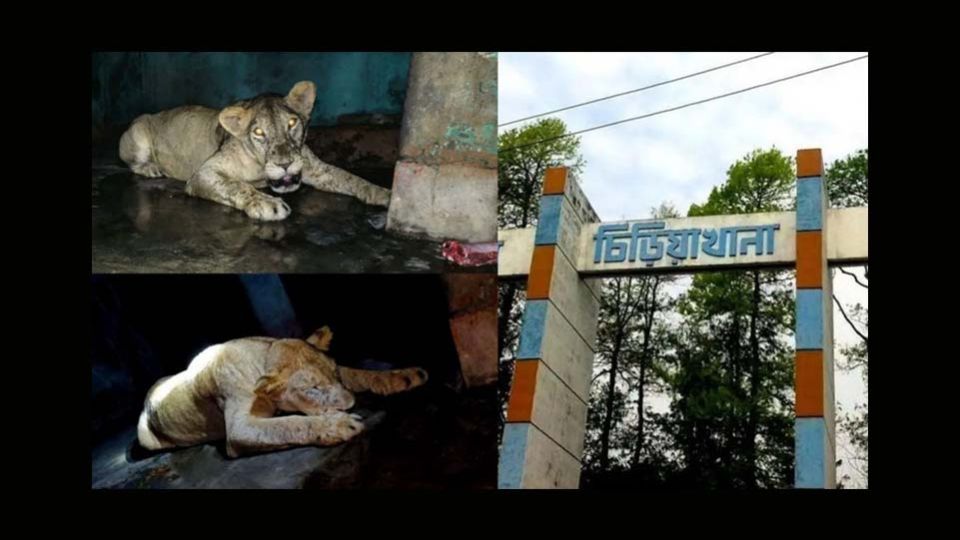
DHAKA – When the lioness escaped her enclosure at Mirpur National Zoo, initial headlines focused on fear — a predator on the loose, a threat to public safety. But the images that surfaced soon after told a different story. Daisy was not prowling with power; she was collapsing. Her ribs jutted out. Her fur was patchy. Her eyes, dull and sunken, reflected exhaustion rather than aggression. Instead of the queen of the jungle, she looked like an animal fighting simply to stay alive.
Her escape did not expose danger. It exposed neglect.
A zoo long criticised, now in crisis
Mirpur National Zoo — officially the Bangladesh National Zoo — has faced criticism for years. Reports as far back as 2016 and 2017 flagged chronic issues: inadequate budgeting for feed, insufficient veterinary staff, cramped enclosures and outdated infrastructure.
Daisy’s condition suggests that these issues weren’t resolved — they were ignored.
Reza Karim, who has studied captive animal welfare, explains, “A lion does not reach this level of emaciation overnight. It indicates long-term malnourishment, chronic stress, or untreated illness. For an apex predator to look like this inside a national zoo is unacceptable by any standard.”
When captivity becomes cruelty
Zoos often defend their existence by citing conservation and education. But conservation requires more than cages — it requires functioning systems, trained staff, and ethical standards. In Bangladesh, the gap between theory and practice is widening.
Visitors regularly report seeing animals pacing restlessly, sleeping excessively, or showing signs of distress — classic markers of zoochosis. Enclosures are often barren, lacking enrichment, and far smaller than global recommendations. Many structures date back decades and have not seen meaningful renovation.
Farzana Shurovi, environmental studies graduate and frequent zoo visitor, describes the experience bluntly. “Every time I go, the animals look worse. I stopped bringing my younger cousins because I didn’t want them to think this is what wildlife is supposed to look like,” she says.
Perhaps, Daisy’s escape wasn’t an act of aggression. It was instead likely an act of desperation.
Public outrage is justified — but what comes next?
Bangladesh’s animal welfare laws exist, at least on paper. The Animal Welfare Act of 2019 outlines humane treatment, medical care, and ethical captivity. But enforcement remains almost non-existent.
Following Daisy’s case, public anger has erupted online. The comments express disbelief, shame, and grief, and many ask the same question: If we cannot care for our captive animals, should we even have a zoo?
Mahfuz Rahman, a father of two, who visited the zoo last year, shared his reaction after seeing the viral images. “We tell our children lions are strong and majestic. What will they learn when they see a lioness starving to death in a national zoo? If we cannot provide proper care, we don’t need a zoo at all.”
His sentiment echoes a growing belief that Bangladesh needs alternatives — rehabilitation centres, sanctuaries, or fewer captive animals overall.
The uncomfortable truth: Zoos are failing their purpose
Globally, modern zoos are expected to replicate natural habitats, maintain strict welfare standards, and justify captivity with measurable conservation outcomes. Mirpur Zoo struggles with all three.
Daisy’s condition became proof of that broken structure.
Daisy is still alive and that alone raises an urgent responsibility. Her recovery must be transparent, supervised by independent veterinarians, and shared publicly. But focusing only on her risks missing the point.
Bangladesh must decide what kind of country it wants to be when it comes to wildlife. One that cages animals but cannot care for them? One that treats living beings as exhibits? Or one that acknowledges when a system is no longer humane and needs to be reimagined entirely?
Mirpur Zoo cannot continue as it is.
If we do not act now, the next headline will not shock us. And that may be the most dangerous outcome of all.