

June 12, 2026
JAKARTA – While Indonesia is still working on the acquisition of Japanese Mogami-class multi-mission stealth frigates, Defense Minister Sjafrie Sjamsoeddin already expressed his eagerness to materialize the transfer of Asagiri-class multi-role destroyers.
Meeting his Japanese counterpart Shinjiro Koizumi in Tokyo on June 5, Sjafrie “expressed his intention to materialize defense equipment and technology cooperation, including the transfer of Asagiri-class destroyers and other equipment”, the Japanese Defense Ministry said in a press release on June 5.
Both ministers also “welcomed the progress of discussions within the working group, which they decided to establish at the defense ministerial meeting in May under the revised defense equipment and technology transfer system.”
The two ministers also reached a consensus to start discussions within the working group, including those on education, training, maintenance, sustainment and operational aspects.
The possible transfer comes as a surprise, as it was not mentioned when Sjafrie hosted Koizumi a month prior, during their May 3-4 meeting in Jakarta where they signed a new Defense Cooperation Agreement (DCA).
The Indonesian Navy chief of staff Adm. Muhammad Ali revealed on May 11 that during the May ministerial meeting, Japan officially offered Indonesia Mogami-class frigates and an unspecified class of submarines.
If we look back to Nov. 17, 2025, however, Sjafrie went onboard a DD-151 Asagiri during his visit to the Japan Maritime Self-Defense Force’s Yokosuka Naval Base in Kanagawa prefecture.
During the trip, Sjafrie also visited FFM Kumano, the second ship in Mogami class of frigate, which is equipped for anti-submarine, anti-surface and anti-air roles.
Sjafrie also visited JS Jingei, the third ship in the Taigei class of attack submarines, Japan’s newest class of submarines and the first to have Lithium-ion batteries.
Taigei is the successor of Soryu-class diesel-electric attack submarines, the first class of submarines in Japan with air independent propulsion (AIP) for longer submerged periods.
About two months before Sjafrie’s visit, Ali had inspected two warships on Sept. 29, 2025, in Yokosuka.
Ali visited SS-595 Narushio, the sixth ship in the Oyashio class of conventional diesel-electric submarine, the predecessor of Soryu-class diesel-electric attack submarines before visiting JS Kumano.
Japan Maritime Self-Defense Force’s frigate JS Kumano docks at the Tanjung Priok Port in North Jakarta on May 9, 2023. The Mogami-class frigate was in a deployment to Indonesia, Malaysia and Singapore to strengthen cooperation and exercises with navies in those countries. (Courtesy of Japanese Embassy/-)
Cold War warships
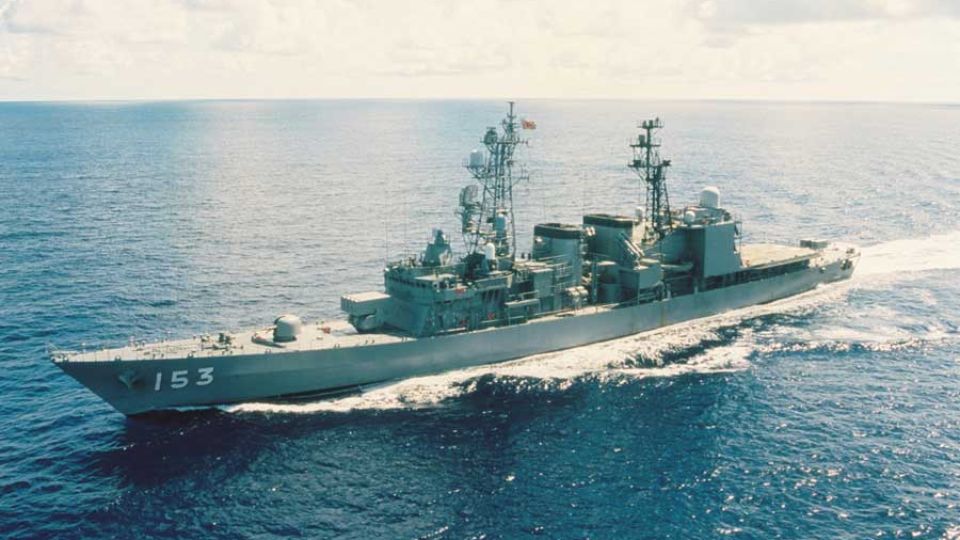
Five Japanese shipyards originally built eight Asagiri-class destroyers and currently six ships are still operational. The oldest Asagiri-class, the namesake DD-151 Asagiri, was decommissioned on March 23. The second ship in class, DD-152 Yamagiri, was converted into training vessel TV-3515 in 2025.
Destroyer DD-151 Asagiri was launched in September 1986 and commissioned in March 1988. The newest of the class is DD-158 Umigiri, launched in November 1989 and commissioned in March 1991.
The destroyers are designed for anti-surface and anti-air warfare roles. For an anti-submarine warfare role, Asagiri-class destroyers rely on SH-60 anti-submarine helicopters, which are equipped with anti-submarine torpedoes and depth charges.
The destroyers have a displacement of 3,500 tonnes and at full load displacement is 4,900 tonnes. They are 137 meters long with a beam of 14.6 m and a draft of 4.5 m.
Powered by four Kawasaki-Rolls Royce Spey SM1A gas turbines in combined gas and gas (COGAG) configuration, the destroyers have a top speed of 30 knots (56 kilometers per hour).
Commenting to the planned acquisition, Indonesian Navy chief spokesman Cdre. Tunggul told The Jakarta Post on Monday that the acquisition plan for Asagiri-class destroyers is still in the early stage.
“[Our task is] to evaluate, examine and analyze technical worthiness, operational effectiveness and technology transfer before taking the final decision,” he said in a WhatsApp message.
“As the main component of maritime state defense, the Indonesian Navy emphasizes its full readiness to bear the mandate, which is determined by the Indonesian Defense Ministry to maintain the sovereignty of our national waters.”
Meanwhile, Curie Maharani from Binus University said that the planned acquisition of Asagiri-class destroyers would strengthen the Indonesian Navy’s capacity while at the same time add more ship to the Indonesian naval fleet.
“Especially since it is a very capable destroyer which will create the need for professional sailors with special expertise,” she told the Post on Monday.
“This will draw the Indonesian Military to focus on defense issues again.”
Curie, however, pointed to the fact that the destroyers are already old with possible limited use.
“The conditions indeed depend on usage, but the lifecycle will certainly be shorter,” she said.
“Moreover, the Asagiri class is less fuel-efficient when compared to the destroyer escort to be transferred to the Philippines.”
Japan initially announced in July 2025 the transfer of six Abukuma-class general purpose destroyer escorts to the Philippines.
Koizumi and his Filipino counterpart Gilberto Teodoro reached a broad agreement on May 31 that Japan will transfer an Abukuma-class destroyer escort to the Philippines promptly after decommissioning it from the JMSDF as well as a TC-90 Beechcraft King Air patrol aircraft, which will be sent within fiscal year 2027, according to officials, as quoted by The Japan News on June 1.
Abukuma-class destroyer escorts are smaller than Asagiri-class destroyers, with a displacement of 2,000 tonnes and full load of 2,550 tonnes.
The destroyer escorts are 109 m long with a beam of 13 m and a draft of 3.7 m.
Equipped with two Kawasaki-Rolls Royce Spey 2SM1A gas turbines and two Mitsubishi S12U MTK diesel engines in combined diesel or gas (CODOG) configuration, the destroyer escorts have a top speed of 27 knots.
The Asagiri class is less fuel efficient than Abukuma class due to the exclusive use of gas turbines.
All six Abukuma-class ships were built and commissioned at around the same time as the Asagiri-class ships. Both classes will be replaced by Mogami-class frigates. There will be 12 Mogami-class frigates with at least nine frigates commissioned.