

July 6, 2026
OSAKA – As of April, the government has, in principle, suspended new admissions of foreign nationals under the Type 1 Specific Skilled Worker residence status for the food service sector. Uncertainty has been growing regarding securing foreign workers, who have been underpinning the industry as it suffers from labor shortages, prompting business operators to revise their hiring plans.
Type 1 Specified Skilled Worker status was introduced in 2019 to cope with labor shortages in Japan. It covers a total of 19 fields, including food service, nursing care and construction, with the period of stay limited to up to five years. Type 2 status, which requires proficient skills, can be renewed indefinitely, effectively giving the holders permanent residency.
‘Indispensable’ manpower
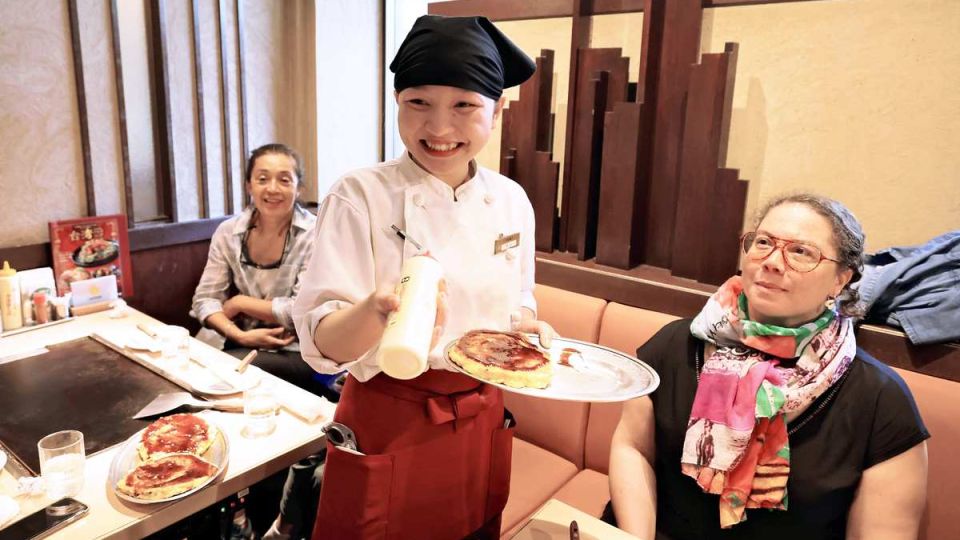
“Thank you for waiting,” said a 24-year-old Vietnamese server as she carried a plate of okonomiyaki — a Japanese-style pancake — to a table and skillfully dressed it with mayonnaise during lunchtime in mid-May, at okonomiyaki restaurant Chibo Sennichimae Main Store in Chuo Ward, Osaka.
She became interested in Japan through anime. Wanting to learn about Japan’s hospitality culture, known widely as omotenashi, she obtained Type 1 Specified Skilled Worker residence status. She has been working at the restaurant since May of last year, handling tasks such as customer service and food delivery.
At first, she faced challenges such as struggling to understand customers speaking in the Kansai dialect, but her colleagues and even customers themselves kindly helped her adjust.
“I’m happy when I can serve customers well and see them smile. I want to work in Japan for a long time,” she said in fluent Japanese.
Tasuku Ishigaki, 41, who oversees server training, said with a smile: “She has a strong desire to learn and works diligently. In just one year, she has become indispensable.”
Chibo Holdings, based in Osaka, employs approximately 70 foreign nationals with Type 1 status, mainly from wider Asia, across its group companies. This accounts for about 30% of its total workforce. The company had planned to hire another 20 to 30 such foreign workers next year.
Company president Kanji Nakai, 50, said, “Since they were such a valuable part of our workforce, the suspension has hit us hard. We will have to revise our recruitment plans.”
Rapid increase
Specified Skilled Worker status can be obtained either by gaining approximately three years of practical job experience, primarily as an intern trainee under the Technical Intern Training Program, or by passing both a Japanese language proficiency test at the level of daily conversation and a skills test related to the specific employment sector. These workers are expected to possess a higher skillset compared to international students working part-time.
The government established an intake cap according to factors such as the need to secure employment for Japanese workers, and future labor shortage projections in each field.
The cap in the food service sector is 50,000. In recent years, the number of such workers accepted by the sector increased rapidly, reaching approximately 46,000 in preliminary figures. This represents an over 200% increase in just over two years through February this year.
With the number approaching the ceiling, the government announced the suspension of new admissions in late March.
Shinsaibashi Mitsuya, based in Chuo Ward, Osaka, operates about 30 cafes and restaurants. The company had planned to conduct job interviews in Vietnam and extend tentative job offers, but was forced to abandon these plans.
A senior official of the company said: “It’s disappointing because we wanted to solidify the flow of hiring of foreign workers we started two years ago. We intend to strengthen other recruitment methods.”
Next 3 years
The 50,000 ceiling is set to last until the end of March 2029, meaning it will likely to continue for approximately the next three years.
However, the government will consider resuming admissions if many of these foreign workers return to their home countries upon the expiration of their residence periods, for instance.
According to the Internal Affairs and Communications Ministry and others, the number of people working in the food service industry in Japan is approximately 4 million. Foreign nationals are estimated to total around 300,000, the majority of whom are international students and permanent residents.
An official of the Japan Foodservice Association, a general incorporated association based in Tokyo with approximately 700 member companies in the food service industry, said, “Foreign workers with the Specified Skilled Worker status have passed skill standards tests and can speak Japanese to some extent, so they could be viewed as work-ready, full-time hires.”
He added, “In terms of numbers, they may not be so large, but they could be counted on as part of hiring plans. So, the suspension has had a huge impact.”
The association is even considering asking the government to raise the ceiling in the future.
Saisuke Sakai, a senior economist at the Research Institute of Mizuho Bank, Ltd., said, “If companies fail to meet their staffing needs despite making sufficient efforts to make up for the labor shortage, the government may need to consider flexibly reviewing the upper limits in line with labor supply and demand.”
Other sectors also nearing cap
Sectors other than the food service industry may also reach their acceptance limit in the near future.
As of March, the food and beverage manufacturing sector reached 70% of its upper limit (133,500 people), while the construction sector, with a ceiling of 76,000, was also coming close to 70% of the quota.
“If it appears likely that a cap will be reached, it is entirely possible that measures to halt intake will be implemented,” said an Immigration Services Agency official.
Those involved in fostering and supporting foreign talent have raised concerns.
“If admission keeps being suspended, foreign workers aiming to come to Japan may lose interest and Japan could end up losing the global competition for talent,” said an official of a company operating a Japanese language school in Myanmar.