

February 5, 2026
SEOUL – Dessert trends shift fast in South Korea, and more or less, they’re sugar-coated. Dubai chewy cookies are the latest craze, but just a trend ago, it was bagels. Rewind a bit further, donuts had their moment, with Knotted at the forefront.
Though the domestic buzz has subsided, the donut brand’s signature pastel box has reached the very countries that gave rise to the classic donut, introducing what its parent company, GFFG, calls the “K-donut.”
According to GFFG CEO Lee Joon-beum, the K-donut is just the beginning. “Knotted, once a breakout hit, has now entered a mature phase with a firmly rooted brand identity,” Lee said.
“This is a defining moment for us, a time we deepen our foundation at home while expanding Korea’s food and culture abroad.”
The United States was the first overseas stop in Knotted’s global push, where two stores opened in 2025.
Against doubts that a Korean donut brand could find footing in America’s crowded donut market, Lee stepped into what he called a challenge he “could not walk away from, given its scale and its influence on global food trends.”
Familiar with American tastes after spending his middle and high school years in the United States and earning an economics degree from the University of Michigan, Lee introduced cream-filled brioche donuts — lighter, airier and less sweet — as a counterpoint to the dense cake donuts common across the country.
“Rather than blending in, we introduced something creamy and fluffy that felt entirely new,” Lee said. “Some people described it as a donut with the soul of ice cream.”
Lee added that the brand continues to foreground its Korean identity, most recently with a limited release of Dubai-style chewy cookies reimagined through Knotted’s own lens. “We reinterpret trends through Knotted’s sensibility to create something entirely our own, almost a new genre,” he explained.
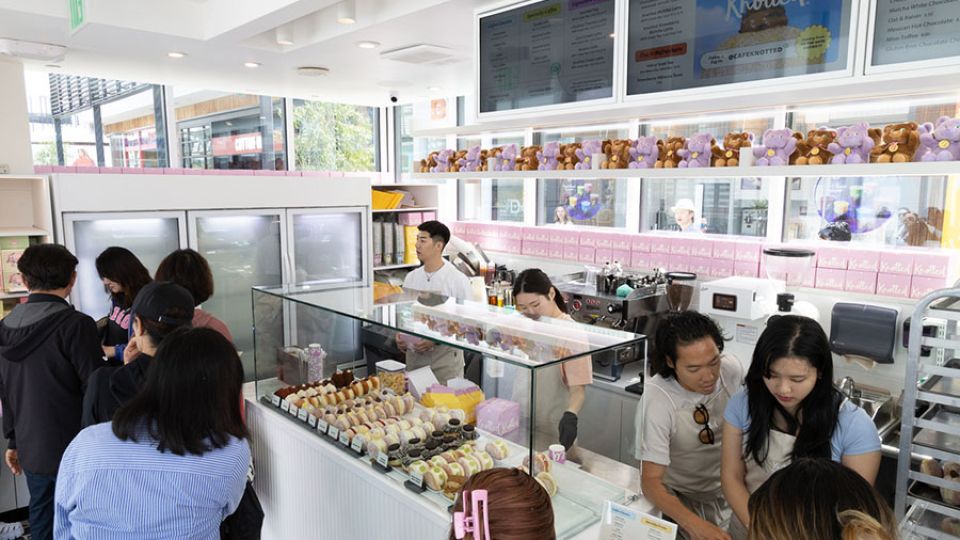
The result was a near-instant hit. When Knotted opened its first Los Angeles store in April 2025, lines wrapped around the block, and the location drew over 130,000 visitors in its first year. For the second store, which opened in December, social media played a key role, generating organic buzz through user-generated content. A third store is currently being discussed for Dallas, Texas.
Following its success in the US, Knotted expanded to Sydney, opening its first store in December through a master franchise agreement with a local partner, drawing long lines and frequent early sell-outs. A second store is set to open in April in Sydney’s central business district.
Tokyo, Hong Kong, Singapore and Malaysia are next on the radar, with Japan identified as a key growth market capitalizing on the success of a 2023 pop-up in Tokyo’s Omotesando district.
Lee entered Korea’s restaurant scene in 2014 with a burger brand and founded Knotted in 2017. Today, GFFG operates several food brands, including Knotted, Hojokban, Little Neck, and Clap Pizza. The company’s revenue surged from 10 billion won ($6.8 million) in 2020 to 39.9 billion in 2021, climbed to 67.6 billion in 2023, then dipped slightly to 63 billion won in 2024.
Now, on home turf, the brand is recalibrating its strategy to remain relevant in a market where its early buzz has worn off.
“While Knotted’s early success largely hinged on novelty, the brand has now entered a new stage where it should be evaluated on quality and customer experience,” Lee said. “We are more focused than ever on strengthening the brand from within.”
In practice, that means downsizing to sharpen consistency, centering operations on directly managed production sites and flagship locations where standards can be closely maintained.
Stores that fail to meet these newly established internal standards are being gradually phased out, including the recent closures of the Haeundae and Cheongdam branches, with Anguk and Gangnam locations in Seoul also slated to shut down.
What appears to be contraction at home is, in fact, GFFG’s bid for long-term sustainability.
“Rather than simply increasing store count, we believe our most important task now is to deepen the flavor and joy each customer experiences,” Lee said. “Every closure was about ensuring that when someone walks into a Knotted store, anywhere in the country, the experience is consistent and the product is at its best.”
The company said it is doubling down on research and development, refining same-day production and building up its online presence as its physical footprint shrinks.
Knotted may have started as a bakery, but its identity has since stretched past food to find footing in character-driven storytelling. Sugar Bear, the fluffy, pastel-colored mascot sits at the heart of a vibrant world of merchandise, brand collaborations and lifestyle products.
“Sugar Bear, more than just a side venture, has grown into a core asset of the Knotted brand that builds emotional connection and fan culture,” Lee said. “What began with small items like plush toys and stationery has now expanded into home, fashion and even food categories.”
In overseas markets, the response has been just as strong, Lee noted, with Sugar Bear keyrings selling out quickly at the first LA store and the dedicated merchandise display at the second location receiving positive feedback from local visitors.
According to the company, Sugar Bear-related commerce has surpassed 21 billion won in cumulative sales. The number of product categories grew from 8 in 2024 to 22 in 2025, while the total number of items expanded from 35 to 105.
Plans are underway to integrate Knotted’s characters more deeply into both physical store experiences and digital platforms.
“Ultimately, our goal is for Knotted to grow beyond a donut brand and become an intellectual property-led lifestyle brand,” he remarked. “In pursuit of that vision, we aim to expand partnerships with leading retail channels and platforms.”