

January 20, 2026
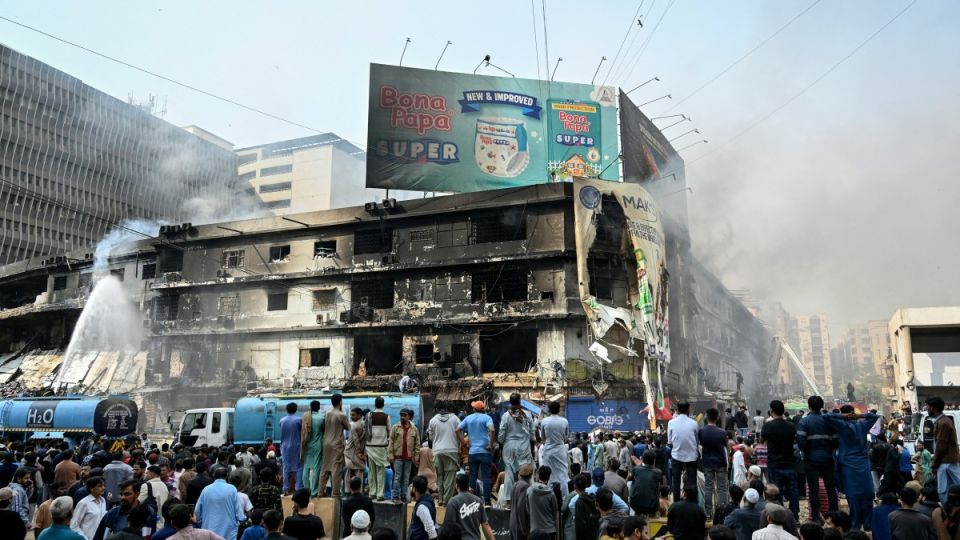
KARACHI – The devastating fire at Gul Plaza, a landmark shopping centre on Karachi’s MA Jinnah Road, is not merely an accident or an unfortunate lapse in safety compliance. It is a grim reminder that poor governance kills.
As rescue operations continue and the death toll rises in the aftermath, what is already evident is that this tragedy was foreseeable, preventable, and rooted in institutional failure rather than fate.
Gul Plaza was an old, densely packed commercial building with hundreds of shops spread across its basement and upper floors, with inadequate emergency exits and fire safety systems. Despite its prominence and heavy daily footfall, reports indicate that the building lacked critical emergency exits and fire-venting infrastructure — features that should have been enforced long ago by the Sindh Building Control Authority (SBCA). Ensuring compliance with these standards is not optional; it is the statutory responsibility of the authority charged with public safety.
The question is not whether a short circuit or another trigger caused the fire; it is why a structure with known safety deficiencies was allowed to operate for decades. The answer lies in institutional decay and bad governance.
Systemic rot
To be fair to individual officers, the SBCA itself has been rendered structurally weak. Over the last several years, the post of director-general (DG) appears to have been treated as a portable office rather than a strategic leadership position. Multiple DGs have been rotated and replaced in rapid succession, without explanation and with tenures too short to allow meaningful enforcement. When leadership is unstable, accountability collapses. When enforcement depends on personal courage rather than institutional backing, violations become routine.
This pattern reflects a deeper and more troubling reality: appointments and transfers at the SBCA appear to be driven less by considerations of competence, integrity, and public safety and more by pliability to vested interests. Officials who are perceived to attempt to enforce rules, resist illegal conversions, or block unsafe constructions are often seen to be sidelined; those who accommodate vested interests are seen to be rewarded. This is not governance; it is the deliberate hollowing out of regulatory institutions.
In earlier writings, I have argued that bad governance promotes corruption and corruption can kill as surely as bombs and militancy. Corruption is not just about bribery; it is about the systematic erosion of norms and safeguards that protect citizens. When building safety codes are ignored with impunity, when regulators are neutralised by political interference, and when accountability is treated as an inconvenience, the results can be catastrophic. In that sense, corruption kills not only through direct theft but by tearing the safety net that holds society together.
This form of institutional sabotage is far more insidious than isolated corruption because it becomes normalised. Over time, citizens come to expect that regulations exist only on paper, that enforcement is negotiable, and that compliance is secondary to convenience. Buildings become death traps not because the rules are unclear, but because enforcement has been deliberately neutralised.
The rot runs deep
The problem is not confined to Karachi. In medium-sized cities such as Hyderabad and Sukkur, and in smaller towns like Nawabshah, Mirpurkhas, and Dadu, master plans are routinely seen to be ignored, residential areas reportedly converted into commercial hubs, and low-rise plots somehow become multi-storey buildings in violation of regulations. Whenever a conscientious officer is seen to enforce planning laws or court-approved master plans, it seemingly results in their swift transfer.
This brings us to the question of accountability. Policymakers who sanction frequent, unexplained transfers of regulatory heads must be held responsible for the consequences of their decisions. When leadership instability becomes systemic, it is no longer an administrative matter; it is a policy choice. And when that choice leads to loss of life, accountability cannot stop at lower-level officials or building owners.
In countries that take governance seriously, such failures trigger criminal inquiries reaching the highest levels of decision-making. In Pakistan, prime ministers have been removed for alleged legal violations. Why, then, is it unthinkable to hold chief secretaries, ministers, or heads of regulatory bodies meaningfully accountable when repeated governance failures result in deaths? Courts have taken suo motu notice of far less consequential matters. Will they now intervene where human lives have been lost?
The case for accountability
Governance is a trust delegated by voters and taxpayers. In an age defined by technology, global competition, and data-driven decision-making, citizens have every right to demand competence, integrity, and continuity in public institutions. Development projects may still be launched and ribbon-cuttings may continue, but at what cost?
Putting unqualified or seemingly compromised individuals in charge of complex regulatory systems is like entrusting a multi-billion-rupee project to someone chosen for obedience rather than expertise. Something may be built, but it will not be safe, sustainable, or worthy of public trust.
The fire at Gul Plaza should mark a turning point. Bad governance is not a soft concept — it is a profound threat to life and dignity. Institutional decay weakens national resilience just as surely as any external threat. In another previous newspaper article, I had argued that those who destroy institutions from within, who prioritise pliability over professionalism, and who treat regulatory enforcement as negotiable are not merely negligent; they are intentionally undermining the foundations of the state.
If this tragedy does not prompt serious accountability and structural reform, it will not be the last. And the next fire, collapse, or disaster will again be described as an accident — until we finally accept that bad governance at the highest policymaking levels is the real culprit.