

August 29, 2025
SEOUL – Korean Air’s recent cabin overhaul, which introduced a new premium tier between business and economy class, has raised eyebrows for tightening space in economy seats, prompting concerns over service quality and compliance with conditions tied to its merger with Asiana Airlines.
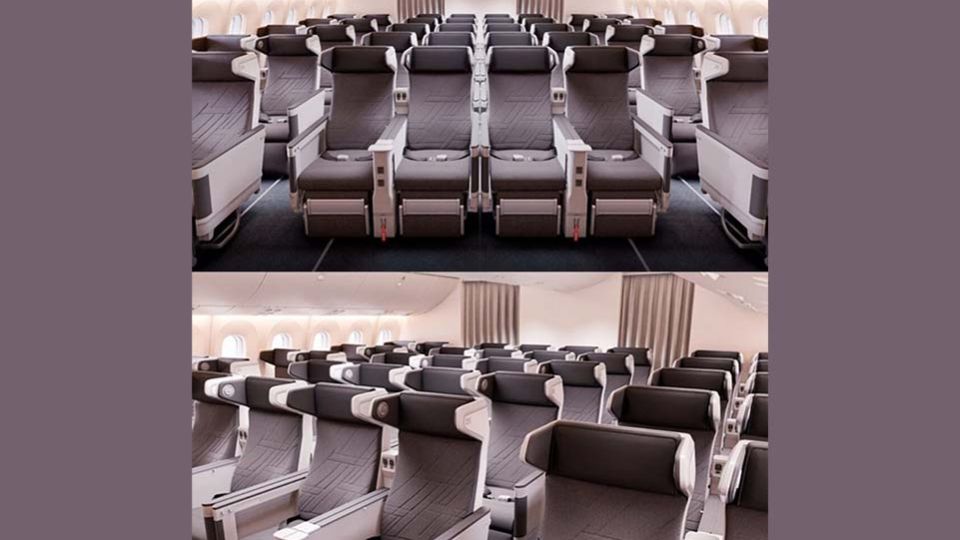
Earlier this month, Korean Air announced the launch of a new 40-seat Premium Class across 11 retrofitted Boeing 777-300ER aircraft, with fares around 110 percent higher than those of standard economy.
While the airline promoted the new 2-4-2 cabin configuration as a comfort upgrade — with revamped interiors and enhanced services both in-flight and on the ground — the controversy has centered on the redesigned economy layout, which shifts from a 3-3-3 to a denser 3-4-3 configuration.
The change results in 21 additional economy seats, with seat width reduced by one inch, or 2.5 centimeters, from 18.1 inches to 17.1 inches.
In response, the Citizens United for Consumer Sovereignty, a nonprofit advocacy group based in Seoul, labeled the change as a structural shift that passes more costs onto consumers at the expense of comfort.
The group said shrinking seat width is ill-suited to today’s passengers, given the increase in average body size. “From 1979 to 2021, the average waist circumference of Korean men increased by 7.3 to 12.9 centimeters, and that of women by 3.6 to 5.6 centimeters,” it said.
The group also challenged Korean Air’s claim that Premium Class offers 1.5 times the space of the redesigned economy seats, saying the actual increase is only between 1.35 and 1.37 times, based on its analysis.
Korean Air has defended the changes, arguing that the configuration aligns with global industry standards and that the same seats are already in use on its Boeing 787 and 747-8i aircraft.
“Eighteen of the world’s top 25 carriers have adopted the 3-4-3 configuration on their Boeing 777-300ERs,” a Korean Air official said, while noting that the new seats feature thinner cushioning to reduce the perceived loss of space.
“The upgraded aircraft also features enhanced in-flight entertainment systems and onboard Wi-Fi, which improve, rather than compromise, the overall service quality,” the official added.
According to the Fair Trade Commission, while airlines generally have discretion over seat configurations, the recent change could be deemed a violation of the corrective measures imposed during the conditional approval of Korean Air’s acquisition of Asiana Airlines in 2022.
The conditions were intended to prevent degradation of service quality on 40 key domestic and international routes, including bans on fare hikes above inflation, limits on seat reductions and restrictions on unfavorable changes to frequent-flyer programs.
For now, the FTC has stated that there are no grounds for immediate sanctions, as the retrofitted aircraft have not yet been deployed on any of the designated routes.
“We will continue to monitor the matter to determine whether the 3-4-3 configuration is applied to the 40 designated routes, as well as any fare changes and the overall impact on consumers,” an FTC official said.
With the new cabin class set to debut in mid-September on medium-haul routes, Korean Air has said it will not assign the retrofitted aircraft to the protected routes, in line with the FTC’s guidelines.
The first flight of the newly redesigned aircraft is scheduled for Sept. 17 on the Incheon–Singapore route, which is not among the 40 routes covered by the agreement.