

June 4, 2026
SEOUL – South Korea and the United States have agreed to move quickly to produce “tangible outcomes” from their nuclear cooperation initiatives after holding their first launch meeting in Seoul, South Korea’s Foreign Ministry said Wednesday.
The announcement came after the two countries held the inaugural two-day meeting starting Tuesday to officially kick off discussions on Seoul’s pursuit of nuclear-powered submarines and greater autonomy over the nuclear fuel cycle, as outlined in the Nov. 14 Joint Fact Sheet.
“During this round of consultations, the two sides agreed to cooperate in order to produce tangible results as early as possible and agreed to establish a mechanism to review progress throughout the year and accelerate future consultations,” the Foreign Ministry said in a press release.
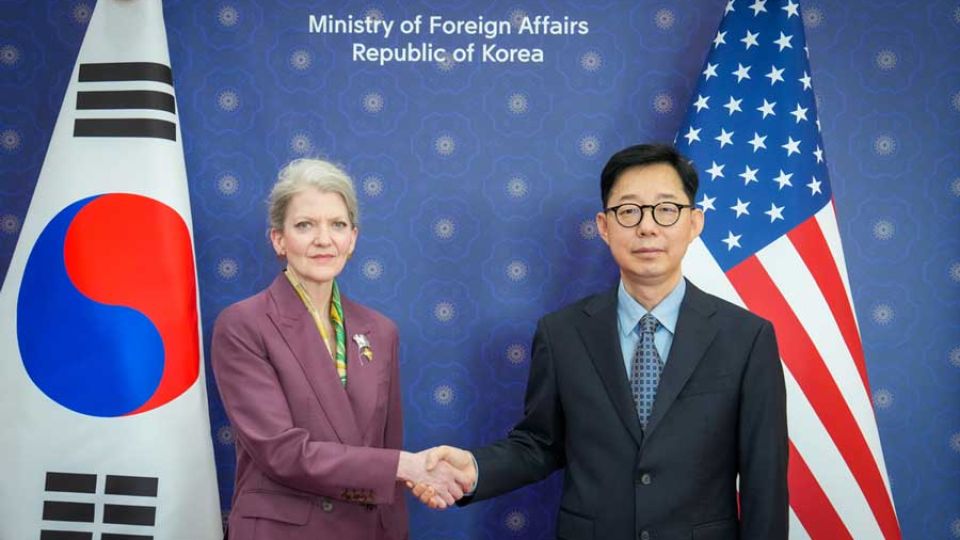
First Vice Foreign Minister Park Yoon-joo and US Undersecretary of State for Political Affairs Allison Hooker convened the launch meeting Tuesday morning at the Foreign Ministry in Seoul, following a delay of several months.
Specific sector-by-sector consultations were then held under the direction of Cheong Wa Dae’s National Security Office and the White House National Security Council, with interagency delegations from both sides in attendance, according to the ministry.
The main items on the agenda were South Korea’s bid to develop nuclear-powered submarines and secure the right to civil uranium enrichment and spent fuel reprocessing. Both are effectively restricted under the current civil nuclear agreement between the allies, known as the 123 Agreement.
The two sides focused on how to move forward with Seoul’s plans to build nuclear-powered submarines on the first day. Intensive talks on ways for Seoul to secure the right to civil uranium enrichment and spent fuel reprocessing took place on the second day.
During the two-day relay meeting, Seoul and Washington agreed on a timeline for how to move forward with nuclear cooperation under the Joint Fact Sheet, according to a Foreign Ministry official in Seoul.
The two sides are expected to hold a second round of consultations in Washington as early as next month.
The inaugural meeting came after months of postponement in the US delegation’s visit to Seoul amid South Korea’s investigation into a massive data breach involving US-listed e-commerce giant Coupang and a holdup in the passage of a special law at the National Assembly to implement Seoul’s $350 billion investment package in the US.
The talks center on two issues that require further bilateral arrangements.
Seoul and Washington need to find ways to allow South Korea to secure civil uranium enrichment and spent fuel reprocessing rights, whether through revisions to the current agreement or other means.
Under the current agreement, Seoul requires US approval to enrich uranium — approval that has never been granted, even for civilian use at levels below 20 percent — while spent fuel reprocessing for commercial purposes remains outright prohibited. Only limited research into pyroprocessing has been allowed under a joint Korea-US study framework, but that research has since stalled.
Seoul and Washington also need a separate agreement for South Korea to build nuclear-powered submarines under the current Korea-US 123 Agreement, which prohibits nuclear materials, technology and byproducts supplied by Washington from being used for “any military purpose.”
South Korea’s Defense Ministry announced on May 26 that the country would domestically build nuclear-powered submarines and use low-enriched uranium — containing less than 20 percent uranium-235 — to fuel their reactors.