

December 30, 2025
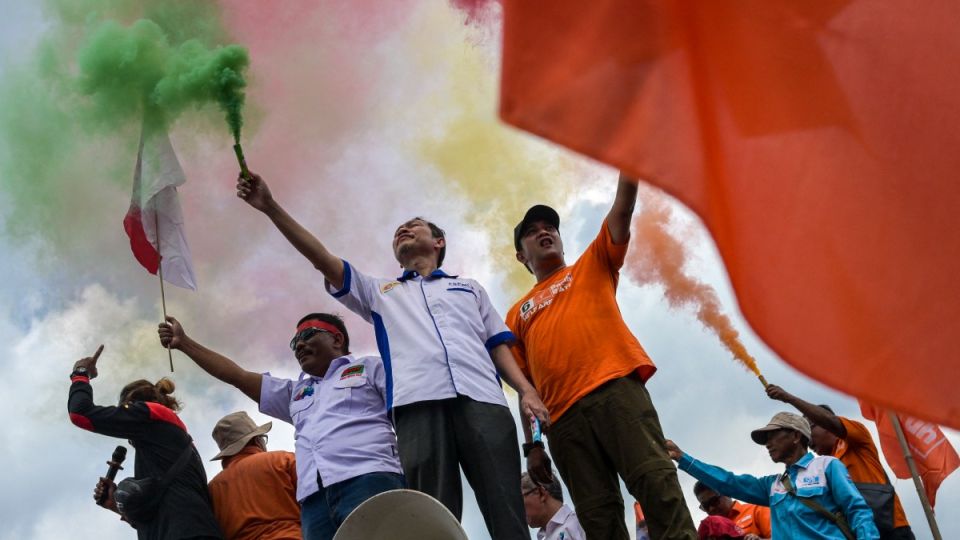
JAKARTA – Labor unions on Monday staged a protest near the National Monument in Jakarta against the newly announced provincial minimum wage, warning that the demonstrations could escalate nationwide and continue throughout next year unless the decision is revised.
The protest focused on the 2026 Jakarta minimum wage, which the capital’s governor set at Rp 5.73 million (US$341) per month, a 6.17 percent increase from the 2025 figure.
Confederation of Indonesian Trade Unions (KSPI) president and Labor Party chair Said Iqbal said the group would pursue legal action to overturn the decision by filing a lawsuit at the Jakarta State Administrative Court (PTUN). He argued that the figure still fell short of meeting living standards amid the rising cost of living in the capital.
Labor groups are demanding the wage be raised to Rp 5.89 million, in line with Jakarta’s decent living needs as calculated by Statistics Indonesia (BPS).
“Today’s action is deliberately small to give the government room to respond and negotiate,” Said told reporters on Monday. “After the New Year, we will return. We will keep protesting until the Jakarta minimum wage is set at Rp 5.89 million.”
Around 1,000 workers took part in Monday’s rally, while KSPI said another protest planned for Tuesday could involve up to 20,000 workers from several regions.
“Some senior officials in the Jakarta administration have claimed that [only a small group of workers actually opposed the wage increase], but in reality this is the position of all Jakarta workers,” he said.
Said added that it was “illogical” for employees in the Sudirman and Kuningan business districts, which are considered high-end areas, to earn less than factory workers in nearby industrial hubs such as Karawang and Bekasi in West Java, where minimum wages are higher at around Rp 5.9 million.
The gap of about Rp 160,000 between the approved minimum wage and the decent living needs estimated by BPS has forced workers to run a monthly household deficit, Said pointed out.
“With that shortfall, workers are effectively subsidizing the system. What kind of minimum wage increase leaves workers worse off?”
Unions are also urging Jakarta to introduce a sectoral minimum wage, proposing an additional 2 percent to 5 percent above the decent living needs for certain industries.
The protests were also linked to minimum wage hike disputes in West Java, where unions accused the provincial administration of “altering or cutting” minimum sectoral wage recommendations submitted by regency or city governments.
Labor groups, including the Indonesian Metal Workers Federation (FSPMI), KSPI and the National Workers Union (SPN), had initially planned to rally in front of the presidential palace complex, but police redirected the protest to Medan Merdeka Selatan, south of the National Monument and about two kilometers from the original location.
“The palace should not be treated as a sacred space that citizens cannot approach,” Said lamented, adding that protest vehicles were forced to retreat despite the relatively small turnout.
“How is it possible that the protesters’ command vehicle was towed away and demonstrators were pushed back? […] It feels like a return to the militaristic era,” he added.
President Prabowo Subianto on Dec. 16 signed a regulation setting a new formula that combines inflation and economic growth, adjusted by an “alpha” coefficient ranging between 0.5 and 0.9, resulting in a potential minimum wage hike of between 5.3 and 7.3 percent.
Provincial leaders, who are responsible for determining the final increase, were required to issue implementing decrees for their provinces within that range by Dec. 24.
Tadjudin Nur Effendi, a labor expert from Gadjah Mada University (UGM), said labor dissatisfaction stemmed from the introduction of the adjustment coefficient, whose application he described as opaque because “there is no clarity” over how regional administrations choose the figure.
However, he said directing protests at the state palace and threatening national escalation “did not reflect” the fact that discontent was largely limited to Jakarta and West Java.
“Historically, minimum wages have also rarely been changed through legal challenges in court,” Tadjudin told The Jakarta Post on Monday.
Indah Anggoro Putri, director general for industrial relations and manpower social security development at the Manpower Ministry, told the Post on Monday that the protests were directed at governors, who are responsible for setting regional minimum wages.
Jakarta Governor Pramono Anung said on Monday that the capital’s minimum wage hike “remains the highest” in percentage terms among all provinces.
To help offset living costs, “The Jakarta [provincial] government is also providing incentives, including free public transportation, cheaper food and subsidized water from [the city-owned utility] PAM,” he said.
He added that although he had heard many of the protesters were coming from outside Jakarta, the demonstrations were taking place in the capital, and the city administration would ensure public order and security.