

January 9, 2026
SHIMLA – In the western Himalayas, land conflicts are usually thought of as battles between the state, corporations, and local communities. But in villages like Jhadak, which is almost 90 kilometers away from Himachal Pradesh’s Shimla district, land governance follows a different law — one where ownership is absent, guardianship is collective, and authority rests not with the state but with a deity.
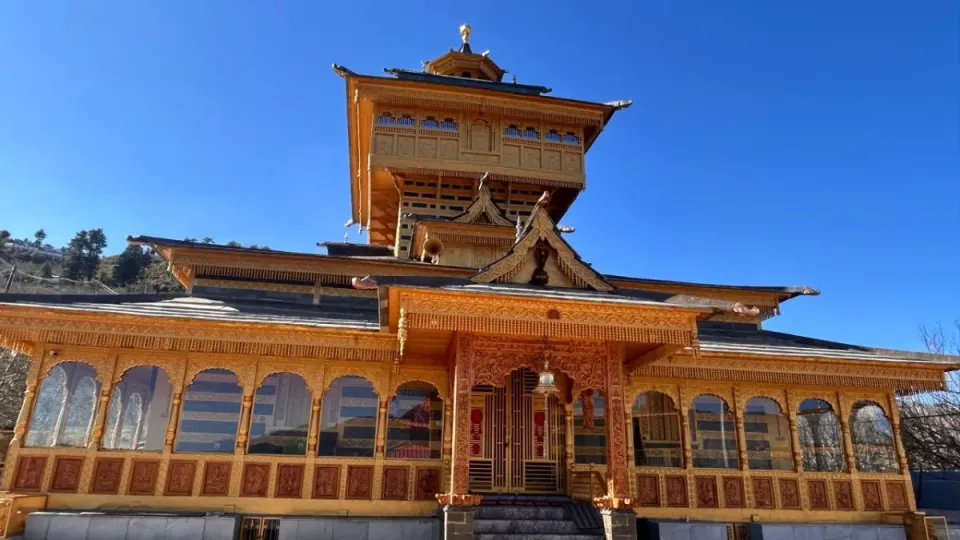
In December this year, the village of Jhadak in Jubbal tehsil revived the Shand Mahayajna after a gap of 54 years. On the surface, the ceremony appeared religious and cultural. But for villagers, it was also a way to reaffirm—and pass on to the younger generation—a centuries-old land system in which Nageshwar Maharaj, the village deity, is considered the moral and legal custodian of land, while residents see themselves only as caretakers.
Farming without owning
For generations, more than a hundred families in Jhadak have cultivated the deity’s land—building homes, growing crops, and planting apple orchards—without ever owning it. Their rights are usufructuary: they can use the land, inherit it, and depend on it for survival, but they cannot sell or own it in their name. As a tradition, these rights pass across generations, including to women if they become widowed.
Bansi Lal, 73, one of the village’s oldest residents, cultivates about 4.7 acres of land recorded in the deity’s name. His family has lived off this land for four generations.
“My forefathers served the deity as caretakers of the temple,” he said. “They lived there, and to survive, the deity granted them this land. I am 73 now; it has been with me all my life, and it will remain with my grandchildren—as long as we follow the deity’s rules.”
For many families, this land is not symbolic—it is survival.
A widow from the village, who requested anonymity fearing social repercussions and the possible loss of land, said she lost her husband when she was 27. “If this land hadn’t been there, I would not have been able to send my two children to school,” she said. “Because of this land, I could enroll my elder son in an engineering course, while the younger one is studying agriculture.”
She believes that the land has made an otherwise difficult life manageable. “We own very little otherwise. In good times and bad, this land has sustained us. I am always grateful for it.”
When Gods hold the title
Himachal Pradesh has one of India’s most restrictive land laws to protect the local people’s land rights. Under Section 118 of state law, outsiders are barred from purchasing agricultural land. A Right to Information response for the Jubbal region shows that land recorded in the name of deities there alone amounts to around 91 acres, which is equivalent to building almost four cricket stadiums. Similar patterns exist across 12 districts, where acres of land are legally tied to temples and local gods.
According to veteran journalist, Dr Shashikant Sharma, deity-owned land enjoys a unique form of protection. “In law, deities are treated as minors,” he explained. “Their land cannot be sold or claimed as private property. This absence of absolute ownership has historically prevented fragmentation and commercial transfer—an unintended but effective conservation mechanism.”
Custom without legal recognition
Despite its resilience, this system exists largely outside India’s formal land governance framework. Laws such as the Himachal Pradesh Land Revenue Act recognise individual and institutional ownership but offer no explicit safeguards for faith-based or customary tenure systems.
Unlike forest-dwelling communities protected under the Forest Rights Act (2006), deity-linked commons survive almost entirely through social legitimacy rather than statutory recognition.
Land-use decisions are mediated through local institutions—kardars (custodians), khunds (ritual functionaries), temple committees, and village assemblies. While these roles remain male-dominated and temple access is often gendered, land use itself is not strictly exclusionary, revealing contradictions within the system.
Lokinder Thakur, 55, who farms deity land, said he does not even know when his family began cultivating it. “I am the third generation, and my son will be the fourth,” he said. “It never crossed my mind that the land is ours. It belongs to the deity. We are only surviving on it—and no one interferes.”
Faith as a consent mechanism
The political relevance of this system becomes visible when large infrastructure or tourism projects seek land.
One of Himachal Pradesh’s most controversial proposals, India’s first Himalayan Ski Village, a $300-million tourism project announced in the mid-2000s required extensive land procurement in Kullu district. The project backed by Alfred Ford faced resistance not only through courts and protests but also through traditional assemblies involving village deities.
Historical records and media reports document that communicators (gur) and representatives of over a hundred deities opposed the project, citing ecological risks, threats to water sources, and violation of sacred landscapes. Combined with environmental litigation, this resistance ultimately led the state to cancel the memorandum. The cancellation of the project ruined the image of the state at a global level. However, the incident illustrated how customary belief systems can function as parallel consent mechanisms, enabling communities to resist land alienation even without formal legal recognition.
Negotiated development, not rejection
Faith-based land governance does not imply blanket opposition to development.
In the Sunni region, a hydropower project required land belonging to Devta Kyalau Maharaj. Instead of forced acquisition, the government approached the deity’s representatives. Following internal consultations, the community consented to transfer around six acres of land for the project. The compensation was deposited directly into the deity’s bank account.
According to Brahma Sharma, the deity’s gur (oracle), this arrangement aligns with historical records. “A settlement report of Himachal forest states that half the land belongs to the deity and half to the state,” he said. “Himachal itself is believed to be governed by gods—the state is only the caretaker.”
Such cases reveal a consistent pattern, be it with the Bijli Mahadev ropeway project or others, resistance is directed not at development itself, but at the loss of natural resources. Projects perceived as locally beneficial and minimally disruptive are more likely to be negotiated within customary frameworks.
Commons under climate pressure
Seen on the ground, deity-based land control works much like a commons system. Because the land is considered sacred, activities such as mining, large-scale tree cutting, or land sales are rare. Forest department officials say they have mapped over 500 sacred forests and groves across Himachal Pradesh, and that these areas show little to no record of illegal activity. As the Himalayas face increasing pressure from climate change, road building, and hydropower projects, villages like Jhadak point to a different way of managing land. Instead of treating such arrangements as outdated customs, there is room to learn from them—especially in ecologically sensitive regions. Similar models of community and indigenous land governance elsewhere have shown that when land cannot be freely bought or sold, people tend to take longer responsibility for it.
(This article is an outcome of the Stories of Hope Media Fellowship by IUCN India under the Himalaya for the Future initiative.)

PHOTO: THE STATESMAN