


January 27, 2026
JAKARTA – It was nearly 10 p.m. at Gondangdia Station in Central Jakarta in mid-December, but the platform was far from empty. Dozens of weary commuters waited patiently for a train bound for Bogor, West Java, one of Jakarta’s satellite cities. Among them was Andi Mardhatillah, who had just left his office in the Thamrin area
“It’s already 10 p.m., but it’s still quite crowded,” said Mardhatillah, who commutes daily by train from his rooming house, locally known as a kos-kosan, in Tebet, South Jakarta.
When he first moved to Jakarta from his hometown of Makassar in South Sulawesi, the 32-year-old was impressed by the city’s public transportation, something he said was lacking back home. That impression has faded over time. After seven years in the capital, he feels traveling on the commuter line has grown increasingly inconvenient, especially during rush hour, when headways can stretch to 10 minutes.
“The fare is low, but we don’t really benefit from it because we have to pay in other ways, such as sacrificing our comfort,” he said.
Millions like Mardhatillah move to Jakarta in search of better opportunities. Like many others, he has learned to compromise to survive in the Big Durian. The city is part of Greater Jakarta, which the United Nations Department of Economic and Social Affairs’ Population Division has identified as the world’s most populous urban agglomeration.
The UN report shows the population of the Greater Jakarta area, which includes Jakarta, as well as Bogor, Depok and Bekasi, all in West Java, and Tangerang, Banten, has reached nearly 42 million, surpassing Tokyo.
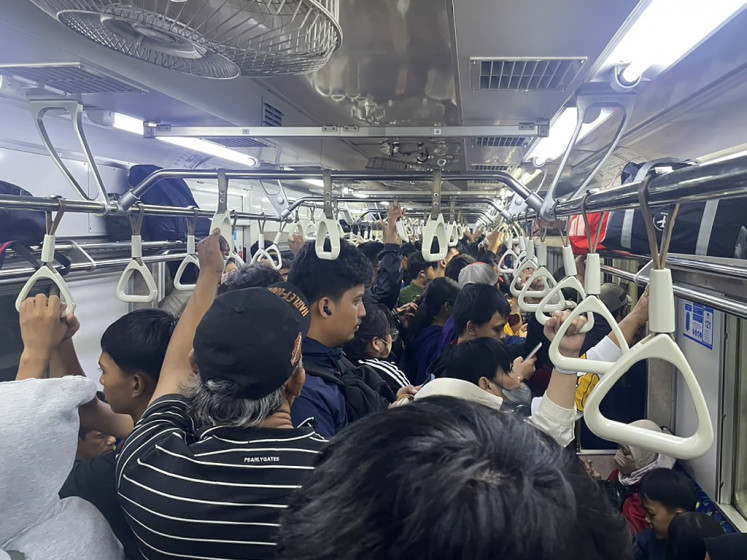
Commuters crowd a train car at Manggarai Station in South Jakarta on the night of Dec. 11, 2025. PHOTO: THE JAKARTA POST
Urban problems
Beyond daily battles with crowded trains, he also deals with recurring respiratory infections, which he has suffered three times since moving to the city, a condition he attributes to Jakarta’s air pollution.
At a glance, Jakarta may seem far from ideal. Residents contend with chronic traffic congestion, poor air quality and regular flooding. These problems are compounded by the risk of land subsidence caused by excessive groundwater extraction, a key reason the government has decided to relocate the capital to Nusantara in East Kalimantan, a project launched in 2022.
Yet Jakarta remains a powerful magnet, drawing people eager to try their luck amid Indonesia’s economic inequality.
“As long as the government does not create ‘other Jakartas,’ people will keep coming here,” said Herlily, an urban studies academic at the University of Indonesia. “We need other magnet cities to slow population growth in Greater Jakarta. We’ve known this for a long time, but we have yet to see concrete action.”
Jakarta functions as the country’s primary employment and economic hub, drawing workers from across Indonesia. Many do not live in the capital itself, but in surrounding cities within Greater Jakarta, reflecting a pattern in which opportunity is concentrated in the urban core while housing and daily life spill outward.
Adult clinical psychologist Ezra Putranto said that a big city like Jakarta plays a role as a symbolic environment in which individuals define their position within the city.
“Of course, each experience is unique, but there are common themes shared regarding the city [Jakarta], like seeing Jakarta as a sacrificing place to gain success and become stronger,” he said.
At times, Jakartans may not realize that they have been normalizing stress caused by the city’s problems due to frequent exposure, Ezra added.
“We don’t regard them as a threat, rather seeing them as part of the normal condition. But the stress does not really disappear. The impact will always be there, psychologically and physiologically.”

Dina Aulia uses her bicycle as a cart to sell a variety of snacks on a pedestrian bridge above Jl. Jend. Sudirman in Central Jakarta on Dec. 11, 2025. PHOTO: THE JAKARTA POST
Source of hope, support
Despite its many challenges, Jakarta continues to offer hope and support to its residents, including Anita Hendranugraha.
Born in Jakarta in 1975, Anita said nearly everyone she has been close to since childhood still lives in the city, making it hard for her to imagine leaving.
“My parents are here, my friends are here, even people I’ve known since kindergarten,” said Anita, who lives near Jl. TB Simatupang in South Jakarta, notorious for heavy rush-hour traffic. “All my life is here. As challenging as Jakarta can be, I still love this city.”
Dina Aulia, who sells local snacks along the main road Jl. Jend. Sudirman, shares a similar sentiment. She has never seriously considered leaving the city, despite enduring floods and once being a victim of phone theft.
Each morning, the 42-year-old wakes at 4 a.m. to handle household chores before her husband, a gardener at a private university, leaves for work at 6 a.m. She then prepares her daughter for school before setting off on her bicycle to sell snacks near office buildings along Jl. Jend. Sudirman.
“On my best days, I can earn up to Rp 300,000 [US$18]. But most days, it’s closer to Rp 150,000,” she said one evening, as rain fell across much of the city.
Dina typically sells snacks until about 7 p.m., Monday through Friday. On Saturdays, she works a half-day, returning home by early afternoon. The routine, she said, keeps alive her dream of owning a home, as she currently lives with her in-laws.
“I used to work at a hijab store for 10 years before COVID-19 hit,” she said.
“Compared with that, I like what I’m doing now. When you work for others, even after years, it can all end suddenly. My husband always says Jakarta can be cruel,” added Dina.
“That’s why we shouldn’t be ashamed to do whatever it takes to earn a living. If we’re ashamed, we won’t survive.”