

May 22, 2026
MANILA – The Philippines’ plastic crisis is shaped not only by how much plastic is consumed, but by how poorly much of that waste is managed after use.
The country generates an estimated 1.51 million tons of plastic waste annually as of 2025, according to Earth Action’s 2025 Plastic Overshoot Day report and World Population Review data.
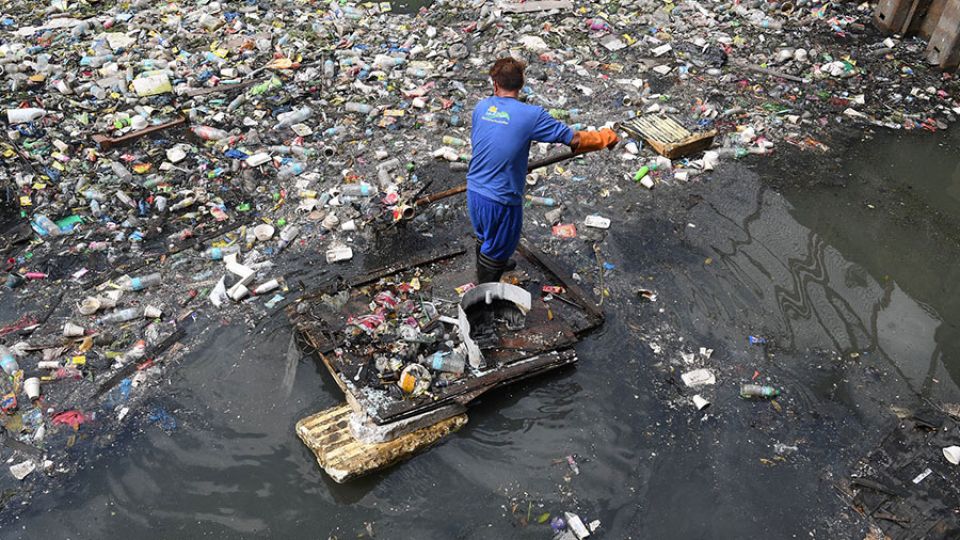
More than half of that waste—about 55.56%, or roughly 839,300 tons—is expected to be mismanaged in 2025, meaning it is left uncollected, openly dumped, burned or otherwise improperly handled. Much of it eventually finds its way into waterways, coastlines and communities.
Comparable estimates from Earth Action’s 2024 Plastic Overshoot Day report placed mismanaged plastic waste at around 842,000 tons in 2024.
Previous data from the Department of Environment and Natural Resources showed that of the estimated 61,000 metric tons of solid waste generated daily in the Philippines, up to 24% is plastic, composed mostly of consumer goods packaging, cutlery and shopping bags.
Inquirer has reached out to the Solid Waste Management Division of the Department of Environment and Natural Resources for the latest plastic waste data but has yet to receive a response.
This gap between what is produced and what is managed defines the country’s plastic waste challenge.
Global comparisons show the Philippines occupies an unusual position in the plastic crisis: It is not among the world’s biggest plastic consumers per person, but it ranks high in plastic waste mismanagement. Data from Earth Action’s 2025 Plastic Overshoot Day report and World Population Review datasets show the Philippines ranks 31st globally in total plastic waste generation, producing an estimated 1.51 million tons annually.
While this is substantially lower than major waste-generating countries such as China, which produces around 56 million tons yearly, and the United States and India, which each generate tens of millions of tons annually, the Philippines still generates more plastic waste overall than several Southeast Asian neighbors with smaller populations, including Singapore and Cambodia.
Yet on a per-capita basis, Filipinos generate only around 13 kilograms of plastic waste per year—far below the global average of 28 kilograms cited in Earth Action’s report.
The figure is also significantly lower than in many high-income countries, including Belgium, where annual per-capita plastic waste exceeds 140 kilograms, the United States at more than 120 kilograms, and Singapore at around 76 kilograms per person annually.
Even within Southeast Asia, the Philippines generates less plastic waste per person than Malaysia and Thailand, according to the report.
Despite relatively low per-capita consumption, the Philippines is projected to mismanage about 55.56% of its plastic waste in 2025, placing it among countries with high levels of plastic leakage. Earth Action classifies the country under a “high” Mismanaged Waste Index.
This contrast highlights a key dimension of the plastic crisis: Environmental impact is shaped not only by how much plastic people consume, but also by whether waste management systems can effectively contain what is discarded.
Separate estimates from Earth Action’s 2025 Plastic Overshoot Day report also project that around 29,338 tons of microplastics could enter Philippine waterways in 2025—equivalent to roughly 80 tons every day.
These figures point to a broader issue: not just how much plastic is used, but how much of it is left uncontained.
A global system under pressure
The Philippines’ plastic waste crisis reflects a wider global trend.
Plastic production has expanded rapidly over the past decades, outpacing waste management systems in many parts of the world. Since the 1950s, the world has produced 8.3 billion metric tons of plastic, with only 9% recycled and the majority accumulating in landfills or the environment, according to a 2017 study published in Science Advances.
Recent data shows this growth has continued. Global plastic production reached 430.9 million metric tons in 2024, a steady increase from recent years and with a continued reliance on fossil-based plastics—conventional synthetic polymers derived from nonrenewable resources, primarily petroleum, natural gas and coal.
Projections indicate the problem is likely to grow. The Organization for Economic Cooperation and Development estimates that plastic production, use and waste could increase by 70% by 2040 if current patterns continue.
At the same time, leakage into natural ecosystems remains significant. A global assessment cited by The Pew Charitable Trusts warns that plastic entering the ocean could nearly triple by 2040 under a business-as-usual scenario.
Even where improvements are being made, progress has not kept pace with growth.
“Although more plastic waste is being well managed, the amount of mismanaged plastic waste has not improved,” Earth Action’s Plastic Overshoot Day analysis said.
Why waste management gaps matter
The Philippines’ plastic waste problem is often framed in terms of sheer volume. But global comparisons suggest a more complicated picture: Environmental impact depends not only on how much plastic is consumed, but on whether waste systems can effectively collect, process and contain discarded materials.
As noted in the SWITCH-Asia report Plastic Policies in the Philippines:
“The annual per capita rate of plastic waste thus stands well below the global average of 31.9 kg and the average in SWITCH-Asia countries of 20.1 kg.”
However, lower consumption has not translated into lower environmental impact.
Earth Action’s 2025 estimates project that the Philippines could mismanage around 839,300 tons of plastic waste this year—equivalent to 55.56% of its total plastic waste generation.
These figures place the country in a distinct global position: not among the world’s largest consumers of plastic, but among those where a significant portion of waste escapes formal systems.
“Plastic pollution has reached gigantic dimensions worldwide. This has been attributed to continuous plastic production and the lack of sound waste management, especially in low- and middle-income countries, such as the Philippines,” the international nongovernmental organization World Wide Fund for Nature said.
The ‘sachet economy’
If waste management gaps explain how plastic escapes into the environment, sachets help explain why the volume persists. Across the Philippines, plastic is used and consumed in its smallest, most pervasive form.
Sachets, the small, single-use packets for everyday goods, dominate the country’s plastic waste stream. As a report by the Global Alliance for Incinerator Alternatives notes:
“Comprising an estimated 52 percent of the residual plastic waste stream, sachets have been accumulating in the environment, where they defile the natural landscape, choke waterways, harm wildlife, and threaten livelihoods like tourism and fisheries.”
According to GAIA Philippines’ 2019 estimates based on Waste Assessment and Brand Audits, Filipinos discard around 164 million sachets daily, equivalent to nearly 60 billion pieces annually.
On an individual level, GAIA said that in a year, the average Filipino uses 591 sachets, 174 shopping bags and 163 labo bags—small, thin, translucent plastic bags used to pack small grocery items or food.
But the challenge goes beyond sheer volume. It lies in the nature of sachets themselves.
Around 62% of the roughly 164 million sachets discarded each day—equivalent to about 101 million pieces—are made of multilayered materials that combine aluminum, adhesives and plastics such as PVC or polystyrene, engineered for durability but not for recovery.
These multilayer sachets are typically used for liquids like shampoo and for powdered drinks such as milk, juice and coffee. They account for about 62% of all sachets discarded each day, or roughly 101 million pieces.
The remaining 38%—around 62 million sachets—are single-layer plastics, commonly used to package snacks and detergent bars.
“In effect, the total number of sachets discarded in one year is enough to bury the entire Metro Manila under a foot of sachets,” GAIA said.
Their widespread use is closely tied to the country’s “tingi” culture, or the practice of buying goods in small, affordable quantities. For many households, sachets make basic products accessible, but this accessibility comes with trade-offs.
“Sachets are widely perceived as affordable, convenient, and indispensable, but only because their true costs are externalized, unaccounted for by corporations that have profited handsomely from the sachet economy, and disproportionately paid for by society,” GAIA said.
This dynamic is reinforced by how products are marketed and sold. According to Greenpeace Philippines:
“Multinational corporations and other large retailers have taken advantage of the appeal of single-serve retail in the form of sachets in order to sell commodities in tingi at price points accessible to low-income households.”
Yet the burden of waste falls elsewhere.
Greenpeace said that “after profiting from the sale of sachets, corporations have taken no responsibility for the plastic waste their products generate.”
What comes next
The problem is not just how plastic is used or consumed, but how it is designed, produced and managed after it is discarded. Across the country, waste systems are left to handle materials that are difficult—and often impossible—to recover.
As the data shows, a significant share of plastic waste does not stay within formal systems. It escapes into waterways, coastlines and communities—shaped not only by consumer behavior, but also by the structure and limitations of the waste management system itself.
In the second part of this series, INQUIRER examines how plastic moves through that system—from production and trade to disposal—and why much of it slips through the cracks.
Inquirer reached out to DENR for updated data on plastic waste generation and management in the Philippines. As of publication, the agency had not responded.