

May 29, 2026
TOCHIGI – Two hours north of Tokyo, surrounded by sprawling rice fields, lies a facility that offers full-board accommodation with three meals a day, access to a 15,000-book library, and up to four hours of evening television.
This is no idyllic countryside retreat, though some who pass through its gates may be increasingly compelled to treat it as one. This is Tochigi Prison, Japan’s largest female correctional facility by capacity, with 456 criminals incarcerated there as at May 21.
Visiting the institution on a rare media tour on that day, I was immediately struck by the visual contradiction of vibrant flowers in full bloom against a pastel-pink facade – a sharp contrast to the grim, drab-grey fortress I had anticipated.
After all, Japan’s justice system has long drawn international scrutiny for alleged human rights abuses and its uncompromising practices.
Upon arrest, suspects can be held at detention centres for up to 23 days per charge without bail, which critics lambast as a “hostage justice” method designed to extract confessions through the psychological shock of lost liberty.
It is only after they are tried and almost inevitably found guilty, given Japan’s formidable 99.9 per cent prosecutorial conviction rate, that convicts are moved to prisons.
Tochigi’s inmates – mostly housed in six-person or solitary cells – have been convicted of crimes as varied as homicide and armed robbery, to petty theft.
The solitary cells look no different from a small rental room. Each cell comes with a television, a study table and a bed, while a panel affords the inmate privacy when using the toilet.
While Tochigi Prison is one of 12 female jails nationwide, the Greater Tokyo region’s other major prisons, like in Fuchu and Yokohama, are for men.
Each of Japan’s 180 prisons nationwide retains some operational autonomy within Justice Ministry guidelines. Human rights groups have alleged inhumane conditions in many facilities, resulting in inmates suffering from frostbite in the winter and heatstroke in the summer.
While the government typically issues detailed rebuttals when criticised – pointing to domestic law, its participation in international conventions, and the need to reform hardened criminals – these criticisms have arguably led to a historic overhaul in the penal code.
However, a paradigm shift is under way. In June 2025, Japan implemented its first penal code revisions since 1907, which signalled a change in focus from punishment to rehabilitation. Instead of mandating prison labour for all inmates, more time is allocated for rehabilitative guidance, counselling and education.
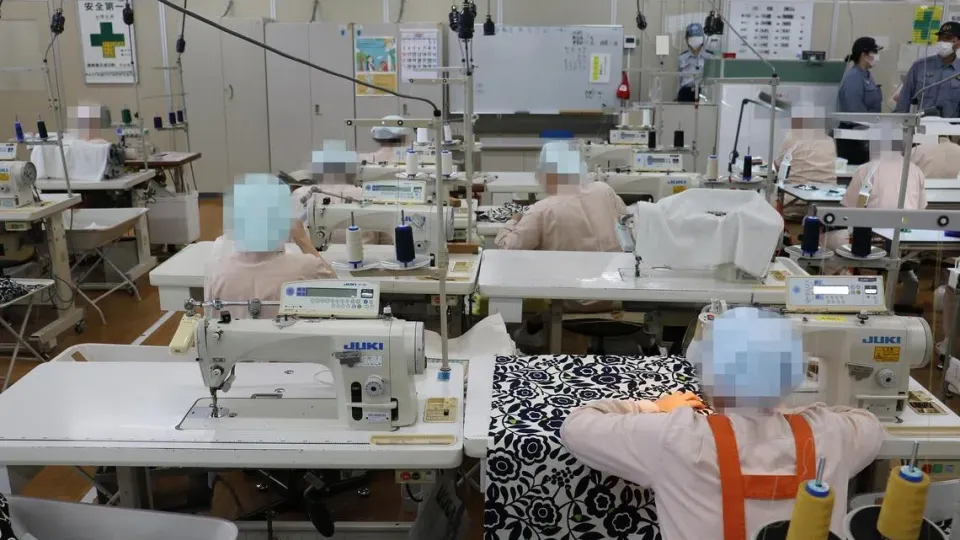
Within the quiet walls of Tochigi Prison, I walk past a room where younger inmates appear to be participating in a business seminar. In another workspace, women were sewing elaborate designs onto flags and banners, the silence punctuated only by the rhythmic whir of sewing machines.
Inmates here can undergo vocational training to earn licences or diplomas in hairdressing, nursing care, beauty therapy, and even forklift operation.
The prison even operates an appointment-only hair salon where female Tochigi City residents can get their hair cut by licensed inmates for a bargain 825 yen (S$6.60), dyed for 1,320 yen, or permed for 2,860 yen. While customers cannot engage in small talk beyond basic styling instructions, the programme is visible proof of Tochigi’s rehabilitation efforts.
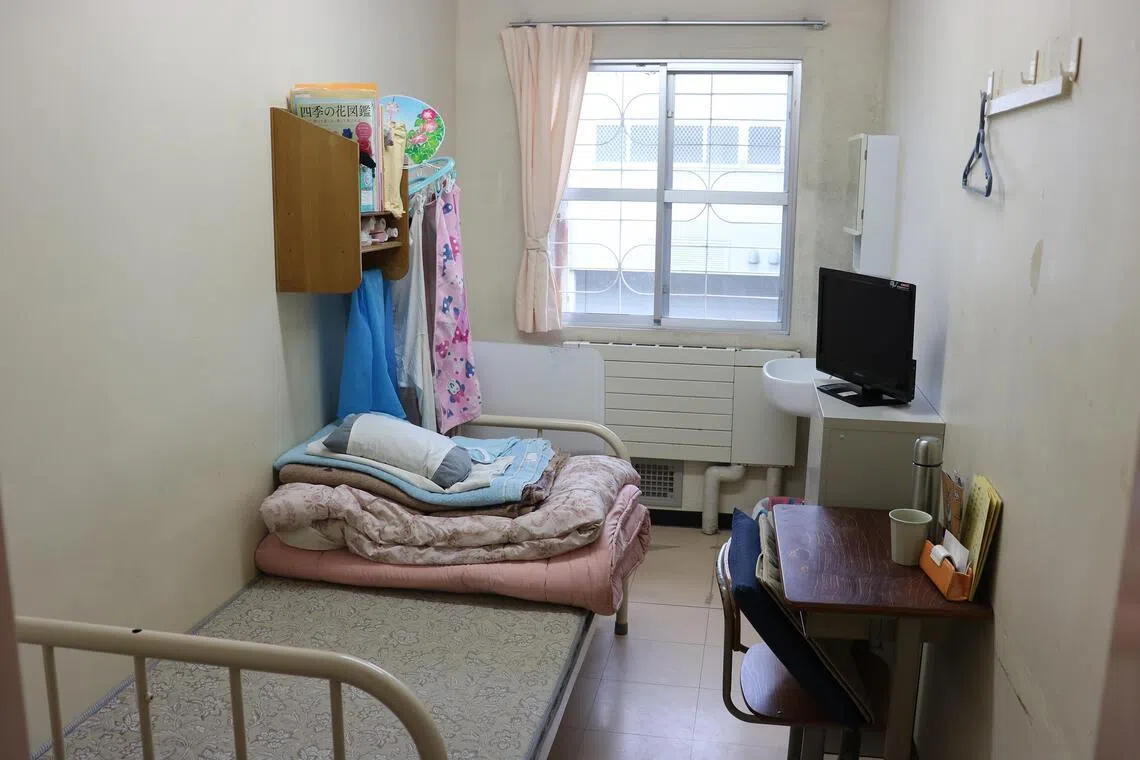
A single-person cell at Tochigi Prison. PHOTO: THE STRAITS TIMES
In 2025, 12 inmates secured confirmed job offers before their release.
During the media tour, prison officer Takayoshi Shiranaga showcased a “reflection room” that felt strangely inviting. Adorned with leafy plants and plush soft toys, it is intended to encourage inmates to open up and air their grievances to staff.
Naturally, Tochigi was putting its best foot forward for the press, yet it was impossible to leave without sensing that the prison takes its mandate on privacy and human rights extremely seriously.
While blurring inmate faces and identifiable features in media imagery is understandably standard practice, the restrictions here required even the backs of their heads – already hidden under work hats – to be pixellated. No communication with inmates was allowed, and officials noted that these strict regulations stemmed from past negative experiences with the media.
Prison warden Kiyochika Miyoshi acknowledged that it was only human for inmates to feel resentful about losing their liberty. However, he emphasised that formal complaint channels have “created a system of trust between the inmates and officers.”
There may be some truth to that, though it also comes with a heavy dose of poverty and loneliness outside the prison, a splash of institutional dependency, and even a measure of Stockholm syndrome thrown in.
Japan’s penal institutions are a living mirror of the country’s societal evolution and Tochigi Prison, which takes in female Japanese convicts from around Tokyo and foreigners from across north-east Japan, feels like a microcosm of society.
Just as three in 10 Japanese citizens are aged 65 and older, the prison’s demographic profile also tilts heavily grey. Many are impoverished, lonely, or both. They choose to become repeat offenders, committing petty theft or shoplifting with the precise hope of getting caught.
At Tochigi Prison, 42.1 per cent its Japanese inmates are repeat offenders, with the most prolific recidivist having been in and out of jail a staggering 20 times.
Behind bars, they find a community of peers and live in relative comfort that might even be luxurious to some, funded by taxpayers to the tune of 2,400 yen per inmate, per day.
Meanwhile, Japan’s growing numbers of foreigners – both residents and visitors – are reflected in the cells. At Tochigi, there are 165 non-Japanese inmates, or 34 per cent, who hail from 33 countries and speak 19 languages. Most are serving time for drug smuggling.
To manage this, the prison has appointed an international affairs office director to liaise with embassies and ensure diverse cultural needs are met. Foreign inmates attend Japanese language classes, while officers rely on translation devices and interpreters.
“It is challenging to convey nuance, and this can cause stress for the inmates,” Mr Miyoshi admitted, when asked about the difficulties. “Furthermore, what inmates discuss among themselves in another language cannot be immediately understood by staff, which could pose a security risk.”
First opened as a men’s prison in 1872, Tochigi Prison began taking in female inmates in 1906, eventually relocating to its current 64,190 sq m site – roughly the size of National Gallery Singapore – in 1979.
It is set to shut its doors for good on March 31, 2028, in line with a nationwide decline in female incarceration. The prison, with a capacity for 655 inmates, is currently 70 per cent full – a far cry from the severe overcrowding of 2004 when 831 women packed into the facility.
“The number of female inmates nationwide is decreasing, and this facility is ageing,” Mr Takayoshi Yamamoto, director of the Correctional Bureau’s general affairs division, tells me.
“Financially, securing the budget to modernise this infrastructure has become difficult. We have enough capacity to disperse these inmates across other female prisons nationwide.”
The state-owned land will eventually be returned to the government, its future use undecided.
I find myself imagining that it could well become a museum or even a luxury resort, for its off-the-beaten-track rustic appeal and historical importance as having once been Japan’s largest female prison.
Across Japan, shuttered penitentiaries are finding a second lease on life as public attractions, allowing visitors to walk down historical corridors for a taste of life behind bars.
In Nara, a striking red-brick juvenile prison built in 1908 and closed in 2017 is due to open as a luxury hotel managed by Hoshino Resorts on June 25. The company also oversees the adjacent Nara Prison Museum, which opened its doors in April.
As the only surviving structure of the Meiji Era’s (1868-1912) “Five Great Prisons”, Nara Prison has been designated a National Important Cultural Property. Built to showcase a modern, Westernised penal system after centuries of isolationist shogunate rule, its Romanesque architecture is iconic.

The in-house hair salon at Tochigi Prison. PHOTO: THE STRAITS TIMES
In its marketing materials, Hoshino Resorts playfully uses the phrase “Luxurious Confinement” to describe its 48 high-end suites, each built by combining multiple 5 sq m prison cells. It added: “Once a place of restriction, this reimagined landmark now invites visitors to experience a luminous and singular retreat where the heavy walls of the past provide the ultimate private escape.”
My fascination with history also drew me to the Abashiri Prison Museum in eastern Hokkaido in 2020.
The infamous former maximum-security facility opened in 1890 and closed in 1984. During the Meiji Era, it held political outlaws including former samurai who fought in the failed 1877 Satsuma Rebellion and who were transferred there as Japan rushed to modernise.
The then-government used these inmates as forced labour to carve infrastructure out of the wilderness, including a 215km national highway.
Once dubbed “Japan’s Alcatraz”, the museum also features a memorial to Yoshie Shiratori (1907-1979), who is the nation’s most notorious escape artist.
Shiratori, jailed for various offences including armed robbery and murder, famously broke out of four different prisons and was the only man to successfully escape Abashiri in 1944. He had used miso soup to slowly rust his handcuffs and cell bolts, even dislocating his own shoulders to squeeze through a narrow gap before vanishing into the wartime darkness. An exhibit that re-enacts his escape can be found in the museum.
Back in Tochigi, and seeing how the prison is a reflection of Japanese society through the profile of its inmates, I find myself feeling sorry for the elderly convicts.
Clad in identical pale pink smocks and white head coverings, I observe as a group sat delicately folding intricate origami of characters such as Totoro, the mythical forest spirit from the Studio Ghibli animation My Neighbor Totoro (1988).
The task is designed as occupational therapy to keep their minds and hands active. And many of them work with a nimble dexterity that belies their wrinkled hands and bent backs.
But it also reads like a cautionary tale for ageing societies. Japan is celebrated globally as a pioneer in healthy ageing, boasting one of the world’s longest lifespans.
Yet for its most vulnerable seniors without any safety net, old age can become a literal prison sentence, the cold bars of their cell serving as, ironically, their warmest refuge.