

November 26, 2025
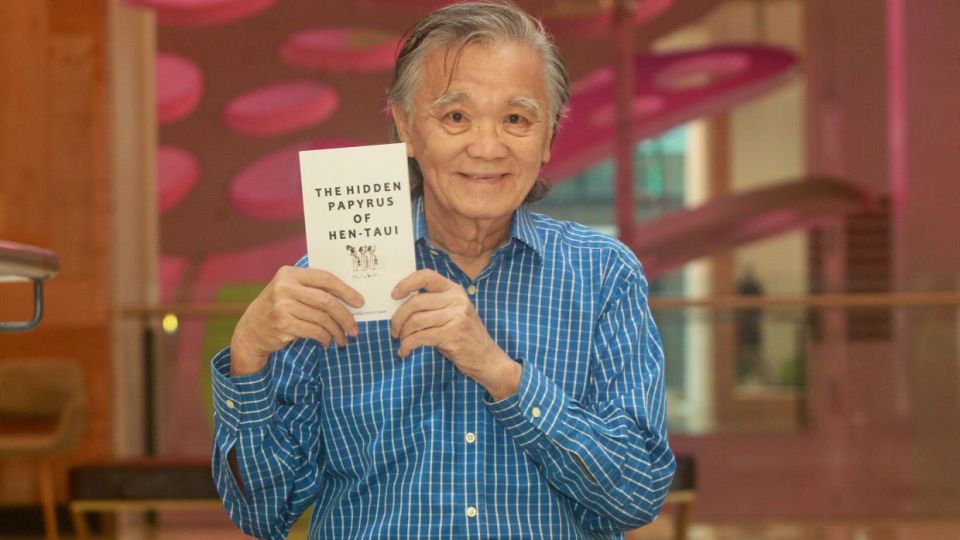
KUALA LUMPUR – A new book shines a spotlight on Wong Phui Nam (1935-2022), one of Malaysia’s pioneering English-language writers and poets from the 1960s, bringing his work – and his influence on Malaysian literature – into sharper view for a new generation of readers.
In The Mirror: New And Selected Works Of Wong Phui Nam, offers an overview of Wong’s oeuvre, tracing his lifelong trajectory as a poet and critic through a curated collection of his poetry and literary criticisms.
It also includes unpublished, unread poems from the final years of his life.
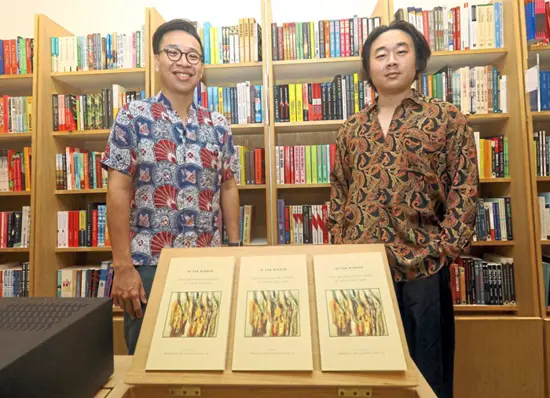
Liew (right) and Lim will launch In The Mirror and celebrate Wong’s legacy at the George Town Literary Festival 2025 in Penang on Nov 29. PHOTO: THE STAR
Born in Kuala Lumpur, Wong was educated at Batu Road School and later went to the Victoria Institution.
The new book, a nod to his university years, is published by his alma mater, the National University of Singapore (NUS) Press – known then as the University of Malaya in Singapore – where Wong studied economics in the mid-1950s.
The only other poetry collection NUS Press has published is by Arthur Yap (1943-2006), a major Singaporean poet, highlighting the esteem in which Wong and his work are held.
A clearer picture
For editors Brandon Liew and Daryl Lim Wei Jie, In The Mirror is meant to be a key text for literary studies in the region, especially owing to the fact that many of Wong’s older published works are out of print and difficult to come by.
Liew, a Malaysian literary scholar currently teaching at the University of Melbourne in Australia, and Lim, a Singaporean poet and literary critic, worked closely with Wong during his final years to prepare his latest works for publication.
Beyond Wong’s poems, including his most widely known work How The Hills Are Distant (1960-1964), and a selection of his critical essays, the editorial duo also wrote a condensed introduction that recounts Wong’s life, linking his work with contemporary poetry in the region.
“This was something that hadn’t been done before, so we wanted readers to get a better picture of who he was. By knowing where he came from and what he was all about, you would have a clearer understanding of his poems, or see them from another perspective,” says Lim during a recent interview in Petaling Jaya.
Much of Wong’s poetry grappled with the spiritual and cultural vacuums left behind by colonial powers, while also contemplating the neo-colonial structure of the state and economy.
Even in his final works, Wong continued to challenge readers to confront the realities of cultural displacement and the complexities of existing within a multi-ethnic society.
Wong had originally been working on two separate manuscripts – one was a collection of his new poems, and another was a selection of his older works. However, after his passing at 87, the manuscripts were entrusted to Liew and Lim, who decided it would be better to combine the manuscripts into one book.
A maker of myths
For a new generation, who may find Wong’s earlier works hard to track down, this collection offers a glimpse of his thinking and creative vision.
“I think there is a dark magic at work in his poetry. He often talks about dreamscapes and nightmares that really gripped me,” says Lim.
He adds that one of the things Wong did best was importing myths from other cultures, such as ancient Egyptian mythology, and translating them into a Malaysian context.
“When I talk to people about Wong’s works, I often say that he used his poetry to construct and explore a shadow world. His purpose of creating this alternate world is to provide a space for him to wrestle with his demons, be it his misgivings about writing in English or thoughts on Malaysia’s socio-political landscape and culture at the time. His poems are quite horror-driven … gothic, even. Real demons and monsters appear in his work,” says Lim.

A reader browses through a copy of ‘In The Mirror’ in a bookstore. PHOTO: THE STAR
Both Liew and Lim got to know Wong at different points in time before they came together to work on the book. Liew worked closely with Wong for A Wasteland Of Malaysian Poetry In English (Liew’s audio-archive project in 2022), while Lim reached out to Wong via email after picking up one of his poetry collections in a bookstore. He struck up a friendship that transcended distance and generational differences.
As their friendships grew, both the younger men came to see Wong not just as a poet and literary critic, but also as “someone full of passion” in person.
“He comes off as a serious person at first, but once we got to know him, we saw that he was always eager to learn more about the world around him and wasn’t shy to ask us questions,” says Liew.
“He also genuinely cared about his craft and about younger people and younger writers. So we wanted to include that dimension of his character into the book,” he adds.

A book event on Wong’s literary works held at Lit Books in Petaling Jaya last month. PHOTO: THE STAR
Towards the end of the book is a section titled Advice To Young Poets, which was based on Wong’s comments at the Malaysian Poetry Writing Competition 2021, where he was a judge.
“A poet should not be feeling that he is working in isolation. Writing is a communal enterprise. He has contemporaries who are also poets. He should see himself in their work and see himself as part of an enterprise to create work that speaks for his time,” outlined Wong’s warm advice.
Another testament to Wong’s openness and capacity for change and growth was reflected in his editorial process.
“Right up to his last days, he continued to edit and refine his poems, changing a word here, rearranging the flow there. It was nightmarish from an archivist’s point of view, but when I asked him why, he would simply reply, ‘Well, it sounds better this way’,” concludes Liew.
In The Mirror: New And Selected Works Of Wong Phui Nam is available in all good bookstores.