

April 10, 2026
SEOUL – If you were a young aspiring journalist or magazine writer in the 2000s, there’s no way you haven’t heard of “The Devil Wears Prada.”
It made the editorial world look equal parts brutal and irresistibly seductive, and for a generation of aspiring writers and magazine obsessives around the world — including, apparently, more than a few in a room packed with local Korean press on Wednesday — it planted a seed: Andie Sachs for some, Miranda Priestly for others.
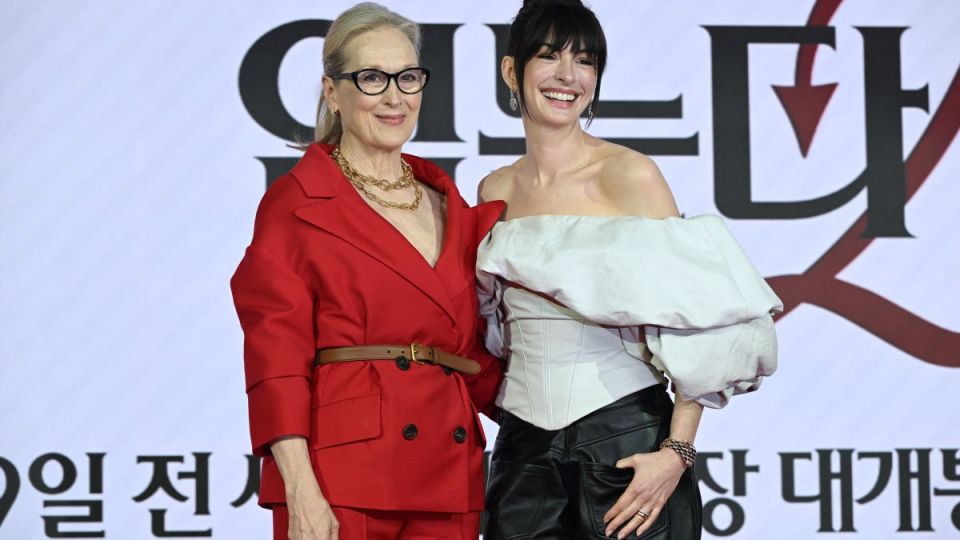
On Wednesday morning at the Four Seasons in central Seoul, Streep, 76, said she’s in Korea for the first time in her life. She landed, saw the mountains, checked into what she called “the most beautiful hotel I’ve ever been in,” and almost couldn’t get out of bed.
Hathaway is back for the first time since 2018, and called this visit “bittersweet.” She had been hoping to tick the popular Starfield Library inside Seoul’s COEX Mall off her bucket list, but the schedule wouldn’t allow it.
But this isn’t 2006, when smartphones didn’t exist and print media still ran the culture. The sequel lands in a rather different world — one where TikTok, Instagram and generative AI have dismantled the gatekeeping apparatus that once made the film’s world feel like the center of the universe.
“The Devil Wears Prada 2” builds itself squarely around that reckoning. Andie Sachs (Anne Hathaway), now a features editor at “Runway,” returns to find Miranda (Meryl Streep) scrambling to keep the magazine financially afloat amid the decline of traditional publishing. She faces off against former colleague-turned-adversary Emily Charlton (Emily Blunt), now a high-powered luxury executive holding the advertising dollars Miranda desperately needs.
Both were quick to draw a straight line between the film’s premise and the current media landscape. “The film we made in 2006 came out the year before the iPhone,” Streep said. “That thing that you all have in your pockets has changed everything — it’s changed everything in publishing, it’s changed everything in our business. Our business has become atomized.”
Hathaway framed it through Andie’s trajectory specifically. “You can’t overestimate the effect the digital revolution has had on all aspects of our lives — in particular when it comes to fashion journalism,” she said. She added, however, that the world the character reenters is one of hard-won possibility: “I think there’s a lot more freedom available. It’s not easy — you’ve gotta fight for it, you’ve got to work for it.”
Andie Sachs was 22 in the first film, a college graduate full of ideas but, as she put it, “a little light on life experience.” Two decades on, she’s “acquired skills, a point of view, a fair bit of humility but also confidence.”
The parallels hit closer to home than just the characters. Hathaway, now 43, was 22 herself when she played the role. “I got to be a baby actress acting alongside the greatest actress of all time,” she said. “To be influenced by Meryl’s extraordinary talent and her even more remarkable humanity — it’s kind of hard to overstate the impact it had on me.” The film, she added, became “one of the most remarkable gifts of my life” — an anchor that, oddly, freed her to take risks and “make a lot of really weird choices” (it also gave her a great haircut, she noted).
Streep said the original caught her off guard: she never expected men to seek her out saying they identified with Miranda, that they felt what it was like to sit atop an institution with that kind of weight. “This is the first film I was ever in where men came and said, ‘I know how you felt,'” she said. “That contributed to its success, and that was very meaningful to me.” On Hathaway, she only had kind words to spare: “You’re so fresh and immediate, you make the moment open-hearted. That’s all you ask from a partner.”
The two diverged on the question of whether the sequel carries a message. Hathaway laid out Andie as something of a role model — “really committed to being empowered with kindness,” someone who wants to bring “a really loving energy into the office,” and financially self-sufficient on her own terms. “Andie Sachs has paid for every bill that’s come her way her entire adult life,” she said. “Her attitude is: if the right person comes along, wouldn’t that be fun? But I’m the right person for me.”
Streep was less persuaded by the moral-lesson premise. “I am so loath to put out the idea — like a chyron at the bottom of the TV screen — that says ‘this is the message of the movie,'” she said. Her read: a woman can be a mean boss, and that’s not a gendered observation. Come for the fun, she suggested; the underpinnings will sort themselves out.
She did point to one thing the film gives her that most productions don’t bother with. “Women over 50 disappear into the woodwork,” she said, “and their opinions are less valued in the culture. So it’s fun to see this person who is incredibly placed in the world.”
Toward the end of the session, organizers brought out a surprise gift: a pair of one-of-a-kind red heels — the franchise’s signature object, reinterpreted with traditional Korean floral embroidery.
Both actors received them with open delight. Streep called them “exquisite, like everything in this country.” Hathaway was, by her own account, speechless. “The craft work that went into them — they’re so delicate, but they’re also so fun,” she said. “I’ll look at them and remember this incredibly special experience.”
“The Devil Wears Prada 2” opens in Korean theaters April 29.