


February 6, 2026
CHANG RAI – Chiang Rai street food vendor Benjaporn Maigate is tired of politicians who use money to buy votes.
“There’s a lot of money being thrown around to buy votes, but I believe everyone must rely on themselves rather than just waiting for handouts,” said the 55-year-old, who added that what people really need are policies that reduce the cost of living, especially electricity and fuel.
“My family, even my mother who’s aged over 70, refuses to be bought. If someone tries to buy our vote, we shut the door on them completely,” she told The Straits Times with a laugh.
Likewise, farmer Rungnapa Kongsui, 47, from north-eastern Ubon Ratchathani province says that while cash handouts are always attractive, the happiness from them lasts “only for a short time”.
“But if you offer sustainability or help that isn’t cash, like supporting careers, jobs and (access to) markets, people will remember that forever,” she said.
Where once many in Thailand’s rural provinces in the north and north-east would be quick to welcome promises of quick government giveaways, voters who spoke to ST ahead of the general election on Feb 8 are sceptical about such populist election measures.
On Sunday, nearly 53 million eligible voters across the country will choose their preferred member of Parliament and the party they like best.
The north and north-east, better known in Thailand as Isan, have always been key election battlegrounds. They comprise 29 provinces and account for 170 of the country’s 500 parliamentary seats up for contest.
The two regions, which have a total of almost 25 million eligible voters this election, have traditionally been strongholds of Pheu Thai, a party linked to former prime minister Thaksin Shinawatra. But in recent elections, the party has won fewer seats in both regions.
Political parties are often keen to lure voters in these areas with promises of crop price guarantees, farming debt moratoriums and agricultural processing industry development.
Farmer Saksayam Lakkan, 52, who worked in food production in South Korea before returning to his hometown in Ubon Ratchathani, does not want empty promises. He says if the government “actually promoted technology and educated the new generation of farmers, we could develop and have a better life”.
Referendum on Constitution
On Feb 8, besides choosing their representatives, voters will also be deciding on whether they want to change the country’s 2017 Constitution, which was drawn up by the military junta under former prime minister Prayut Chan-o-Cha following the 2014 coup.
The Charter has long been criticised as entrenching unelected power, namely allowing unelected Upper House senators to have a say in approving laws and appointing constitutional court judges.
Even if this first referendum succeeds, two more referendums are needed before a new charter will emerge and that can take years.
“Repeated failures in past amendment efforts have created a widespread perception that the current Constitution is effectively unamendable, fostering public scepticism and political fatigue,” said political science lecturer Purawich Watanasukh from Thammasat University.
This explains why the referendum’s “vote yes” campaign has not been particularly strong or effective in mobilising compared with other election issues, he added.
Will the People’s Party move forward?
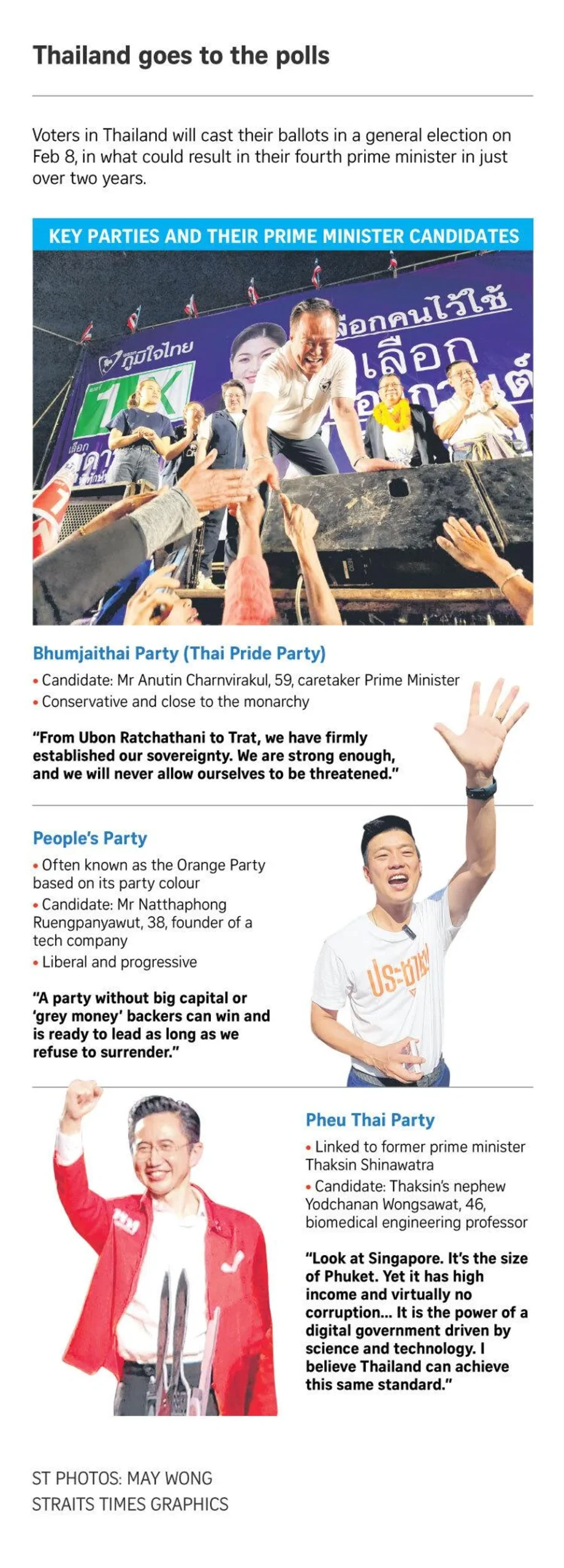
A key contender in the polls is the People’s Party, a young, progressive, liberal band of candidates, and the incarnation of the now-defunct Future Forward and Move Forward parties.
Both were dissolved by the constitutional court – Future Forward for a campaign finance violation in 2020 and Move Forward for potentially undermining the constitutional monarchy with its campaign to change a law on royal insults in 2024. The key leaders have all been barred from participating in the elections for 10 years.
Mr Natthaphong Ruengpanyawut, 38, the People’s Party’s lead candidate for prime minister, said he is determined to win this election again – the party had won the most seats at the 2023 general election.
Asked by ST at a campaign walkabout how different his party’s fate will be this time, he said: “This is the very first time that we have no senator powers to vote for the PM. So this time, I urge all Thai people to believe in the power of themselves to vote for the People’s Party.”
At the 2023 general election, the party, the then Move Forward Party won the most parliamentary seats in the Lower House, but its candidate Pita Limjaroenrat failed to become prime minister because the senators of the Upper House refused to vote for him.
Back then, the appointed group of 250 Upper House senators were given constitutional powers to vote for the prime minister, together with the 500 MPs in the Lower House. But when their five-year term expired in 2024, so did this authority. The new batch of 200 senators in Parliament today do not have that same special power to vote for the prime minister.
Stoking nationalist sentiments
Another key contender in the elections is caretaker Prime Minister Anutin Charnvirakul’s Bhumjaithai Party. Mr Anutin, 59, replaced Ms Paetongtarn Shinawatra as Prime Minister in September 2025, after the constitutional court removed her for an ethical violation.
Mr Anutin, known to be a royalist conservative, has also in recent months been regarded as a defender of Thai sovereignty against Cambodia over undemarcated areas between the two nations.
The military clashes between the two countries have been paused but Mr Anutin has been stoking the growing nationalism sentiments.
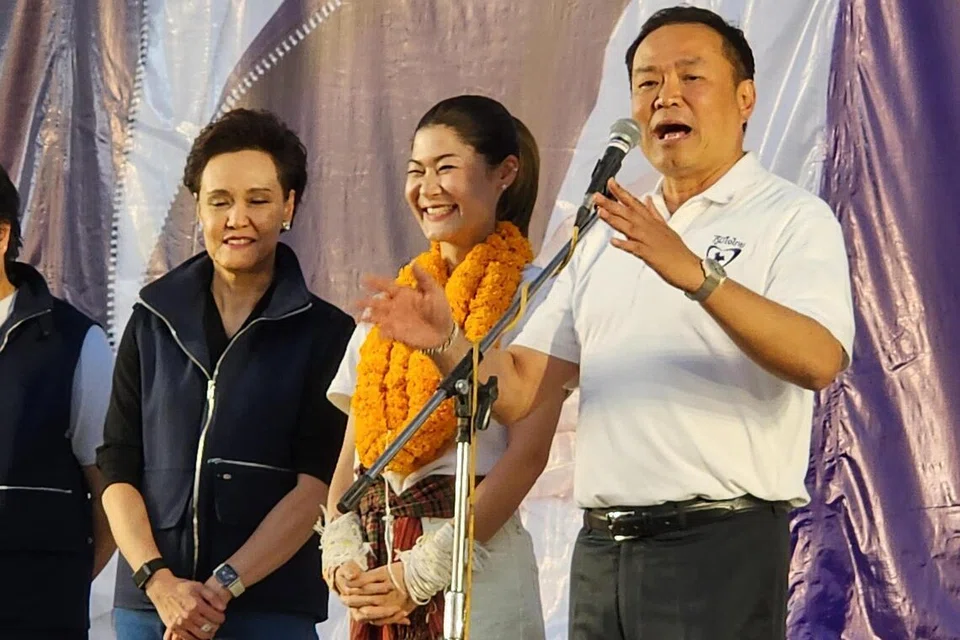
Mr Anutin Charnvirakul (right), the current caretaker PM and leader of the Bhumjaithai Party, at a rally in Ubon Ratchathani. PHOTO: THE STRAITS TIMES
“On border issues? Don’t worry. On rice and cassava prices? They will go up, guaranteed. On drugs and scammers? We will wipe them all out completely,” he said to loud cheers and applause from a crowd of mostly senior rural villagers at a rally in Ubon Ratchathani during the campaign.
He also linked handling the citizens’ economic woes to tighter border security: “As long as we’re in charge, prices will never fall because we dare to close the borders to protect our market. I will build a wall for you, and I assure you, they won’t dare touch it.”
Bhumjaithai has “actively mobilised public emotion and patriotic discourse to boost its popularity and consolidate support”, said Thammasat University’s Dr Purawich.
He noticed Bhumjaithai has “framed the election in explicitly moral and emotional terms, campaigning on narratives that divide voters into those who “love the nation” and those who do not.
Political scientist Titipol Phakdeewanich of Ubon Ratchathani University warns that Bhumjaithai is playing a dangerous game as driving up nationalist sentiments is bad for Thailand in the long run.
“Because we cannot deny that we still have to connect with Cambodia, in order to connect with the region,” he added.
Waning Shinawatra influence?
For Pheu Thai, the Thai-Cambodia conflict has barely been raised during campaign trails.
That’s because the issue led to the downfall of former Thai prime minister Paetongtarn Shinawatra, daughter of Mr Thaksin. In a leaked phone conversation with Cambodia’s de facto leader Hun Sen, she was heard criticising one of her own army commanders and being conciliatory as both families used to share close ties.
But her actions angered many and she was dismissed over an ethical breach in August 2025.
Pheu Thai has been touting populist policies like creating new millionaires every day through lottery draws by awarding nine individuals one million baht (S$40,176) each and income top-ups for those who earn less than US$1,140 (S$1,451) annually.
Mr Thaksin’s nephew Yodchanan Wongsawat, 46, a biomedical engineering professor who is the party’s top candidate for prime minister, told a rally crowd in Bangkok how his team plans to develop Thailand.
“By harnessing innovation, we can become a leading nation on the world stage. I am ready to serve as your 33rd prime minister, a leader who puts science and technology at the forefront of national development.”

Mr Yodchanan Wongsawat, the lead PM candidate for Pheu Thai party, linked to former prime minister Thaksin Shinawatra . The 46-year-old is a biomedical engineering professor and the nephew of Thaksin. PHOTO: THE STRAITS TIMES
No matter who wins the election this time, third-generation business owner Pakpoom Phonpisit, 44, hopes that the new government will get to work quickly.
He said: “Election campaign policies tend to prioritise populist appeal, which are often impractical to implement in reality. As the private sector, our expectation is simply for a government that operates with integrity – one that is free from corruption and favouritism towards any specific group – so that the country can effectively move forward.”
