

November 4, 2025
ISLAMABAD – Mamdani poised to become youngest NYC mayor in more than a century; Ghazala Hashmi leading race for Virginia’s Lt governor.
As New York prepares for a potentially historic mayoral election that could bring its first Muslim and South Asian mayor, Virginia is witnessing another milestone.
Ghazala Hashmi, a Democrat, Muslim and South Asian-American, is leading the race for lieutenant governor, while Zohran Mamdani, also a Democrat, heads into New York City’s mayoral contest with commanding support.
With less than 24 hours to go before the polls open, community leaders are urging Pakistani Americans and other Muslim voters to turn out in force for Tuesday’s elections.
New York City is seeing unprecedented early voting this year. According to the City Board of Elections, 584,105 ballots had been cast by Saturday evening, compared with only 109,000 at the same point in the 2021 mayoral election.
Young voters under 50 make up about 69 per cent of these early ballots, and Emerson College polling shows overwhelming support for Mamdani among this group. Older voters remain more evenly divided, but the energy and turnout among younger voters could prove decisive on Election Day.
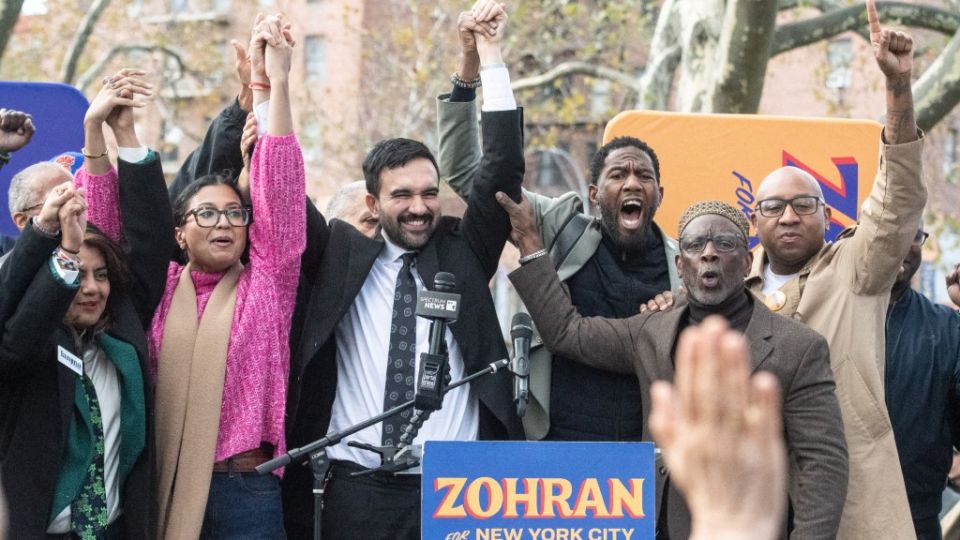
Mamdani, aged 34, stands poised to become not only the youngest mayor in more than a century but also the city’s first Muslim and South Asian leader.
His campaign — centred on freezing rent increases, making buses free, and investing in publicly owned grocery stores — has energised younger voters and working-class neighbourhoods. Analysts note that his rise has already captured national attention, prompting commentary from US President Donald Trump.
“Some people are saying he’s here illegally,” Trump said, while also calling Mamdani “a communist” and warning, “Well then, we’ll have to arrest him.”
At another rally, he declared: “This guy … wants to destroy New York. … I love New York and we’re not gonna let him do that.”
Trump reiterated that label during an interview with CBS, saying Mamdani was a “communist, not socialist”. Asked about comparisons made between the two, the US president said, “I think I’m a much better-looking person than him.”
Mamdani’s team has said Trump’s remarks are attempts to intimidate a rising generation of progressive politicians.
Mamdani himself has spoken about the broader stakes: “In the words of Nelson Mandela, ‘It always seems impossible until it is done.’ My friends, we have done it. I will be your Democratic nominee for the mayor of New York City.”
Observers describe Mamdani’s rapid ascent — from state assemblyman to frontrunner for one of the most powerful municipal offices in the country — as a potential national inflection point for progressive politics. His campaign has energised young voters and activists across the country, with his ideas and platform generating attention in political circles well beyond New York.
Virginia’s early voting has also been strong, although the focus is more on turnout than ideology. By Saturday, more than 1.6 million ballots had been cast statewide, representing roughly 40pc of the projected total turnout. This is a marked increase from the 1.1m early votes recorded at the same point in 2021.
Young voters under 40 make up nearly 35pc of early voters and appear to be favouring Democratic candidates, including Hashmi and Abigail Spanberger.
At a brunch hosted by Pakistani-American supporters of the Republican Party in Springfield, Virginia’s Secretary of Commerce Juan Pablo Segura urged Muslim and South Asian voters to support Republican candidates, citing shared conservative social values.
“Go out and vote,” Segura told the gathering. “Join the political process if you want to be counted … Do not complain if you do not vote.”
Mansoor Qureshi, Chairman of the Civic Committee on the Governor’s Asian Advisory Board, highlighted the potential influence of these communities.
“With more than 450,000 registered voters, South Asian and Muslim communities in Virginia can significantly shape election outcomes,” he said, noting that previous close races, including Governor Glenn Youngkin’s 60,000-vote margin and Lt Governor Winsome Sears’s 50,000-vote win, could easily have been affected by small shifts in participation.
Hashmi, who made history as Virginia’s first Muslim woman senator, has avoided emphasising religion in her campaign. Instead, she focuses on her record as an educator and policymaker. Her campaign literature highlights equity, educational opportunity, and expanding prospects for working-class families rather than the identity of her faith.
She told supporters: “This is about ensuring opportunity and equity for every Virginian. We want to build a future where everyone, regardless of background, has a fair shot.”
The contests in New York and Virginia together illustrate a broader shift in American politics: Muslim and South Asian Americans are emerging as strong candidates, coalition-builders, and decisive voting blocs. In New York, their support is powering a progressive insurgency; in Virginia, their turnout could influence statewide partisan balance. Across both states, participation, identity, and representation are increasingly intertwined.
The conversation at the Republican lunch focused on the outcome of the two elections. Participants argued that if Mamdani wins in New York, the consequences could ripple across the national Democratic Party, reinforcing activist-led platforms and challenging centrist models. And this, they said, would further galvanise the Republican base.
If Hashmi prevails and the community turns out as leaders hope in Virginia, it will reaffirm that coalition-building among Muslim and South Asian Americans is central to modern electoral arithmetic.
The participants acknowledged that US politics may hinge on two simultaneous shifts: the emergence of a new kind of candidate, and the awakening of a community that was sidelined after 9/11.