

May 4, 2026
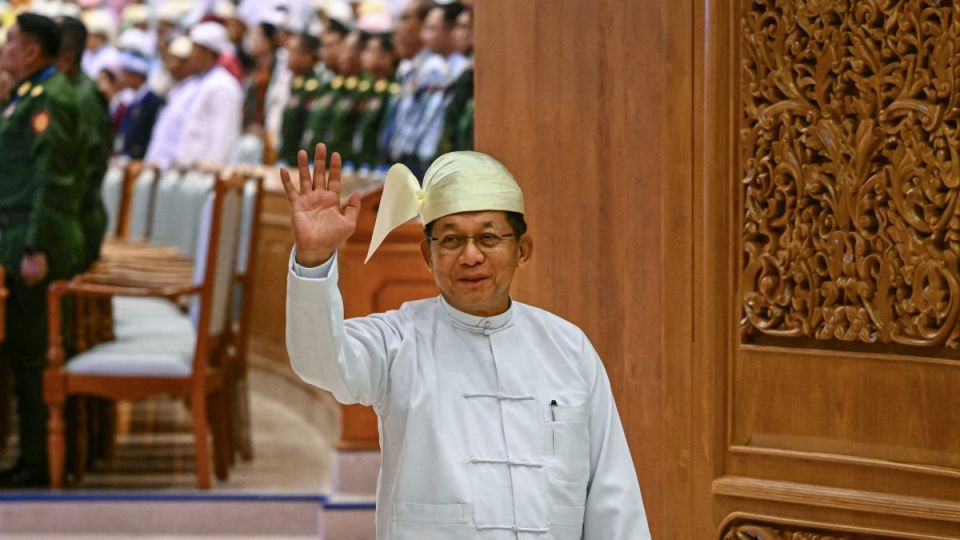
TOKYO – With Min Aung Hlaing, Myanmar’s former commander in chief, assuming the presidency, the country’s military regime has solidified its grip on power. Since the 2021 coup, the junta has moved to further cement its alliances with China and Russia, which makes it crucial to monitor developments in Myanmar not only for its democratic future but for its growing impact on Indo-Pacific geopolitics.
The coup that toppled the National League for Democracy government and its leader, Aung San Suu Kyi, had as its ultimate goal the restoration of military control over parliament. Diplomatic sources noted that Min Aung Hlaing had long harbored a desire to ascend to the presidency.
The current regime, with a president who masterminded the coup and a circle of loyalists in the Cabinet and military, differs fundamentally from the administration of Thein Sein, which was established in 2011 when the head of the military government retired as part of a transition to civilian rule.
Driven partly by the desire to lift Western economic sanctions, Myanmar underwent democratic reform at breakneck speed, taking the world by surprise. This ultimately paved the way for the long-cherished dream of a Suu Kyi-led government.
“A dynasty has been constructed around Min Aung Hlaing,” said Ichiro Maruyama, former Japanese ambassador to Myanmar. “There won’t be even a 0.1% change for the better. The crackdown will only intensify.”
While the new administration granted pardons on April 17 to Suu Kyi and Win Myint, the president of the NLD government, this has no real impact on the governing structure. The gesture is seen as performative, aimed at securing recognition for the new regime from the Association of Southeast Asian Nations and the broader international community.
Given the massive political and military “debt” owed to Beijing and Moscow since the coup, Myanmar’s dependence on these two nations and their subsequent influence over Myanmar are likely to grow in tandem.
Beijing’s strategic intervention
This situation arose out of the military’s dire circumstances in the civil war. In October 2023, armed ethnic minority groups launched a concerted nationwide offensive, plunging the military into disarray and causing it to lose Lashio, a strategic city in Shan State on the Chinese border. Though the groups gained momentum and advanced toward the capital, Naypyitaw, China finally intervened to halt their progress.
While China had shown consideration for pro-democracy forces, at this critical moment it threw its weight decisively behind the junta. Beijing leveraged its influence over its proxy, the United Wa State Army (UWSA), to cut off the supply of weapons to two ethnic groups that were then dominating the battlefield in Shan State.
Beijing forced the insurgent forces to retreat from Lashio by closing border gates and effectively starving the ethnic groups out by cutting off daily necessities. China also acted as a frequent mediator in ceasefire negotiations.
Having gained a crucial reprieve, the junta moved to rebuild its strength through mandatory conscription to fill its depleted ranks. It further bolstered its offensive power by co-opting the very drone tactics that anti-regime forces had successfully deployed against it.
A senior official of a Karen ethnic group that controls the border with Thailand noted last year that his forces were struggling due to a sudden increase in strikes by suicide drones.
Min Aung Hlaing reportedly thanked Chinese President Xi Jinping during their meeting in China last year, crediting Beijing’s pressure on border-area insurgents with fostering peace.
Bolstered by a steady influx of Russian weaponry, including fighter jets, Myanmar’s military regime pushed harder to retake lost ground. Without the combined support of Beijing and Moscow, the regime would likely have been unable to proceed with the general election as scheduled in December last year.
China’s backing of the military regime is obviously driven by self-interest. Beijing has long envisioned a grand strategic corridor — a major resource and logistics artery — that would provide direct access to the Indian Ocean and bypass the Strait of Malacca.
The oil and natural gas pipelines connecting Kyaukpyu, Myanmar, to Yunnan Province, China, which began operations in the 2010s, are to be joined by a railway along the same route. China is also expected to lead the development of a special economic zone and a deep-sea port, a calculated move by Beijing to leverage Myanmar for its own strategic gain.
For China, stability in Myanmar is essential to realizing these ambitions. Its support for the junta is seen as a strategic attempt to prevent a collapse of the governing structure and the country’s fragmentation.
Moscow’s growing naval presence
As for Russia, the junta has entered into agreements that raise concerns about geopolitical risks.
According to diplomatic sources, a 2023 agreement granted Russian warships access to the Thilawa naval base near Yangon so they can restock on fuel, food and water. Since around that time, the countries’ navies have expanded their maritime cooperation, launching regular naval exercises in the Andaman Sea.
Myanmar and Russia have further solidified their strategic partnership through a series of long-term agreements covering nuclear energy, the development of small modular reactors and space technology. And Myanmar’s outreach extends beyond Moscow, with the junta rapidly strengthening ties with Belarus, a key Russian ally.
In addition to aligning with the authoritarian axis of China, Russia and Belarus, the military regime has remained vocally critical of the Quad framework of Japan, the United States, Australia and India.
Speaking to Russian media in May last year, Min Aung Hlaing accused powerful nations such as India, Australia, Japan and the United States of attempting to bolster their influence in the Asia-Pacific region. He claimed that such maneuvers would serve only to escalate regional conflicts.
***
Japan-U.S. need shared strategy
Port developments in Myanmar’s Kyaukphyu and Dawei will likely become a matter of geopolitical concern in the Indo-Pacific in the future.
There are plans to develop Kyaukphyu as a trade port, but Ichiro Maruyama, a former Japanese ambassador to Myanmar, expressed doubt about how transparently the plan will be implemented.
“The United States was extremely concerned about China’s possible military use of the port,” Maruyama said. “If there had been no coup, Japan and the U.S. would have been able to consider cooperative measures” with the National League for Democracy’s administration to block China.
A Thai firm had planned to develop a special economic zone in Dawei, which faces the Andaman Sea. Japan was involved in the project, but it fell through. Myanmar’s military junta then concluded a memorandum with Russia for cooperation on building a port, a power plant and a refinery.
A media outlet in Myanmar close to the military published a comment saying the port will be Russia’s maritime entrance to Southeast Asia and will provide Moscow with strategic and military influence.
“If China and Russia have ports along the route for transporting oil from the Middle East, it will be a major threat,” Maruyama said.
The administration of U.S. President Donald Trump has shown little interest in Myanmar, but in Congress, both Republicans and Democrats have continued to take a hard line against the junta. Lawmakers plan to pass a bipartisan bill that would expand sanctions on those with ties to the Myanmar military.
Under the bill, the Myanma Oil and Gas Enterprise and the Myanma Economic Bank will be sanctioned for the first time. This is expected to significantly limit military funding and the country’s ability to obtain foreign currency, as well as curb repressive airstrikes.
Members of the Association of Southeast Asian Nations have varied in their response to Myanmar’s new administration. Thailand, for one, has been friendly.
“The new administration appears to be seeking to build close ties not only with China and Russia, but also with India and ASEAN,” said a local expert on the junta.
Japan must not recognize the government unless the country becomes a true democracy. Moreover, Japan must devise new policies on Myanmar in cooperation with the United States and like-minded countries in ASEAN, with the aim of achieving stability in the Indo-Pacific.