

June 12, 2026
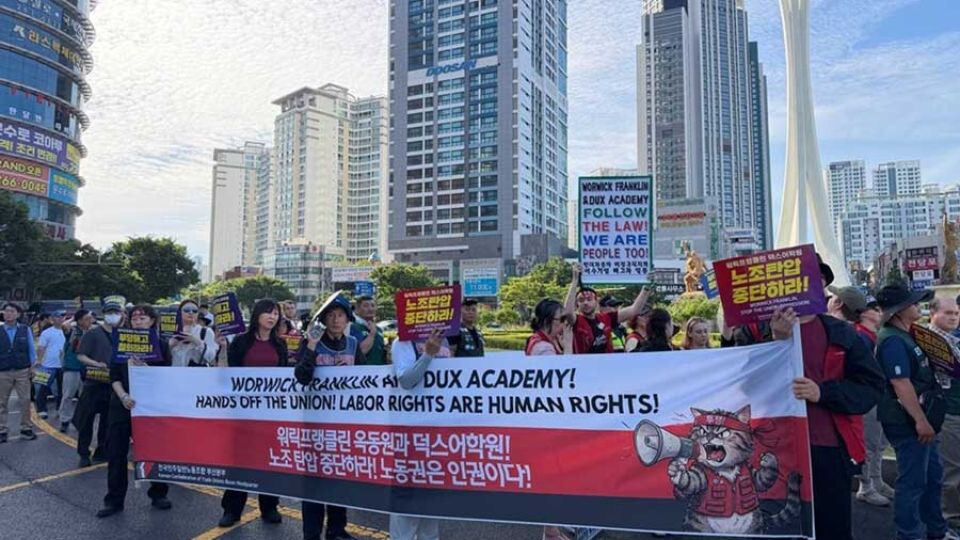
SEOUL – A group of native English teachers in Ulsan suffered a setback in a labor dispute with their former employers after a regional labor panel rejected their claims that they lost their jobs for organizing a labor union.
The Ulsan Regional Labor Relations Commission on Wednesday evening dismissed complaints filed by former teachers at the Ulsan branches of English academy chains Dux and Warwick Franklin in Nam-gu.
The teachers alleged that their contracts were not renewed in retaliation for efforts to form a labor union affiliated with the Korean Confederation of Trade Unions.
The academies argued that the teachers’ contracts had simply expired, saying the instructors were employed on one-year contracts subject to renewal.
The teachers, however, maintained that the nonrenewals were arbitrary and amounted to dismissals.
They also argued that some of them should have been regarded as indefinite-term employees under Korea’s Act on the Protection of Fixed-term and Part-time Employees, which generally grants such status to workers employed by the same company for more than two years.
“We had hoped that we could win, as the atmosphere we felt during meetings with the panel was positive,” said Bae Seong-min, secretary-general of the Korea General League of Unions Busan, a KCTU affiliate that supported the teachers.
“I suspect previous court rulings that excluded holders of work-linked visas from protection under the two-year rule may have influenced the decision.”
Five E-2 visa holders lost their jobs following the unionization effort, and four of them joined the labor commission case. Filing a complaint with a labor relations commission is generally a prerequisite before taking a labor dispute to court in Korea.
The dispute points to long-standing controversy over foreign workers on visas tied to specific employers.
Korean nationals and holders of residence visas, such as F-2 long-term resident and F-5 permanent resident visas, have been recognized as eligible for protection under the two-year rule.
However, courts and labor authorities have been reluctant to apply the same standard to workers whose legal status is directly linked to their employment, including holders of E-9 and E-7 visas, who make up a growing share of Korea’s workforce.
Labor advocates argue that such arrangements leave foreign workers with fewer practical protections in the workplace, as losing a job can also jeopardize their right to remain in the country.
The teachers said collective bargaining was one of the few ways to address that imbalance. They also claimed they were unable to join an existing union of Korean teachers at the academies despite making inquiries.
The academies rejected the allegations, saying employment matters were handled lawfully through labor law specialists and that personnel decisions reflected individual performance evaluations.
Of the four teachers, three have since found jobs at other academies, but they plan to appeal the ruling to the National Labor Relations Commission and, if necessary, pursue the matter in court, Bae said.
They argue that the situation should be rectified, as foreign instructors are denied labor protections afforded to their Korean colleagues despite performing the same work.
“Foreign workers possess the same inherent needs as any Korean citizen: a secure home, a stable community and a reliable income to provide for our children,” said Nico Bekke, a member of KGLU’s Foreign Education Branch, speaking on behalf of the affected teachers.
“We demand nothing less than the absolute equality we have rightfully earned.”