

December 8, 2025
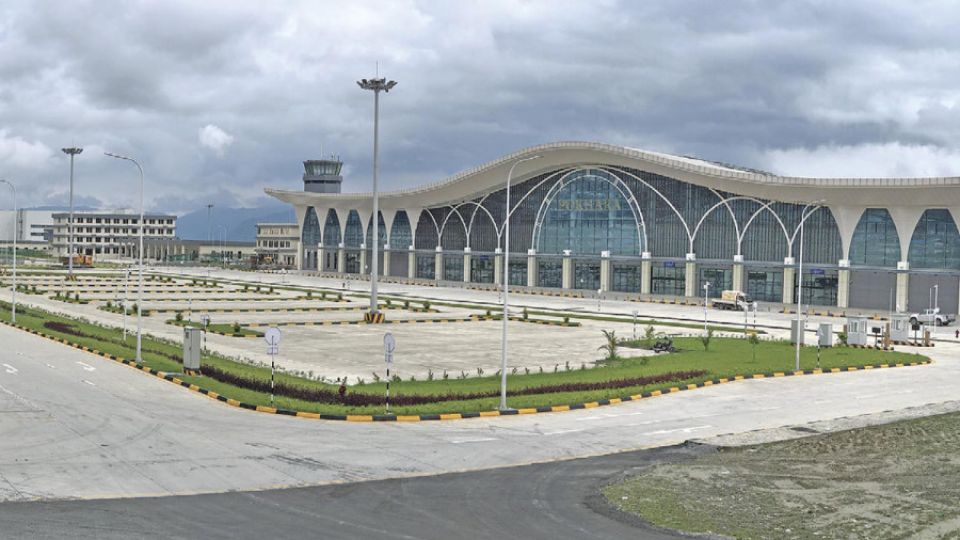
KATHMANDU – Nepal’s anti-graft body on Sunday filed a corruption case at the Special Court against 55 individuals, including five former ministers and 10 former secretaries, as well as a company over irregularities in the construction of the $215.96 million China-funded international airport project in Pokhara.
According to the court, this is the biggest corruption case filed at the Special Court in terms of the cash involved under a state procurement process.
The anti-corruption body has determined Rs8.36 billion to be recovered from each of the 56 defendants, the largest financial penalty. The final sentencing, however, will be determined by the court.
“They [all 55 individuals and the company] revised the approved cost estimate of the airport with malicious intent, inflated the estimate abnormally, and made excessive payments accordingly. The total loss of $74.34 million is equivalent, at the Nepal Rastra Bank exchange rate of Rs112.55 per USD on August 10, 2018, to Rs8.36 billion,” reads the charge sheet filed by the Commission for Investigation of Abuse of Authority, the anti-graft body.
“Evidence establishes that there was corruption,” reads the charge sheet filed at the Special Court, a court designated to oversee public corruption cases.
“The anti-graft body has formally filed the charge sheet in the court on Sunday,” said Yagya Raj Regmi, the court’s information officer. “Now, formal proceedings will begin.”
The airport, the gateway to the Annapurna Circuit, the world’s famous trekking destination, came into operation in January 2023 but has not received any scheduled international passenger flight to date.
Before Sunday’s charge sheet, the anti-graft body last week filed a separate corruption case against Nepal’s civil aviation chief, Pradeep Adhikari, over his alleged involvement in the construction of a heliport in Nalinchowk, Bhaktapur.
The anti-graft authority said three separate investigations are currently underway related to the Pokhara airport case.
Last December, the Special Court convicted 11 individuals, including four top Nepali officials, in a 2017 corruption case involving the purchase of two Airbus A330s.
This suggests deep-rooted corruption in tourism and civil aviation, which are among the major drivers of Nepal’s economy. Nepal’s aviation sector is under global scrutiny due to recurring crashes that have claimed hundreds of lives. Experts say the crashes stem from persistent corruption such as constructing airports without conducting proper studies and operating them without ensuring sufficient safety measures and essential resources.
How the scam unfolded
In the making since 1975, the Pokhara international airport project has been bogged down by public pressure, shady deals, questionable contracts, and the Covid crisis. Construction began when the country’s chronic political instability had reached its peak.
The project was bankrolled by China, and from the outset, the construction company China CAMC Engineering Co [which has secured multiple projects in Nepal including the Pokhara airport, a national pride project] acted with malafide intent to secure and influence the project, the charge sheet reads.
The airport site selection, detailed engineering work, and master plan of the New Pokhara Airport were prepared in 1971 by DIWI, a German consulting engineering firm, under an Asian Development Bank loan for Nepal’s Airport Development Project.
In 1975, the government acquired more than 3,106 ropani (158.01 hectares) of land to build the airport.
JICA reviewed DIWI’s master plan in 1988 and the then Department of Civil Aviation, now the Civil Aviation Authority of Nepal, conducted a detailed engineering survey in 1993.
With the decade-long Maoist insurgency—which began in 1996, the same year Pokhara’s luxury property Fulbari Resort opened—escalated, the hospitality sector in Pokhara suffered serious setbacks, and the airport project halted. Following the end of the insurgency, locals in Pokhara renewed demands for its construction.
In 2009, the elected Maoist government led by Pushpa Kamal Dahal gave the go-ahead for the airport. The project remained dormant until 2011, when it was revived through a deal reached behind closed doors.
In 2011, then finance minister Barsha Man Pun of the Maoist party was found to have secretly signed a memorandum of understanding with China CAMC Engineering Co, committing to support the firm in securing the construction contract.
This secret deal surfaced after Nepali Congress leader Deep Kumar Upadhyay circulated the MoU during a meeting of the parliament’s Public Accounts Committee, which then summoned Tourism Ministry and aviation authority officials regarding the unusually short bidding deadline.
The MoU stated that “the government of Nepal shall provide CAMC solid and substantial support” in a tender that the Civil Aviation Authority of Nepal would issue for an engineering, procurement, and construction (EPC) contract for the regional international airport.
The MoU was signed by Minister Pun and Lui Shengcheng, regional general manager of CAMC. The deal was inked on September 20, 2011, at the Ministry of Finance in Singha Durbar.
The then energy minister, late Post Bahadur Bogati, and Chinese Ambassador Yang Houlan were present as witnesses. Following the signing, the Finance Ministry instructed the aviation authority to invite bids. But the project stalled following the revelation of the secret deal involving Pun. Pun was forced to scrap the controversial MoU.
As the project became increasingly controversial, Pokhara residents again staged protests. Several hundred demonstrators from the lake city marched to Singha Durbar demanding that construction of the long-delayed regional international airport begin immediately.
They picketed the government complex for over two hours, urging authorities to revive the project stuck since 1975.
Then, on February 9, 2012, the aviation authority invited fresh bids for the airport. Although it was a global tender, the condition was that the airport was to be constructed under the EPC model, or turnkey model. This condition, effectively, gave Chinese contractors a clear edge, according to top officials at the civil aviation body.
On July 18 of that year, the tender evaluation committee opened the financial proposals.
Unexpectedly, the lowest bidder—China CAMC—quoted a price of $305 million, which was way higher than the government’s estimate of $169.69 million. The government had at the time planned to borrow $145 million or more in soft loans to finance the airport. This amount was pledged by Beijing from the surplus of the loan it had originally allocated for the Trishuli 3A Hydropower Project, the first EPC project in Nepal.
The other bidders—Sinohydro Corporation and China International Water and Electric Corporation—quoted prices of $337.82 million and $349.28 million, respectively.
But the project got embroiled in controversy again after the labour unions at the Civil Aviation Authority Nepal launched a protest citing excessive cost, arguing it was not financially viable.
Notably, all three proposals, among nine bidders, were from contractors approved by the Chinese Exim Bank. The bank had written to Nepal’s finance ministry that it would release the loan only to its approved bidders.
Following the unusual proposals, the anti-graft body seized tender documents on suspicion of financial irregularities. The constitutional body, however, shelved the case for years.
The project stalled again, and officials from Kathmandu and Beijing began holding regular meetings.
In January 2013, CAMC wrote to Nepal’s Tourism Ministry expressing willingness to build the project at the government-estimated cost.
But matters became even more complicated when China Airport Construction Company, a consultant hired by CAMC, submitted another study pegging the cost at $264 million. With a 16 percent price escalation and 13 percent VAT, the total would reach nearly $300 million—almost matching CAMC’s original bid.
Public outrage peaked when Pokhara residents launched a relay hunger strike in 2013 that lasted more than 100 days.
On April 7, 2014, the Civil Aviation Authority board—chaired by then tourism minister Bhim Acharya—approved the project at a revised cost of $215.96 million.
This estimate was recommended by a four-member independent panel headed by former Supreme Court registrar Ram Krishna Timalsena.
In May 2014, civil aviation chief Ratish Chandra Lal Suman and CAMC Chairman Lou Yan signed the $215.96 million contract.
The soft loan agreement was signed during then prime minister KP Sharma Oli’s Beijing visit in March 2016. He laid the foundation to commence the construction in April 2016. CAMC began work at the site on November 1, 2017, and the first tranche of the loan disbursement was made on April 1, 2018.
Under the agreement, Nepal would receive the loan from China EXIM Bank, of which 25 percent would be interest-free. Interest on the remaining amount was set at 2 percent annually. The repayment period was set at 20 years, including a seven-year grace period.
The charge sheet states that Prof Dr Rabindra Nath Shrestha, Associate Professor Santosh Kumar Shrestha, and Associate Professor Surya Gyawali, in collusion with officials at the Civil Aviation Authority, the tourism and finance ministries, and CAMC, were appointed through a public institution as committee members.
Despite their long experience and expertise at the TU Institute of Engineering, Pulchowk, they misused their reputation, position, and authority while receiving payment from the state treasury, according to the charge sheet.
“With malicious intent, they issued a recommendation containing an incorrect report stating that the construction cost of the Pokhara airport would be $230.06 million, contrary to the Public Procurement Act, Public Procurement Regulations, the Civil Aviation Authority of Nepal Act, and other applicable laws,” the charge sheet states.
Although Associate Professors Shrestha and Gyawali admitted to investigators that they were instructed to deliver the report within a short time and lacked the opportunity to study relevant documents, the charge sheet says: “The review report submitted by the team is against procurement law and clearly prepared in favour of China CAMC Engineering Co Ltd and other public-official defendants. The recommendation was made with malicious intent, in collusion with CAMC and public officials, to artificially inflate the project cost and thereby facilitate illegal benefits, exchanges of interests, and compensatory arrangements.”
Individuals known in the academic community abused their reputation as a shield against future legal consequences.
“It has been confirmed that the committee was formed and used to produce a favourable recommendation with bad intention,” the anti-corruption agency said.
On October 20, 2014, a meeting was held at the office of then-finance minister Ram Sharan Mahat, involving the finance minister, then-secretaries Suman Prasad Sharma of the finance ministry, Bhesh Raj Sharma of the ministry of law, acting tourism secretary Mohan Krishna Sapkota, then-joint secretary Madhu Kumar Marasini of the finance ministry, under secretary Hari Bahadur Khadka at the tourism ministry, and under secretaries Lal Bahadur Khatri and Prem Upadhyaya, section officer Kamal Kumar Bhattarai, and then civil aviation director general Ratish Chandra Lal Suman.
“Based on a bad-faith decision, the meeting concluded that the tourism ministry had submitted to the Cabinet a proposal for approval of the project at the revised cost of $215.965 million,” the charge sheet claimed.
To implement the contract, finance ministry officials Kamal Kumar Bhattarai, Lal Bahadur Khatri, Madhu Kumar Marasini, Secretary Suman Prasad Sharma, and Minister Mahat decided on October 31, 2014 to seek loan assistance from China EXIM Bank and accordingly submitted the loan application.
As a result, the contract for the airport was implemented at an abnormally high cost, the anti-graft body concluded in its investigation.
Between August 2018 and February 2024, a total of $224.77 million (equivalent to RMB 1.41 billion, including VAT) was paid to CAMC. Of this, $74.34 million was paid based on artificially inflated cost estimates and excessive valuation, benefiting the defendants and causing wrongful payment to the contractor.
According to the charge sheet, defendants include former tourism ministers Post Bahadur Bogati, Bhim Prasad Acharya, Ram Kumar Shrestha, and Deepak Chandra Amatya, and former finance minister Mahat.
Other defendants include Lok Bahadur Khatri, Manrup Shahi, Jyoti Adhikari, Manoj Karki, Phurba Chiring Sherpa, Tri Ratna Manandhar, Ranjan Krishna Aryal, Surya Prasad Acharya, Suresh Man Shrestha, Suresh Acharya, Muktinarayan Paudel, Madan Kharel, Hari Bahadur Khadka, Sushil Ghimire, Ratish Chandra Lal Suman, Ram Krishna Timalsena, Purushottam Dangol, Vinod Ananda Chaudhary, Suman Kumar Shrestha, Roshan Chitrakar, Rishikesh Sharma, Narayan Giri, Mahesh Kumar Basnet, Baburam Paudel, Ashok Kumar Subedi, Murari Bhandari, Suvarna Raj Upadhyay, Kul Prasad Sinkhada, and Hansaraj Pandey.
Similarly, the charge sheet has been filed against Pradeep Adhikari, Pratap Babu Tiwari, Punya Raj Shakya, Rudra Prasad Fuyal, Ram Chandra Subedi, Mukunda Prasad Bhandari, Dhruba Das Bhochhibhoya, Ganga Sagar Man Shrestha, Dwarika Prasad Bhattarai, Prof Dr Rabindranath Shrestha, Associate Professor Santosh Kumar Shrestha, Associate Professor Surya Gyawali, Suman Prasad Sharma, Bheshraj Sharma, Mohan Krishna Sapkota, Madhu Kumar Marasini, Lal Bahadur Khatri, Prem Upadhyaya, Kamal Kumar Bhattarai, and China CAMC Engineering Co. Ltd—with Chairman Wang Bo and Regional General Manager Liu Shengcheng implicated.
“These officials colluded in evaluating a technically baseless and financially overpriced bid from China CAMC Engineering Co Ltd. They illegally negotiated, formed advisory groups twice [on September 12, 2013, and September 9, 2014] despite no provision for such bodies in the Public Procurement Act,” the charge sheet states.
“They used the committee’s recommendations as a pretext to justify accepting an abnormally inflated contract of $244.04 million (including 3 percent contingency and 13 percent VAT), far above the previously approved $169.69 million,” according to the charge sheet.
The anti-corruption body concluded that the decision was made with wrongful intent and motives of corruption. “Despite a large discrepancy in the cost estimates, the civil aviation body and other decision-makers negotiated in violation of procurement laws and approved a contract that added more than $70 million—confirming irregularities.”