

July 22, 2026
KATHMANDU – Several lawmakers have proposed significantly tightening the qualifications required to climb Mount Everest as Nepal’s Integrated Tourism Bill enters a parliamentary committee for clause-by-clause scrutiny.
A total of 58 lawmakers have registered 263 amendments to the bill before it returns to Parliament for final debate and voting.
Although the proposals differ in detail, they share a common objective: requiring climbers to prove their experience on lower peaks before being allowed to attempt the world’s highest mountain.
Lawmakers Shishir Khadka and Nitima Bhandari Karki have proposed issuing Everest permits only to climbers who have successfully climbed at least one mountain above 7,000 metres and two mountains above 8,000 metres in Nepal.
They have also proposed that all commercial mountaineering activities, expedition promotion and marketing, and the sale of expedition packages be carried out only through trekking agencies registered and licensed in Nepal.
“Foreign companies shall not be permitted to directly sell or operate such expeditions or packages,” their proposed amendment states.
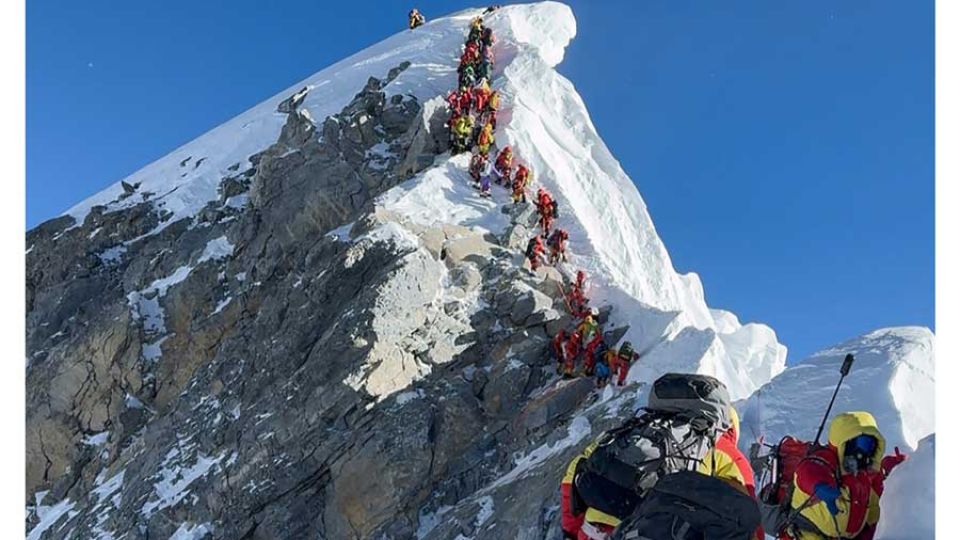
The lawmakers have further proposed that the government determine the carrying capacity of each mountain before opening it for climbing.
“When opening any mountain in Nepal for climbing, the government shall determine the maximum number of climbers permitted on each mountain during every climbing season after considering the mountain’s physical carrying capacity, favourable weather windows, and the level of congestion likely to occur,” the proposal says.
It also recommends auctioning climbing permits within the prescribed quota by setting a minimum price and awarding the permits to the highest bidders.
Lawmaker Ganesh Karki has proposed that Everest permits be issued only after applicants provide documentary proof of successfully climbing at least one mountain above 7,000 metres and one above 8,000 metres in Nepal.
Similarly, lawmaker Ganesh Bahadur Bishwakarma has proposed mandatory mountaineering training and medical certification for all applicants. Climbers would have to submit certificates from recognised mountaineering training institutions and a government-recognised health facility, based on a medical examination conducted within one month of the application.
Bishwakarma has also proposed requiring proof of a successful ascent of at least one mountain above 7,000 metres in Nepal before an Everest permit is issued.
Lawmaker Dhananjaya Regmi has proposed that climbers seeking permits for mountains above 8,000 metres first demonstrate successful ascents of at least two peaks above 6,000 metres and one above 7,000 metres in Nepal.
Several lawmakers have also proposed that climbing permits for any 8,000-metre peak, not just Everest, be issued only after applicants successfully climb at least one mountain above 7,000 metres in Nepal.
Another proposal recommends that all climbers and expedition members complete the full acclimatisation process within Nepal before attempting a summit.
Lawmaker Bodha Narayan Shrestha has proposed that government-appointed liaison officers be provided salaries, allowances, accommodation, food and other benefits by the state. Currently, these costs are borne by expedition teams.
Lawmakers have also proposed allocating designated plots for base camps and higher camps and allowing camps to be established only in approved areas.
Another amendment seeks to establish integrated check posts for mountaineering management, headed by a Nepali Army officer and staffed by representatives of relevant government agencies. Liaison officers would be deployed at these posts in sufficient numbers to monitor climbing activities and would be required to reside there.
Adventure tourism activities such as paragliding, skydiving, heli-skiing and ultralight flying during climbing expeditions would be permitted only on mountains below 6,000 metres.
The proposals also call for the creation of a permanent Tourism Crisis Management and Recovery Fund to support the tourism industry during pandemics, natural disasters and other crises. The fund would provide wage support for tourism workers, concessional refinancing and soft loans, with a fixed percentage of tourism taxes or royalties earmarked for the fund.
Lawmakers have proposed that all personnel involved in mountaineering operations—including Sirdars, mountain guides, climbing support staff, cooks, videographers and photographers—must be Nepali citizens.
They also propose that taxes be deducted at source from workers’ wages, deposited against their permanent account numbers (PAN), and that all payments be made through Nepali banks.
Above base camp, climbing support workers would be prohibited from carrying more than 20 kilograms of equipment or supplies.
The proposals also guarantee that Sirdars, mountain guides and climbing support workers may refuse to continue an expedition if weather conditions become hazardous, their health deteriorates, or their safety is at risk. Workers exercising this right would be protected from wage deductions, dismissal or other employment-related penalties.
Insurance requirements would also be significantly strengthened. The proposals call for a mandatory cashless medical and rescue insurance scheme meeting international standards.
Insurance coverage for climbing support workers, Sirdars and mountain guides would be based on prevailing market values and occupational risks, with minimum coverage of Rs50 million in the event of death, Rs20 million for medical treatment and Rs10 million for search and rescue. Parliament would review these coverage amounts every three years.
Every expedition would also be required to obtain insurance from a licensed Nepali insurer covering personal accidents, medical treatment, search and rescue, and the management and transportation of mortal remains.
Environmental provisions include a ban on single-use plastics in all mountaineering areas and the implementation of a zero-waste policy for both biodegradable and non-biodegradable waste.
Under another proposal, every expedition team would be required to digitally track or QR-code every item carried onto the mountain, record all equipment transported above base camp, and weigh and certify all equipment and human waste brought back before returning it to base camp.
The amendments also propose banning drones and helicopters above 6,000 metres without prior government approval, except for national security or other authorised purposes.
No Sirdar, mountain guide, high-altitude worker or base camp worker would be allowed to accompany an expedition unless they are members of a recognised mountaineering association.
Lawmakers have also proposed making licensed guides mandatory on designated high-risk, protected, Himalayan and remote trekking routes, including climbing expeditions.
The bill also seeks tighter regulation of digital tourism platforms. Under the proposal, all online tourism service providers offering booking, marketing, listing or facilitation services in Nepal would be required to register with the Department of Tourism.
Foreign digital tourism platforms operating in Nepal would have to appoint a local representative, register for tax, set up a consumer grievance mechanism, and regularly submit business reports. Licensed Nepali tourism service providers could be barred from using unregistered digital platforms.
The National Assembly passed the Integrated Tourism Bill on February 9. The legislation aims to diversify and systematically regulate Nepal’s tourism sector while strengthening safety, environmental and governance standards in mountaineering.