

December 11, 2025
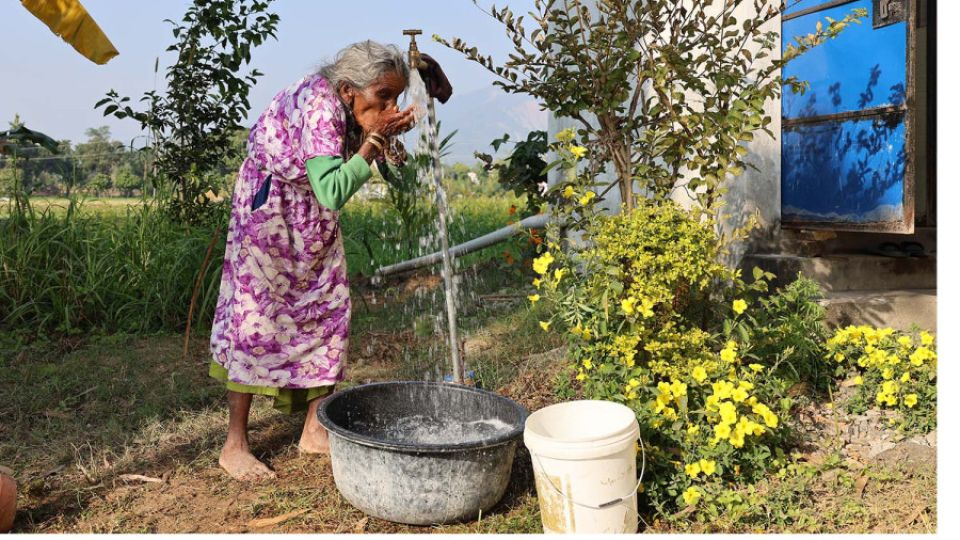
KANCHANPUR – For 74-year-old Kanti Das of Radhakrishna Tole in Bhimdutta Municipality, life has taken a turn she once believed impossible. Since October, each morning now begins with a simple pleasure: twisting the tap outside her home and watching clear, treated water gush out.
For someone who has spent four decades in this village in farwestern Nepal, the past few weeks feel nothing short of miraculous. She can bathe when she wishes, wash clothes without setting aside an entire day, feed her cattle with ease, and drink without fear.
Das still remembers the years when water dictated every hour of her life. “Until two decades ago, there was no water in our village,” she says, recalling the exhausting routine of walking nearly four hours every day to fetch two gagri (mud or copper pot) of water.
She and other women balanced the pots in a bamboo doko basket strapped to their backs, often making two trips a day. “Bringing water twice a day used to consume the whole day. Life was difficult. Really difficult.”
Migration from the hills to the plains was common in her part of the country. Families from Darchula, Achham, and Baitadi—districts that consistently rank among the lowest on the human development index—moved to Kailali and Kanchanpur in search of opportunity. But the Tarai, despite its flat land and warmer climate, offered no relief from water woes.
“We even installed a tubewell, but water didn’t come,” locals say.
Groundwater was hard to access; people dug 80 to 90 feet without success. And for families dependent on seasonal farm work or daily wages, drilling deeper was not an option.
Bathing became a monthly or weekly ritual.
Every Saturday, villagers walked to a nearby river with soaps and detergents. The riverbank turned into a chaotic wash station—people bathing, clothes soaking, cattle wandering, and open defecation taking place nearby. During the monsoon, waste from toilets in uphill settlements flowed into the river. Yet this same water was used for bathing, washing, and even drinking.
Things improved slightly 18 years ago when the then village development committee laid pipes from a water tank in Tilachaur. But the supply was irregular and poorly maintained. Water came twice a week at best; during repairs, taps stayed dry for weeks. People frequently fell sick with diarrhoea and other waterborne diseases, and the aging system soon buckled under rising demand as the population grew.
Access to clean and safe water has long been a pressing issue in Nepal—and the right to such water is more than a development target; it is a recognised human right.
Access to safe, affordable, and reliable water and sanitation services is essential for sustaining healthy livelihoods.
74-year-old Kanti Das of Radhakrishna Tole in Bhimdutta Municipality tests water at her newly installed tap. PHOTO: THE KATHMANDU POST
In 2010, the United Nations General Assembly explicitly recognised the right to safe drinking water and sanitation as essential to the realisation of all human rights. Five years later, the UN enshrined clean water and sanitation as Sustainable Development Goal 6, aiming for universal and equitable access by 2030.
Nepal echoes this commitment domestically. The Constitution guarantees access to clean water as a fundamental right, placing a constitutional responsibility on the state to ensure it.
Yet achieving this remains challenging.
Rural communities like Radhakrishna Tole have long depended on rivers, streams and unprotected wells. Traditional purification methods such as boiling were known but rarely practised. Despite the country’s abundant water sources, geography, poor infrastructure, pollution, and unplanned urbanisation have left millions vulnerable.
The 2021 National Population and Housing Census shows tap or piped water is the main source for 57 percent of households. But safely managed drinking water—clean, reliable and accessible—has declined from 24 percent two decades ago to just 16 percent today.
Waterborne illnesses such as cholera, typhoid and dysentery remain widespread, especially in remote regions.
Against this backdrop, the transformation in Radhakrishna Tole is striking.
A towering 450,000-litre vertical tank now stands above the settlement, delivering treated water to 1,400 households in wards 6 and 7 of Bhimdutta Municipality.
The Purnagiri Urban Water Supply and Sanitation Project—financed by the government and the Asian Development Bank—began in March 2022 and was completed in October this year. It is part of a broader initiative launched after Nepal and ADB signed a loan agreement in 2018 to strengthen water supply and sanitation in small towns nationwide.
The programme aims to establish or rehabilitate water supply infrastructure in 20 subprojects across 19 municipalities, including the installation or restoration of 2,000 kilometres of pipelines. It will build 20 water treatment plants, each with an estimated capacity of at least 0.6 million litres per day, and expand piped water connections to 60,000 households, including 6,000 subsidised connections for poor and vulnerable families—among them all poor households headed by women.
In sanitation, the project seeks improvements across 21 municipalities by constructing 2,500 toilets for poor and vulnerable households through output-based aid; building 16 sex-segregated, disability-inclusive public toilets with proper wash facilities and septic tanks; establishing two decentralised wastewater treatment plants; and developing 30 kilometres of stormwater drainage.
Ultimately, these interventions are expected to enable 320,000 people in participating municipalities to access 24/7 piped water supply at 100 litres per person per day that meets national drinking water quality standards, while 64,000 people will gain access to improved sanitation.
In Radhakrishna Tole alone, the new system is designed to serve nearly 28,600 people.
Subas Raj Panta, project coordinator from the Town Development Fund—a government financial intermediary created under the Town Development Fund Act of 1997—says community participation has been key to the system’s success.
“Water users contributed 5 percent in the initial phase. This model creates a sense of ownership,” he says. For long-term sustainability, households now pay water fees based on consumption: Rs200 for 6,000 litres, plus Rs40 for every additional 1,000 litres.
The Town Development Fund provides up to 25 percent of civil works costs for water supply subprojects to water users’ associations or municipalities and facilitates user contributions—25 percent through Town Development Fund loans and 5 percent through upfront payments.
The government provided 70 percent of the funding.
Scepticism has gradually eased.
Devendra Dhungana, chair of the Purnagiri Water Supply and Sanitation Users’ Committee in ward 7 of Bhimdutta Municipality, admits he did not believe abundant, treated water would ever reach their homes. “Water is life, and we had no access to treated water until October,” he says. “We contributed Rs7,500 before the project started. There was a slight tussle as the tender wasn’t called on time, but now the project is complete. We are happy.”
The Asian Water Development Outlook 2025, released on Monday, says that despite Nepal’s abundant water resources, only about 25 percent of the population has access to fully functional drinking water systems.
Nepal faces a paradox of abundance and scarcity: plentiful natural water, yet persistent shortages, contamination and destructive floods.
Urban areas are under increasing strain, with populations growing at over 4.5 percent annually. In cities like Kathmandu, water is supplied intermittently—typically for just three to four hours every alternate day.
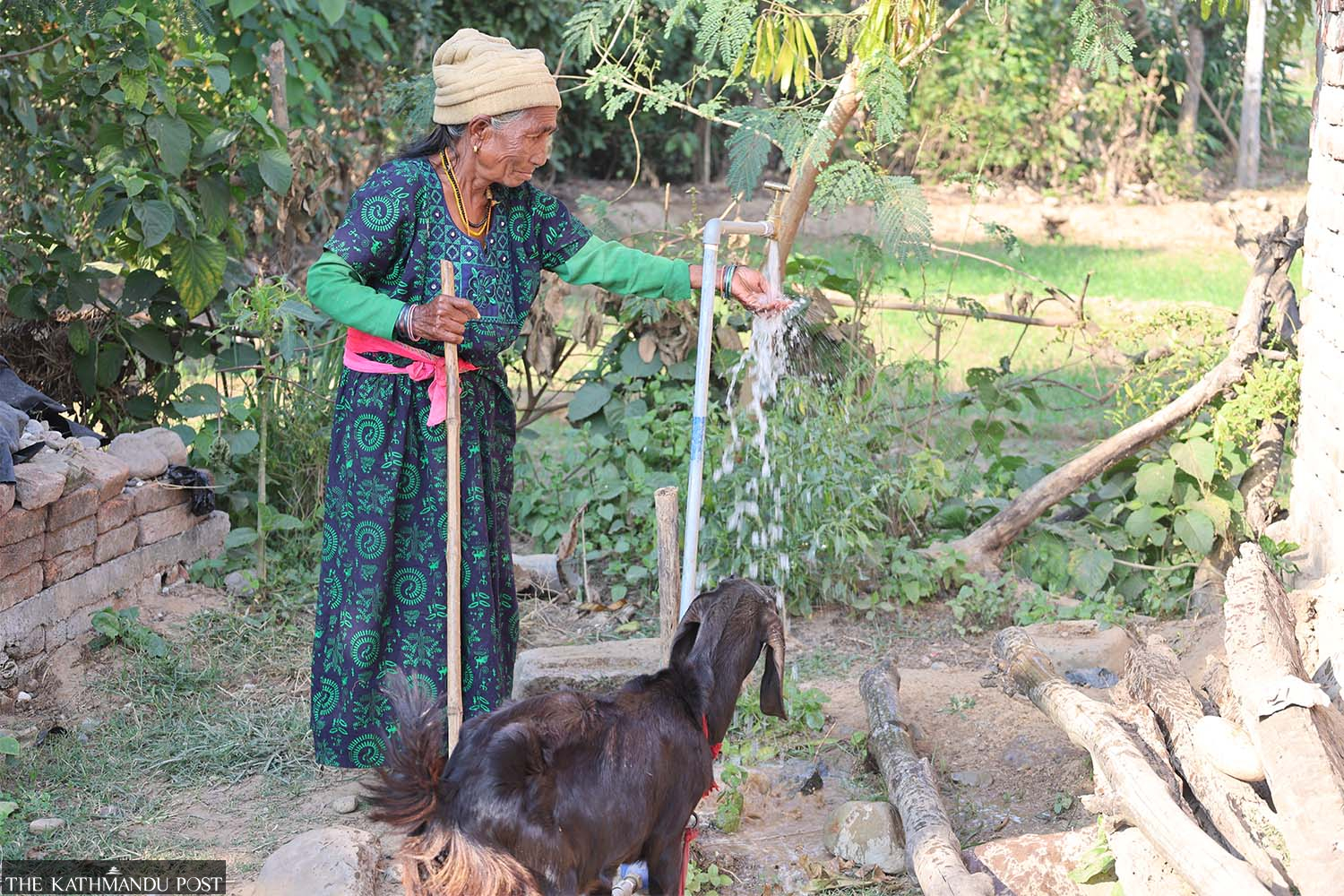
For 82-year-old Devi Bhandari of Radhakrishna Tole, the change is transformative.
Standing by a newly installed tap, feeding water to her cattle from a small bucket, she moves slowly but with unmistakable satisfaction. “We were totally dependent on rainfall and rivers,” she says. “In the early days, we even collected water in tree bark.”
Having migrated from Bajhang more than five decades ago, she remembers when no one in the village knew water even needed to be treated.
Many rural communities relying on springs and groundwater now face growing hardship, with some households forced to migrate as local sources dry up, the ADB report warns. Such losses threaten livelihoods, cultural heritage and social stability. It calls for integrated watershed management, reforestation and protection of groundwater recharge zones.
“Rapid urban growth and internal migration have created unprecedented demand for reliable water and sanitation services in Nepal. While cities and towns are expanding, many households still lack access to safe water, putting health and well-being at risk,” says Arnaud Cauchois, ADB Country Director for Nepal.
“We have supported the Nepal government in delivering clean water and sanitation across 19 municipalities and strengthening local capacity for sustainable service delivery. Seeing water flow into homes in some of Nepal’s most remote areas and transform daily life for the people who need it most is deeply gratifying.”
After decades of hardship, Bhandari is relieved. She drinks from her tap without hesitation. “We can also give this water to our cattle,” she told the Post proudly.
Still, challenges remain. Demand for the new system is lower than anticipated because many working-age residents spend most of the year in India. Some households continue to borrow water from neighbours. Others remain unconvinced about the importance of safe drinking water.
Awareness, affordability and behavioural change remain obstacles.
But for older residents like Das and Bhandari, who spent most of their lives struggling for water, the change is life-altering. Where they once calculated every drop, they now plan their days more freely. Water no longer dictates their lives; it sustains them.
The steady stream flowing from their taps is more than convenient.
“Today, we can bathe daily in our home, which was a monthly affair before,” Das says, standing beside the tap in her front yard.