

April 28, 2026
SEOUL – North Korea and Russia could be moving to formalize a five-year military cooperation plan, a step analysts view as a potential sign of a shift toward a more institutionalized alliance involving arms, technology transfers, joint training and personnel exchanges.
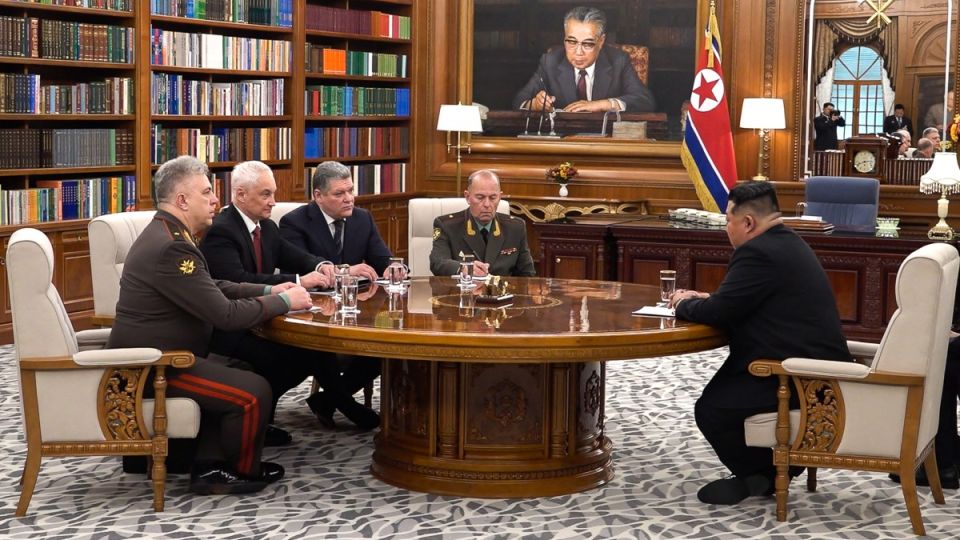
Russian Defense Minister Andrei Belousov told North Korean leader Kim Jong-un during talks in Pyongyang that Moscow is prepared to sign a “Russian-Korean military cooperation plan for the 2027-2031 period” this year, according to Russia’s state-run Tass news agency Sunday.
“We have reached an agreement with the DPRK Defense Ministry to place our military cooperation on a sustainable, long-term footing,” Belousov was quoted as saying, referring to North Korea by its official name, the Democratic People’s Republic of Korea.
The remarks came as Belousov and Vyacheslav Volodin, speaker of Russia’s State Duma, visited Pyongyang to attend the opening ceremony of a memorial honoring North Korean troops killed while fighting alongside Russia in its war against Ukraine.
Belousov arrived in Pyongyang on Sunday and departed the following day, while State Duma Speaker Vyacheslav Volodin arrived a day earlier and attended events over the weekend, according to reports.
Lim Eul-chul, a professor at Kyungnam University’s Institute for Far Eastern Studies, said the development shows North Korea and Russia are evolving beyond a “transactional partnership based on necessity” into a “long-term blood alliance” tied to their shared strategic interests.
He said Belousov’s proposed five-year plan appears to be “a move aimed at preparing for the post-Ukraine war period.”
“It suggests the possibility that North Korea and Russia could enter a stage of ‘institutional alliance,’ in which cooperation and integration across all sectors accelerate even after the war ends,” Lim said.
Lim added that the plan could include technology transfers, joint production, regularized military exercises and supply chain integration, drawing comparisons to Russia’s long-term military cooperation frameworks with countries such as Belarus and India.
“Such cooperation could extend beyond arms transfers to include technology sharing, joint production, regularized military drills and supply chain integration,” he explained.
Lim warned that over five years, North Korea could significantly modernize its conventional weapons while advancing satellite, nuclear-powered submarine and next-generation missile technologies, posing a greater security threat to South Korea.
South Korea’s Unification Ministry said Monday it was closely monitoring the development, noting that there appear to have been no previous cases of mid- to long-term military cooperation of this kind between North Korea and Russia.
The military cooperation between the two countries appears to be “becoming increasingly close and more firmly established,” Unification Ministry spokesperson Yoon Min-ho said during a regular briefing.
North Korea’s state media, however, has yet to address the specific details of Kim’s meeting with Belousov, including the five-year military cooperation proposal.
According to the Korean Central News Agency on Monday, Kim met Belousov on Sunday and exchanged greetings for Russian President Vladimir Putin. Kim expressed appreciation for Belousov’s visit “on behalf of the military leadership of the Russian Federation,” saying it added political significance to the memorial’s opening.
The KCNA said the two sides exchanged views on “daily-aggravating international and regional situations” and discussed “a series of issues for further consolidating and developing the political and military cooperation and assistance between the two countries.”
Kim also reaffirmed Pyongyang’s support for Moscow’s war, saying North Korea would “as ever fully support” Russia’s policy to defend its “national sovereignty, territorial integrity and security interests.”
The proposed five-year plan has drawn attention, as it suggests the two countries are seeking to move beyond short-term wartime cooperation and place their military relationship on a more structured, long-term footing.
The move can be seen as another step in expanding military cooperation following the signing of a comprehensive strategic partnership treaty between North Korea and Russia in 2024. Under the agreement, the two sides committed to providing mutual assistance, including military support, should either country be attacked.
The talks followed the opening of the Memorial Museum of Combat Feats at the Overseas Military Operations in Pyongyang, held on the first anniversary of what North Korea and Russia call the liberation of Russia’s Kursk region from Ukrainian forces.
In a speech at the ceremony, Kim said the memorial symbolized ties “forged in blood” between Pyongyang and Moscow.
“No matter how the rules of war change and whenever and wherever a crisis occurs, we should be strengthened into a sincere, dedicated and powerful bulwark with unified power,” Kim was quoted as saying by the KCNA on Monday.
Putin, in a letter conveyed to Kim by Belousov, said the memorial would “undoubtedly be a clear symbol of friendship” between the two countries.
Since 2024, North Korea is believed to have deployed roughly 15,000 troops along with conventional arms to support Russia’s war in Ukraine. South Korea’s intelligence agency has estimated that around 6,000 of those soldiers have been killed or wounded in the conflict.