

May 19, 2026
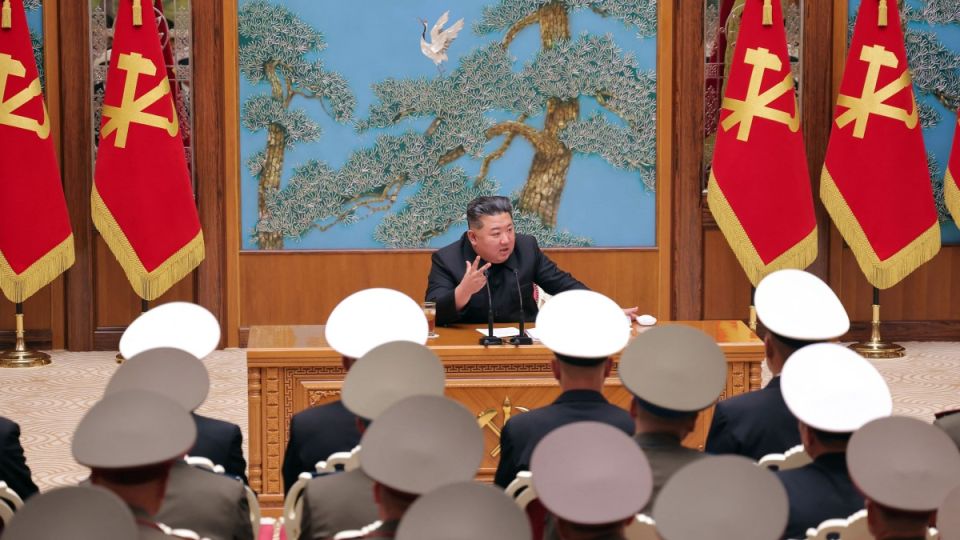
SEOUL – North Korean leader Kim Jong-un convened the first publicly reported meeting of division- and brigade-level commanders since taking power in 2011, state media reported Monday, in a move analysts said signals the start of a broader military restructuring drive tied to Pyongyang’s “two hostile states” policy.
According to the Korean Central News Agency, Kim met Sunday with commanding officers from divisions and brigades across the armed forces, stressing the need to strengthen frontline units along the country’s southern border and adapt to the “changing aspects of modern warfare.
The meeting is believed to be the largest gathering of operational military commanders under Kim’s rule, with analysts estimating attendance at around 180 to 250 officers from the ground, naval, air, strategic and special operations forces.
During the meeting, Kim underscored the importance of modernizing frontline combat units and reaffirmed Pyongyang’s policy of turning the southern border into an “impregnable fortress.”
The North Korean leader said plans were underway to “remodel the military’s organizational structure” and strengthen frontline and other major units in military and technical terms as an “important decision to more thoroughly deter war,” according to KCNA.
Kim also called for reforms to military training systems with greater emphasis on practical exercises suited to “modern warfare,” while stressing that division and brigade commanders bear responsibility for building the world’s “strongest” military.
The report marked the first time North Korean state media disclosed a gathering exclusively involving division- and brigade-level commanders, according to Korea Institute for National Unification senior research fellow Hong Min.
“Divisions and brigades are the frontline units directly responsible for combat execution, unlike corps-level units that mainly handle operational planning,” Hong said.
He said Kim’s references to “organizational measures” and “military organizational restructuring” suggest the main targets of the overhaul are likely division- and brigade-level units tasked with implementing new warfare concepts and weapons systems.
He added that Kim appeared to be directly communicating his intentions to frontline commanders to prevent distortion or delays in implementation during what he described as a transition into the execution phase following North Korea’s 9th Party Congress and recent constitutional revisions, both carried out earlier this year.
The analyst noted that Kim’s references to “modernization of the KPA and progress made in developing the military and technical equipment” and “newly define the concept of operations in all spheres” likely reflected lessons drawn from the wars in Ukraine and the Middle East, including the growing importance of drones, precision strikes, electronic warfare and multidomain operations.
According to Hong, the inclusion of commanders from the navy and strategic forces also suggests Pyongyang is pursuing a broader multidomain operational concept encompassing land, sea, air, underwater, cyber and space domains.
The meeting also marked the first explicit mention of the “southern border” since North Korea revised its constitution earlier this year to include a new territorial clause.
Hong said the language appeared to militarily operationalize the constitutional revision by more clearly defining North Korea’s border concept to include not only the land-based Military Demarcation Line but potentially maritime boundaries such as the Northern Limit Line in the Yellow Sea and sea boundaries in the East Sea.
He added that Kim’s reference to turning the border into an “impregnable fortress” likely points to an expansion of border fortification projects already underway since 2024, including minefields, anti-tank barriers, blocking structures and military roads near the inter-Korean border.
Hong further said Kim’s remarks about “renewing” the Korean People’s Army’s “strategic action preparedness” beyond comparison with the present suggest Pyongyang is pursuing a more integrated and operational nuclear posture.
He linked the comments to defense goals unveiled at the Party Congress in February, including modernization of nuclear command-and-control systems, deployment of new strategic weapons, integration of nuclear delivery platforms and development of multidomain strategic assets.
Hong also pointed to the possibility that combat experience gained through North Korea’s troop deployments to Russia, along with potential Russian technology transfers in areas such as electronic warfare and missile systems, could be feeding into Pyongyang’s military modernization drive.
University of North Korean Studies distinguished professor Yang Moo-jin said the gathering appeared aimed at multiple objectives, including strengthening regime cohesion and military loyalty amid heightened global instability and ongoing conflicts abroad.
Yang said Kim’s push to fortify the southern border appears intended to pressure frontline commanders to enforce the regime’s severance of inter-Korean ties while accelerating deployment of tactical nuclear weapons and new artillery systems near the border.
The moves are also tied to broader military restructuring and weapons redeployment under North Korea’s “two hostile states” framework, he said.
Yang noted that during Kim’s recent visit to key munitions factories on May 6, the North Korean leader ordered the deployment of newly developed 155-millimeter self-propelled howitzers capable of striking Seoul along the southern border within this year.
He added that North Korea earlier replaced commanders of key frontline corps — including the 2nd, 4th and 5th Corps — with officers considered more experienced in modern warfare, moves he said appear connected to the latest military reorganization efforts.
Yang also said Kim’s repeated emphasis on awareness of the “principal enemy” appears aimed at tightening ideological discipline within the military and blocking the inflow of outside information.
Meanwhile, South Korea’s Unification Ministry said the gathering appeared aimed at reinforcing both military modernization efforts and ideological discipline within the armed forces.
“The event also appears intended to boost morale and strengthen cohesion within the military,” ministry spokesperson Yoon Min-ho said during a regular briefing, adding that the government would continue to closely watch related developments.