

April 8, 2026
SEOUL – Kim Yo-jong’s praise of President Lee Jae Myung’s “frank and broad-minded” attitude may ease tensions on the Korean Peninsula, but falls short of signaling any shift toward reconciliation, experts said Tuesday, noting Pyongyang’s commitment to its “two hostile states” doctrine.
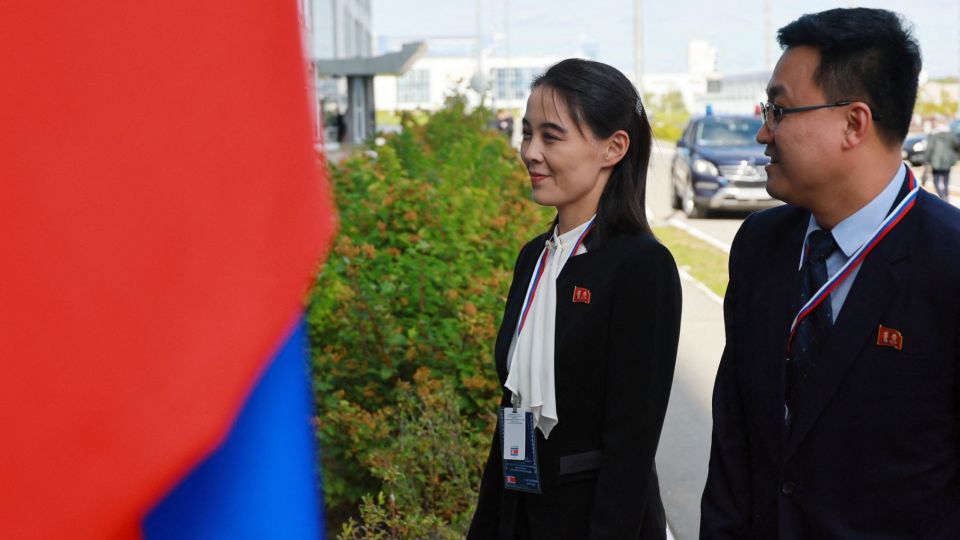
Kim Yo-jong, department director of the Central Committee of the Workers’ Party of Korea and the sister of leader Kim Jong-un, issued a statement Monday via the North’s Korean Central News Agency.
In it, she welcomed Lee’s expression of regret over a drone incident, calling it “very fortunate and wise behavior” and quoting her brother as describing Lee’s response as “a manifestation of a frank and broad-minded man’s attitude.”
The remarks came about 10 hours after Lee expressed regret over unauthorized drone flights into North Korea. His apology followed last week’s indictment of three individuals who allegedly carried out drone incursions into the North between September and January.
Though the measured tone was a departure from Pyongyang’s typically harsh rhetoric, Kim Yo-jong still coupled the remarks with a warning: Seoul should “stop any reckless provocation” and “refrain from any attempt at contact,” she said, underscoring clear limits to any perceived thaw.
Experts say the message from Pyongyang is less about opening dialogue and more about locking in deterrence.
“The statement outwardly accepts President Lee’s expression of regret, but its core objective is to secure binding measures to prevent recurrence and preemptively establish justification for future responses,” said Hong Min, a senior research fellow at the Korea Institute for National Unification.
Hong highlighted what he described as a structured narrative embedded in the statement: South Korea’s wrongdoing, followed by regret, North Korea’s “broad-minded” acceptance and, ultimately, justification for retaliation if similar incidents occur again.
“This effectively locks in South Korea’s responsibility and a commitment to prevent recurrence, while securing legitimacy for future North Korean retaliation,” he said. “By quoting Kim Jong-un directly, the issue is elevated to a leader-to-leader level.”
He also highlighted what he called the statement’s most consequential line — the demand to abandon contact.
“Despite the appearance of acceptance, the most aggressive element is the simultaneous call for preventing recurrence and abandoning attempts to contact (Pyongyang),” Hong said. “It is aimed at preemptively blocking any resumption of inter-Korean dialogue and shutting down attempts to use the apology as a diplomatic opening.”
Since last year, Seoul has repeatedly signaled its willingness to resume dialogue with Pyongyang, including a recent proposal for military-level talks aimed at addressing tensions over border markings and preventing accidental clashes along the inter-Korean frontier in November 2025. The Lee administration has framed such outreach as part of broader efforts to stabilize the situation and rebuild trust through practical, confidence-building measures.
However, North Korea has not responded positively to these overtures, maintaining its stance of disengagement.
Lim Eul-chul, a professor at Kyungnam University’s Institute for Far Eastern Studies, said Kim Yo-joing’s statement reflects a calibrated shift toward managing tensions rather than escalating them.
“It is a form of condescending acceptance that signals a willingness to pragmatically manage military tensions, while simultaneously reinforcing the ‘two hostile states’ doctrine,” Lim said.
In 2024, North Korea formally codified its position that inter-Korean relations constitute those between “two hostile states,” a shift first signaled by Kim Jong-un in late 2023 when he abandoned the long-standing goal of peaceful reunification.
“At least for the time being, excessive escalation is unlikely. This suggests a shift toward what can be described as situation management,” he added.
Lim noted that while the language toward Lee was unusually positive, the underlying tone remained cautionary.
“Phrases such as ‘very fortunate and wise behavior’ are notable, especially as they cite Kim Jong-un directly, but the overall tone remains instructive and admonitory,” he said.
Crucially, experts say Pyongyang is using the episode to reinforce its strategic framing of inter-Korean relations.
“The phrase ‘refrain from any attempt at contact’ is the most critical element,” Lim said. “It signals that while the apology is welcomed, North Korea rejects any renewed engagement framed around reconciliation or reunification.”
“In essence, Pyongyang is indicating that under the ‘two hostile states’ model, it will allow only controlled tension management — not reconciliation,” he added.
Seoul struck a cautious, yet optimistic note.
Presidential chief of staff Kang Hoon-sik framed Lee’s apology as a stabilizing move rather than a diplomatic overture, saying it reflected “a strong commitment to restoring inter-Korean trust and easing military tensions,” during a briefing. He also dismissed speculation about a broader initiative, such as dispatching a special envoy to Pyongyang, as “groundless.”
South Korea’s Unification Ministry described the North’s response as a “meaningful step” toward peace and coexistence on the Korean Peninsula. Officials said the exchange reflected a shared recognition by both sides of the need to curb actions that unnecessarily escalate military tensions.
Reaffirming that hostility benefits neither side, the ministry stressed Seoul would maintain its commitment to refraining from hostile acts while continuing to pursue peaceful coexistence.