

May 18, 2026
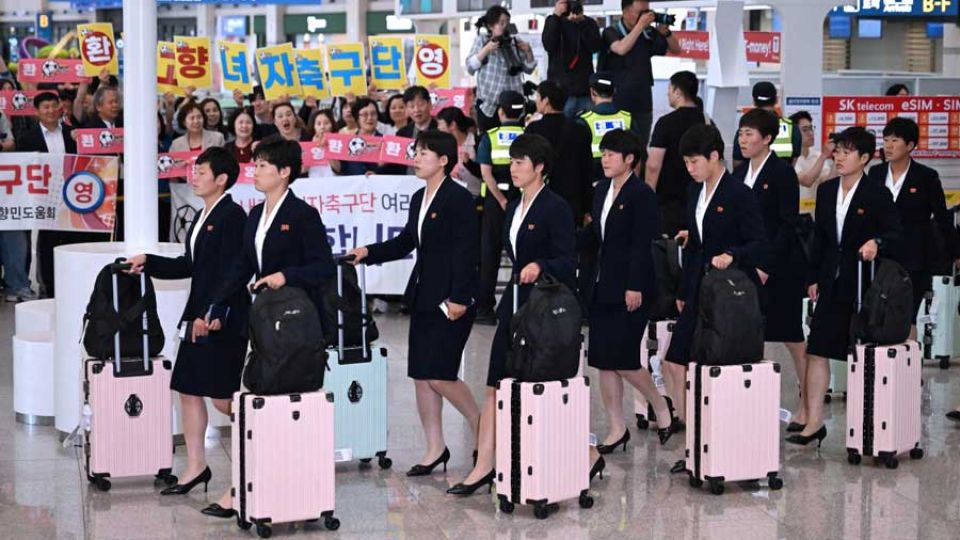
SEOUL – A North Korean women’s soccer team arrived in South Korea Sunday for a continental tournament match against a South Korean side, the first visit by North Korean athletes in more than seven years.
Pyongyang-based Naegohyang Women’s FC landed at Incheon International Airport at 2:15 p.m. Sunday via Air China. “Naegohyang” means “My Homeland” in Korean.
Naegohyang will face Suwon FC Women on Wednesday at Suwon Sports Complex in Gyeonggi Province in the semifinals of the Asian Football Confederation Women’s Champions League.
The winner will advance to the final against either Australia’s Melbourne City or Japan’s Tokyo Verdy on May 23 at the same venue.
According to Seoul’s Unification Ministry, the visiting delegation consists of 39 people, including 27 players and 12 staff members. The team will stay in South Korea from Sunday through May 24. The ministry has approved the visit under the Inter-Korean Exchange and Cooperation Act.
The visit comes as inter-Korean relations remain at one of their lowest points in years.
North Korean leader Kim Jong-un declared in late 2023 that inter-Korean ties were relations between “two hostile states,” abandoning Pyongyang’s long-held view of the two Koreas as one people temporarily divided and further chilling relations with Seoul.
The visit has drawn unusual public attention in South Korea. All 7,087 seats for Wednesday’s semifinal sold within 12 hours of ticket sales opening, according to Suwon FC.
Civic groups involved in inter-Korean exchange have organized a joint cheering squad of around 3,000 people. The Unification Ministry plans to support the campaign financially, with the related budget expected to reach up to 300 million won ($200,000).
Still, some experts cautioned against assigning excessive political meaning to the event.
Yang Moo-jin, a distinguished professor at the University of North Korean Studies, said overinterpreting the visit could backfire diplomatically.
“If South Korea interprets the visit too politically, North Korea could instead use it as grounds to pressure the South by claiming Seoul is politicizing sports,” Yang said.
Unification Minister Chung Dong-young said the North Korean team’s visit itself was meaningful at a time when virtually all inter-Korean exchanges had been suspended, though he added that he was still considering whether to attend the match in person.
The match has also drawn attention in Washington.
Victor Cha, Korea chair at the Center for Strategic and International Studies, said in a recent commentary that there were “three useful data points worth tracking.”
“The fact that Pyongyang allowed athletes to travel to South Korea is significant given North Korea’s shutdown of all dialogue with South Korea and its assertion of the enemy-state declaration vis-a-vis Seoul,” Cha said.
“In this regard, the football match could demonstrate the potential to separate cultural exchanges from politics.”
Naegohyang is sponsored by a Korean People’s Army-affiliated conglomerate of the same name that produces cigarettes, electronics, sportswear and soju. The club is regarded as one of North Korea’s football powerhouses and has won the North Korean Women’s Premier League twice.
Naegohyang previously defeated Suwon FC Women 3-0 during the group stage in Myanmar in November 2025.
The visit marks North Korea’s first sports delegation to South Korea since the International Table Tennis Federation World Tour Grand Finals in Incheon in December 2018.
It is also the first visit by a North Korean women’s football team to the South since the 2014 Incheon Asian Games.