

April 28, 2026
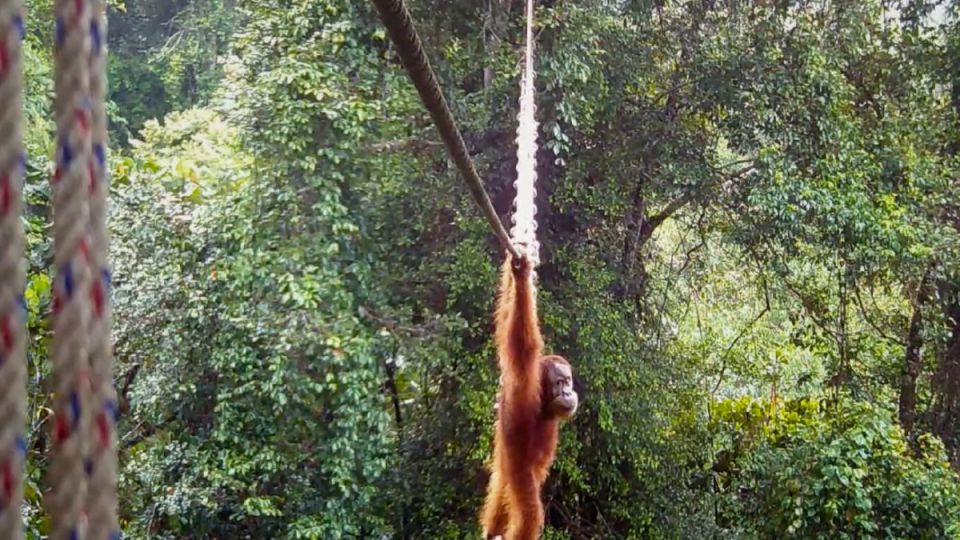
JAKARTA – A Sumatran orangutan (Pongo abelii) has been filmed for the first time using a man-made canopy bridge to cross a road in North Sumatra, marking a major conservation milestone and offering rare proof that development need not sever forest lifelines.
The footage, captured by a camera trap, shows a young male carefully making his way along a rope bridge suspended above the Lagan–Pagindar road in Pakpak Bharat regency.
Midway across, he pauses as if taking in the view, then glances toward the camera before continuing, a moment conservationists say they had long been waiting for.
The roughly 10-meter bridge was installed in 2024 through a joint initiative between Indonesian conservation group Tangguh Hutan Khatulistiwa (TaHuKah), the United Kingdom-based Sumatra Orangutan Society (SOS) and local authorities. It is one of five canopy crossings built to reconnect forest patches fragmented by the expansion of the Lagan–Pagindar road.
While the road has improved access for remote communities to schools, hospitals and other essential services, it has also split a population of around 350 orangutans, isolating them in separate forest blocks and heightening the risk of inbreeding and long-term decline.
“For two years, we have watched and waited for this moment,” SOS chief executive Helen Buckland said in a statement on Sunday. “Seeing this young male orangutan confidently cross the road using the canopy bridge is a huge milestone for conservation.”
Although similar structures have been used by other arboreal species, including gibbons, langurs and long-tailed macaques, this is believed to be the first recorded instance of a Sumatran orangutan using such a crossing in the wild.
The bridges, each requiring about 200 meters of rope and taking only a few days to install, were designed as a simple but effective solution to habitat fragmentation.
“Witnessing a Sumatran orangutan confidently crossing that bridge is living proof we need not sever the forest’s lifeline in order to build our own communities,” said Pakpak Bharat Regent Franc Bernhard Tumanggor.
The milestone comes as human-orangutan encounters continue to rise elsewhere in North Sumatra. On April 21, authorities relocated a 25-year-old orangutan to Mount Leuser National Park (TNGL) after rescuing it from a farming area in Karya Jadi village, Langkat regency.
The animal had been roaming a rubber plantation surrounded by oil palm estates and was frequently seen near workers’ huts.
Residents reported the sighting over concerns about its safety, prompting officials from the Natural Resources Conservation Agency (BKSDA) to evacuate and examine the orangutan before releasing it back into the wild.
Officials say such incidents are becoming more frequent as forests are converted into plantations, pushing orangutans closer to human settlements and exposing them to threats such as poisoning, food scarcity and poaching.
“That area used to be an orangutan habitat, but over time the forest has been replaced by plantations,” BKSDA official Bobby Nopandri said.
Classified as critically endangered by the International Union for Conservation of Nature (IUCN), Sumatran orangutans face steep population declines driven by habitat loss, fragmentation and illegal hunting. In the wild, they are found only on Sumatra and Kalimantan.
– Apriadi Gunawan contributed the story from Medan, North Sumatra