

May 20, 2026
MANILA – The Philippines has gained visibility on security and sovereignty issues but remains far less associated with addressing wider problems confronting Southeast Asia.
This was noted by Dr. Alicor Panao in an analysis of the results of the 2025 Foreign Policy Community of Indonesia Survey on Asean Dialogue Partners.
Based on the survey, which examined which member states of the Association of Southeast Asian Nations “positively contribute to addressing the problems/conflicts across major regional and global issues,” the Philippines performed strongest on South China Sea territorial tensions, scoring 17.39%—one of the highest in the region.
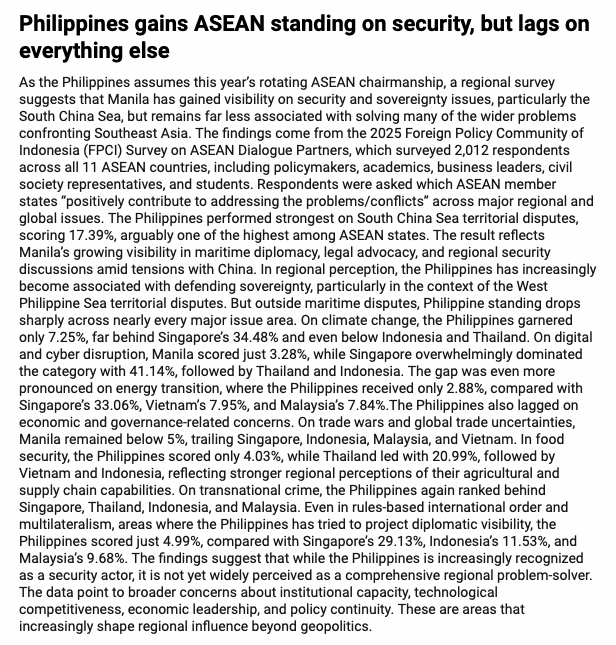
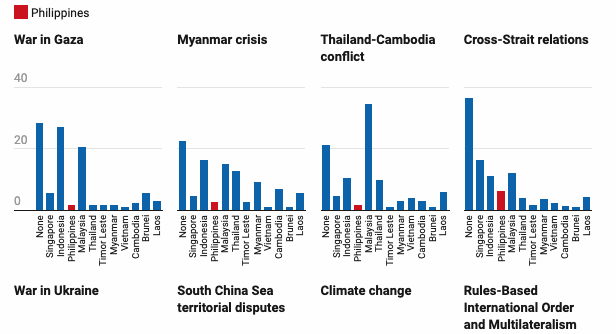
Panao said the result reflects the Philippines’ increasing visibility in maritime diplomacy, legal advocacy and regional security discussions amid tensions with China.
He said that “in regional perception, the Philippines has increasingly become associated with defending sovereignty, particularly in the context of the West Philippine Sea territorial tensions.”
Panao, an Inquirer data scientist and an associate professor at the University of the Philippines, said the findings “suggest that while the Philippines is increasingly recognized as a security actor, it is not yet widely perceived as a comprehensive regional problem-solver.”
“The data point to broader concerns about institutional capacity, technological competitiveness, economic leadership and policy continuity,” he said, adding that “these are areas that increasingly shape regional influence beyond geopolitics.”
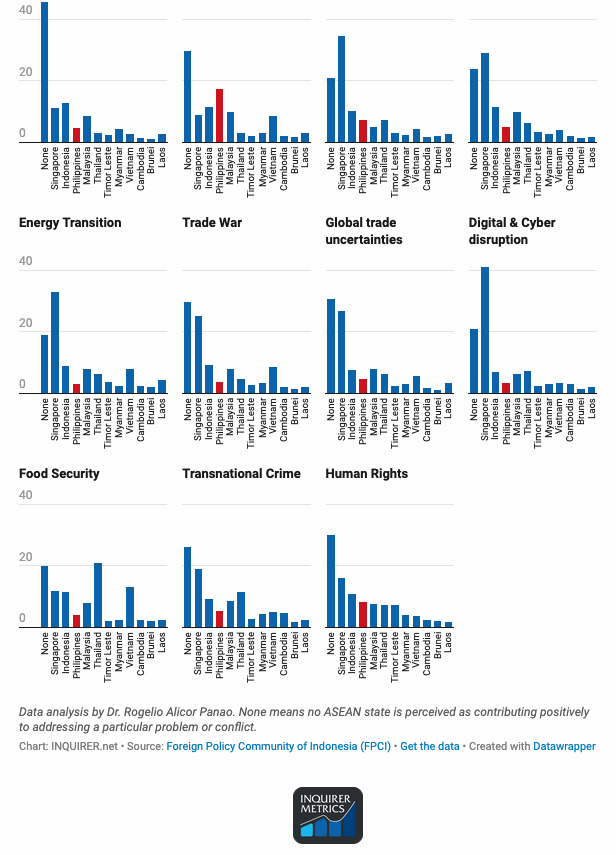
Across almost every major issue area, the country’s standing “drops sharply,” he said.
For instance, on climate change, the Philippines garnered only 7.25%, far behind Singapore’s 34.48% and below Indonesia and Thailand. On digital and cyber disruption, the Philippines scored 3.28%, while Singapore dominated the category with 41.14%, followed by Thailand and Indonesia.
The gap was even more pronounced on energy transition, Panao said, as the Philippines received only 2.88%, compared with Singapore’s 33.06%, Vietnam’s 7.95% and Malaysia’s 7.84%.
“The Philippines also lagged on economic and governance-related concerns,” he said.
On trade wars and global trade uncertainties, the Philippines remained below 5%, trailing Singapore, Indonesia, Malaysia and Vietnam.
The Philippines scored only 4.03% in food security, while Thailand led with 20.99%, followed by Vietnam and Indonesia, reflecting stronger regional perceptions of their agricultural and supply chain capabilities.
Panao said that on transnational crime, the Philippines again ranked behind Singapore, Thailand, Indonesia and Malaysia.
Even in rules-based international order and multilateralism—areas where the Philippines has tried to project diplomatic visibility—the Philippines scored 4.99%, compared with Singapore’s 29.13%, Indonesia’s 11.53% and Malaysia’s 9.68%. /dm