

June 22, 2026
MANILA – The government on Sunday said it will look into reports that the 24 Filipinos recently repatriated from Russia were victims of illegal recruiters.
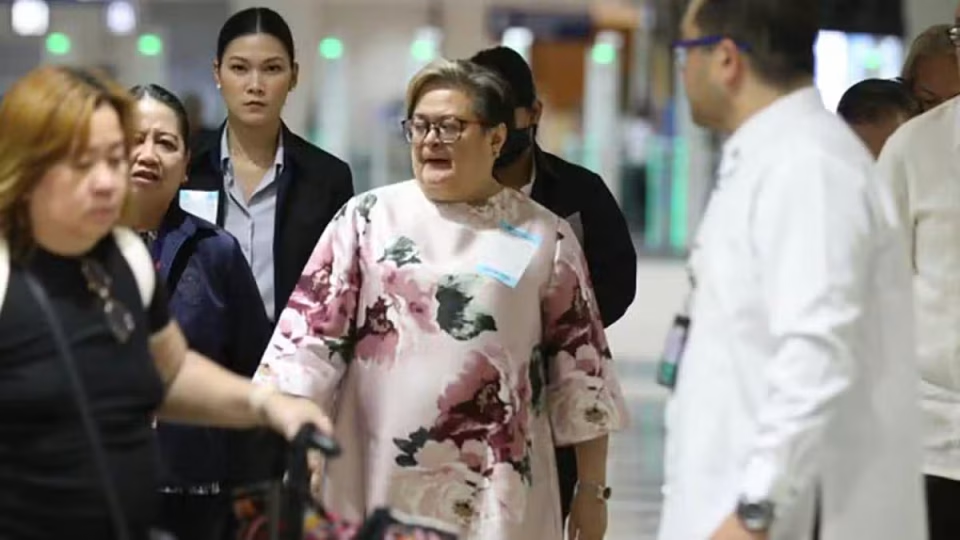
The Filipinos — 22 women and two men — arrived in Manila in two batches over the weekend after they were released in the port city of Yakutsk, capital of the Sakha Republic (Yakutia) in eastern Siberia, where they had been detained for more than nine months.
“They didn’t have papers as workers in Russia, so it got to the point of immigration cases [being filed] against them, leading to deportation,” Department of Migrant Workers Secretary Hans Leo Cacdac said.
“We need to address this … if it’s necessary to apprehend illegal recruiters or human traffickers. We will coordinate with the Department of Justice and law enforcement agencies to look into their cases,” he added.
Cacdac said most of the Filipinos worked as cleaners, and some came from other countries before ending up in Russia.
The Filipinos arrived in two separate flights from Krasnoyarsk, Russia, to Bangkok, Thailand, then to Manila.
Six of the detainees landed on Saturday at around 11:40 p.m., while the remaining 18 arrived on Sunday at 4 a.m.
No charges
In a statement on Sunday, the Department of Foreign Affairs (DFA) said it was President Ferdinand Marcos Jr. who “personally” raised the case with Russian President Vladimir Putin during their bilateral meeting on the sidelines of the Asean–Russia Commemorative Summit in Kazan on June 17.
“Following the president’s appeal, Russian authorities immediately facilitated the workers’ release by 19 June 2026, bringing an end to months of uncertainty for them and their families,” the DFA said.
Marcos said even Putin was “surprised” about the case, but assured him that he “will find a way to fix this problem.”
The Filipinos were not charged with any wrongdoing.
‘Undocumented’
In a news release issued by the Russian internal affairs ministry on Telegram on Sept. 3, 2025, it said law enforcement authorities arrested the “undocumented” Filipinos, who were providing cleaning services.
The migrants were found in several rented apartments on Oyunsky and Kalandarishvili streets, as well as in a residential building in the 202nd microdistrict in Yakutsk.
All of those detained were between 25 and 40 years old, mostly women, and were offering cleaning services by posting advertisements online.
Five of them had entered Russia on tourist visas and remained after their visas expired.
Meanwhile, the others arrived on work visas “but failed to complete migration registration procedures, obtain work permits, or sign employment contracts.”
All of them were found to have violated residency regulations, particularly Part 1.1 of Article 18.8 of Russia’s Code of Administrative Offenses.
They had been placed in the temporary detention center for foreign nationals under Russia’s Ministry of Internal Affairs.
They were supposed to be deported from Russia after paying the imposed fines.
Gov’t assistance
Cacdac said the repatriated Filipinos were provided with hotel accommodations and free transportation back home, some including flights to provinces.
“The president also ordered that they be given financial assistance … There is also employment or livelihood assistance available to them,” he said.
Cacdac also shared that one of the Filipinos has a child with special needs, while two others have parents with serious illnesses.