

January 20, 2026
SEOUL – South Korea-US military drills should not be affected by political judgment or public sentiment, a think-tank said Monday, even as the Lee Jae Myung administration continues efforts to engage North Korea.
The state-affiliated Korea Institute for Defense Analyses, said in a report released Monday that politicizing joint exercises could heighten security uncertainty in Northeast Asia and weaken alliance cohesion, particularly amid an evolving threat environment and ongoing discussions over the transfer of wartime operational control.
“Given the changing security landscape and the OPCON transition process, allowing combined exercises to be adjusted by political considerations could negatively affect allied defense teamwork,” KIDA said in its latest report.
Since the inauguration of the liberal Lee Jae Myung government in July last year, debate has resurfaced over scaling back or adjusting joint drills as part of a conciliatory approach aimed at reviving dialogue with Pyongyang.
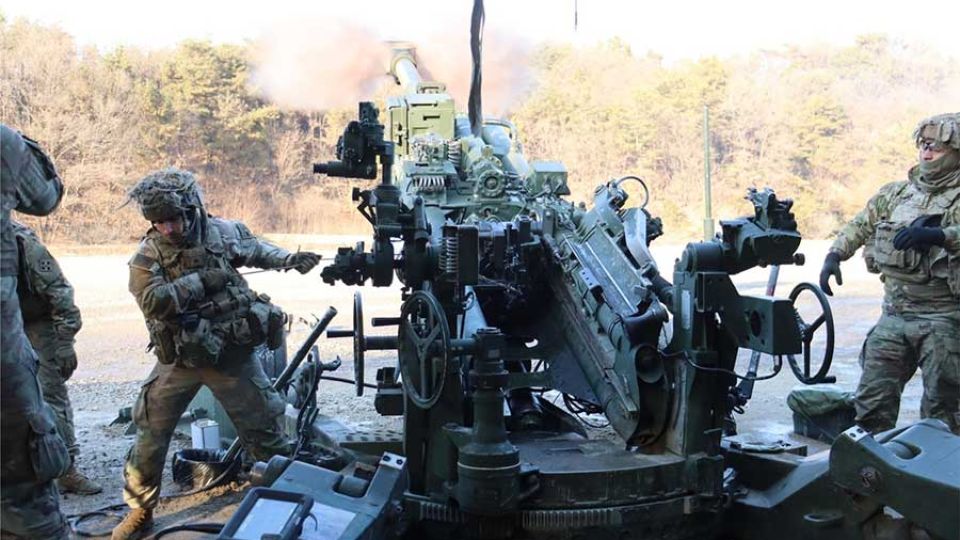
South Korea and the United States conduct regular combined exercises each year, including Ulchi Freedom Shield and Freedom Shield, incorporating scenarios that reflect the most recent developments in North Korea’s weapons programs and other threats. The drills combine computer-simulated command post exercises and field training exercises, testing allied readiness across land, sea, air, cyber and space domains.
The report noted that North Korea has continued testing a range of weapons systems, including intercontinental ballistic missiles, hypersonic missiles and tactical nuclear-capable ballistic missiles, while repeatedly conducting training premised on nuclear weapons use. It also pointed to Pyongyang’s expanding gray-zone activities — such as cyberattacks and GPS jamming — alongside deepening military cooperation with Russia.
These developments, KIDA argued, make strengthening the allied defense posture more critical than ever.
The South Korean government aims to complete verification of Full Operational Capability, the second phase of the three-stage OPCON transition process, within this year. To meet that goal, the report stressed the need to pre-test changes to joint exercises that reflect the expanded role of the South Korean military and to address operational challenges in advance.
The importance of combined exercises is further underscored by Washington’s policy of “strategic flexibility,” under which the primary mission of US forces is expected to expand from defending the Korean Peninsula to contributing to broader regional security in Northeast Asia, the report said.
KIDA acknowledged that joint exercises were suspended during the 2018 PyeongChang Winter Olympics and subsequent US–North Korea summit diplomacy, and that decisions over whether to conduct such drills could serve as a conciliatory signal in future negotiations. However, the institution cautioned that combined exercises remain a key means of strengthening interoperability and visibly reinforcing US extended deterrence.
“Implementation of combined exercises should be guided by consistent policy considerations, not short-term political calculations,” he said.
Even if adjustments to drills become unavoidable, the think tank emphasized the need to clearly communicate to North Korea, China and other potential adversaries that the core level of allied readiness remains intact. He also reiterated that the suspension of joint exercises in 2018 ultimately failed to function as decisive leverage in negotiations with Pyongyang.
Rather than using the exercises themselves as bargaining chips, KIDA suggested that Seoul and Washington consider more flexible signaling measures, such as adjusting the level of public disclosure or the deployment patterns of strategic assets.
“While the suspension of joint drills in 2018 helped create a favorable atmosphere for dialogue, it did not lead to tangible denuclearization measures or a meaningful reduction in threats,” KIDA said, warning that scaling back exercises without substantive steps from North Korea risked undermining deterrence credibility.
The South Korean military said last month that it had completed all joint field training exercises with the US that were postponed after being rescheduled from August last year as part of the annual UFS exercise.
In a press notice, the South’s Joint Chiefs of Staff said 22 of roughly 40 field drills were deferred by about a month in August and subsequently carried out by the end of the year to help maintain balanced readiness throughout the year.
The allies had previously cited multiple factors for the adjustment, including extreme weather conditions and the need to distribute training more evenly across the year to sustain readiness. Some observers, however, have interpreted the rescheduling as aligning with the Lee Jae Myung administration’s broader push to improve inter-Korean relations.