

May 12, 2026
SEOUL – Demands to tie performance bonuses to a fixed percentage of operating profit are spreading from Korea’s semiconductor industry into autos, telecom and internet platforms.
The union at Kakao, the country’s dominant messaging platform, became the latest to seek such a payout Sunday, filing for state mediation after wage talks stalled.
The filing with the Gyeonggi Regional Labor Relations Commission was reportedly joined by units at Kakao Pay, Kakao Enterprise and a fourth affiliate. The union did not explicitly frame its demand as a percentage, but the figure proposed equates to roughly 13 to 15 percent of last year’s operating profit, according to industry estimates. On Kakao’s 2025 operating profit of about 440 billion won ($298 million) and a headcount near 4,000, that implies around 15 million won per employee.
Kakao said it had negotiated in good faith but could not agree with the union on “the detailed design of the compensation structure,” and pledged to engage with the commission’s process.
The Kakao filing is the most recent of several.
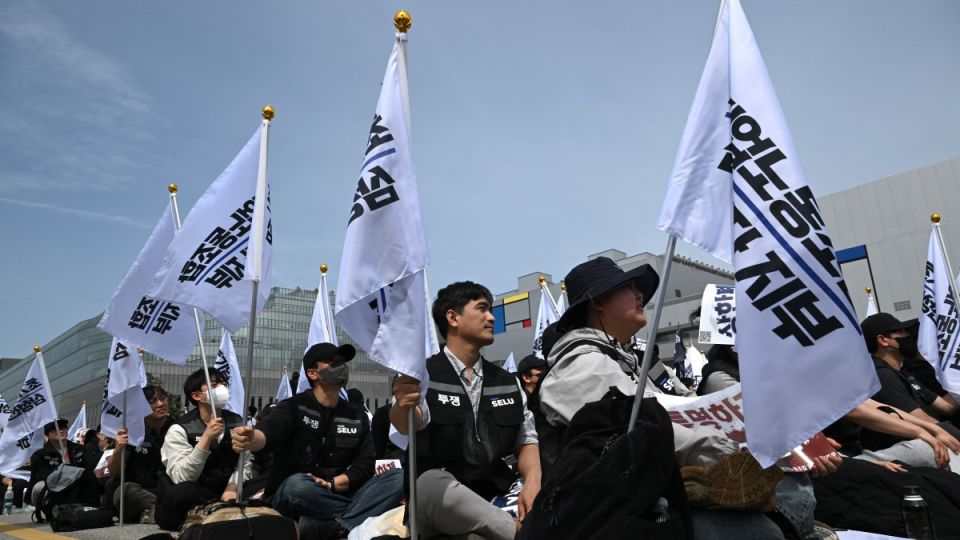
Samsung Electronics’ largest union is seeking 15 percent of chip-division operating profit and has scheduled an 18-day strike starting May 21. Beyond chips, Hyundai Motor’s union opened this year’s wage talks demanding 30 percent of 2025 net profit, which on the carmaker’s 10.36 trillion won bottom line would exceed 3 trillion won. The LG Uplus union has tabled a 30 percent operating-profit bonus alongside an 8 percent wage hike and a 35-hour workweek. The same union accepted a 1.3 percent raise the previous year.
The common origin is a landmark agreement in 2025 at SK hynix, which committed the memory firm to channel 10 percent of annual operating profit into a bonus pool and scrapped the previous cap of 1,000 percent of monthly base salary. As artificial intelligence-driven demand for high-bandwidth memory transformed SK hynix’s earnings, the deal produced an early-2026 payout equivalent to 2,964 percent of base pay, or more than 100 million won per employee on average.
Macquarie has estimated the figure could reach 1.29 billion won per head by 2027 if the memory upcycle holds.
That benchmark is now resetting expectations at companies where the underlying earnings story is far weaker.
Kakao shares closed at 46,000 won on May 8, down from above 70,000 won a year earlier, with investors waiting for monetization of its AI agent services. LG Uplus’s 3.4 percent operating profit growth in 2025 owed largely to subscriber inflows after security breaches at SK Telecom and KT, not to organic momentum. Hyundai’s first-quarter 2026 operating profit fell 30.8 percent year-on-year to 2.51 trillion won, less than the bonus pool its union is requesting.
“Bonuses are normally tied to individual contribution and paid in stock or options,” said Lim Chae-un, an emeritus professor of business administration at Sogang University. “What’s spreading here is the reverse: a slice of operating profit handed out in cash through union bargaining, without any real measure of contribution.”
The timing is unsettling corporate Korea.
Samsung is committing tens of trillions of won to recapture ground in HBM and advanced packaging, while Hyundai Motor Group is pouring comparable sums into software-defined vehicles and electrification. Telecom carriers are funding AI data centers while sustaining the dividends that make their stocks income vehicles. JPMorgan estimated in a May 6 report that meeting Samsung’s union demands plus the planned strike could subtract up to 43 trillion won from the chip division’s 2026 operating profit.
Samsung and its union resumed negotiations Monday under government-brokered postmediation to narrow positions before the May 21 walkout. At Hyundai Motor, Choi Young-il, the co-CEO overseeing domestic production, opened wage talks last week by telling negotiators to “face reality,” citing US tariffs and Middle East risks.