

November 27, 2025
JAKARTA – A recent sighting of a rare variant of the parasitic flower rafflesia has caught the attention of researchers and non-specialists alike, as hope rises that the rediscovery will lead to more answers about the plant.
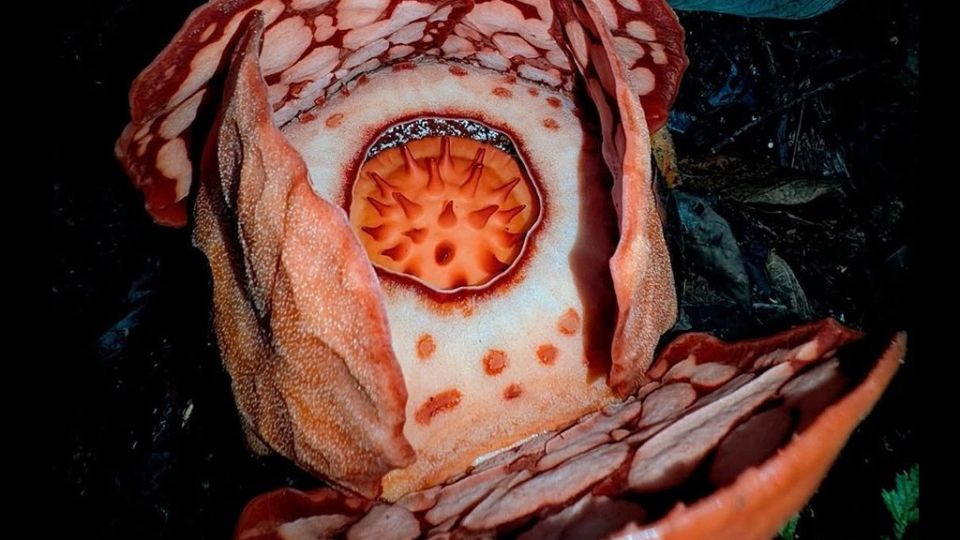
A flower of the species Rafflesia hasseltii was found in Sumpur Kudus district, Sijunjung regency, West Sumatra, on Nov. 19, thanks to a tip received by Bengkulu-based conservationist and rafflesia enthusiast Septian Andriki from local resident early this year.
Septian, who once worked as a physical education teacher in an elementary school in Bengkulu, has joined expeditions to locate rafflesia since 2012. He has seen at least 12 rafflesia species since then, including discovering the Rafflesia kemumu species in 2017 in Bengkulu, a region known as ideal habitat for the plant.
Rafflesia hasseltii was among the remaining species Septian had not seen himself.
But he could not immediately check the information, as the suspected flower was located in the neighboring province of West Sumatra, a 15-hour drive away from Bengkulu. Only when Chris Thorogood of Oxford Botanic Garden and Arboretum, whom he had known since late 2010s, came to Indonesia in November that he dared to embark on the expedition.
“[Thorogood] asked whether I was sure it’s a hasselltii or not. I told him that I can’t guarantee, because in the photo, the flower had not bloomed yet,” Septian told The Jakarta Post on Sunday.
“We decided to go anyway. But I predicted the flower would bloom, and my prediction rarely misses.”

MAP: THE JAKARTA POST
After 20 hours of driving, the team got to Sumpur Kudus community forest and proceeded with an additional three hour hike through rough terrain to reach the flower. It was late afternoon when the team got to the forest entrance, so they had to rush to avoid meeting with Sumatran tigers that usually roam the area.
Septian got his hopes up for finally seeing hasseltii for the first time in 13 years, only to get discouraged by Iswandi, of the community forest management group and the team’s guide, who said that the flower might not bloom by the time they got there.
But all the hard work paid off, when Septian and Thorogood found the flower, and confirmed that it was a blooming Rafflesia hasseltii.
“I wept,” Septian said. “Iswandi was afraid I was possessed by the spirits in the forest, while Chris thought I was hallucinating due to the exhaustion.”
The video of Septian weeping was first uploaded by Thorogood on his Instagram account @illustratingbotanist and later reposted by Oxford. The university’s post has garnered more than 500,000 likes.
This was the latest time for a hasseltii to be observed blooming since 2024, when a flower was seen blossoming in Bengkulu, according to the Rare Flower Concerned Community (KPPL) Bengkulu.
Hasseltii belongs in the same genus with Rafflesia arnoldii, often deemed as the world’s largest flower. But the former has a smaller flower with larger spots compared to its gigantic relative.
Like most plants in the genus, hasseltii is parasitic to Tetrastigma, a genus of plants in the grape family. Rafflesia hasseltii has been observed in Sumatra, the Malay Peninsula and Sarawak, Malaysia.
The latest rediscovery by Septian and Thorogood was part of a multinational joint research supported by funding from the Oxford Botanic Garden and Arboretum involving researchers in Indonesia, Malaysia and the Philippines, three countries where rafflesia is found. In Indonesia, the research involved BRIN, Bengkulu University and KPPL Bengkulu.
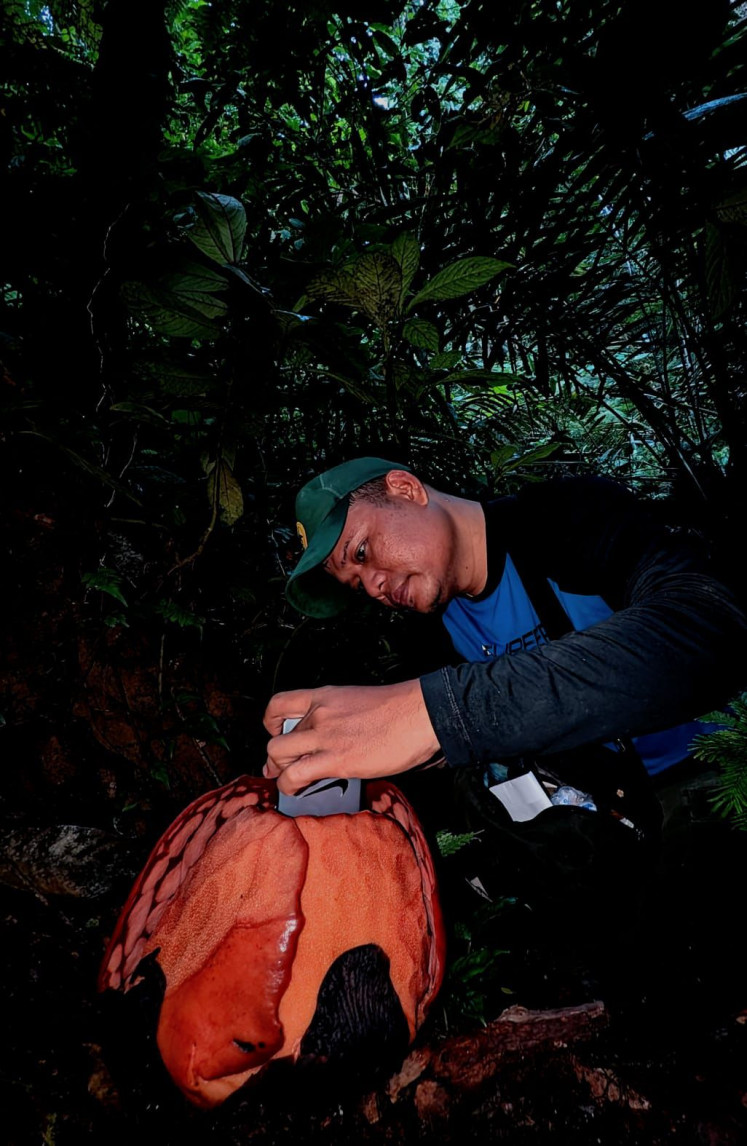
Conservationist and ‘Rafflesia’ enthusiast Septian Andriki takes picture of the inside part of the flower of a ‘Rafflesia hasseltii’ on Nov. 19 in Sumpur Kudus district, Sijunjung regency, West Sumatra. The flower was observed during a field observation jointly conducted by local conservationists as well as researchers from National Research and Innovation Agency (BRIN) and Oxford University. PHOTO: HANDOUT/SEPTIAN ANDRIKI/THE JAKARTA POST
Of 16 rafflesia species found in Indonesia, the research team have gathered DNA samples from 13 variants to see their phylogenetic, or natural evolutionary, relationships, said BRIN researcher Joko Ridho Witono. Joko also participated in Septian and Thorogood’s trip to West Sumatra, but did not reach the hasseltii flower.
The research, he added, aims to get a complete genomic picture of rafflesia as well as potentially finding new species of the plant that have not been well documented. Researchers are also aiming to draft conservation strategies for the parasitic plant, which is often found outside of conservation areas, such as in the West Sumatra community forest.
“This highlights the importance of community-based conservation. Without proper education, rafflesia can be extinct due to human activities,” Joko said, as quoted by a statement from BRIN on Sunday.
The hasseltii rediscovery might be surprising not only for common people, but also researchers, as most rafflesia needs a good environmental condition in order to grow, said Sofi Mursidawarti, a retired BRIN researcher who focused her research on Rafflesia arnoldii.
“Any rediscovery of a rafflesia is astonishing, because we didn’t expect it to happen with the high rate of deforestation and environmental degradation. The plant itself needs a very specific condition to bloom,” she said.
Despite decades of research, Sofi admitted researchers worldwide still have many unanswered questions about the plant. She conveyed her hope that hasseltii rediscovery may lead to more funding and support for more research as well as momentum to educate local residents on its conservation.
Septian concurred. His video may go viral on social media, but popularity is not the goal for his rafflesia research.
“We’re trying to reregister all the rafflesia, while also communicating with the locals on how to save and protect its habitat,” Septian said. “I also hope that local governments will be more aware of this rare flower of ours.”