

December 15, 2025
SEOUL – As South Korea proceeds to relocate the presidential office back to Cheong Wa Dae, more than 200 outsourced workers staffing the compound face potential job losses, igniting criticism of public sector employment practices.
The presidential office’s gradual reinstatement to Cheong Wa Dae, also known as the Blue House, means public access to the site will be suspended. As such, the over 200 personnel handling visitor guidance, facility management, security and maintenance during the compound’s brief stint as a tourist site will no longer be employed there. According to the government, their employment will only be maintained through December.
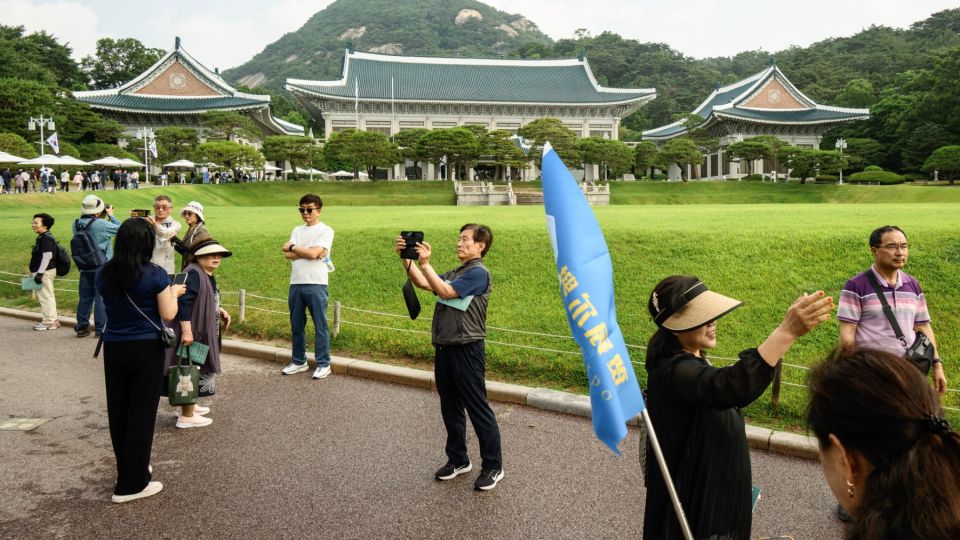
After former President Yoon Suk Yeol moved the presidential office to Yongsan-gu in 2022, Cheong Wa Dae was repurposed as a tourist spot. Hundreds of personnel were employed through subcontractors, under the Cheong Wa Dae Foundation established under the Ministry of Culture, Sports and Tourism.
This created a multilayered subcontracting system, in which workers were effectively employed through “subcontractors of subcontractors.”
As of this year, the Cheong Wa Dae Foundation indirectly employed 225 workers, including 36 cleaners, 31 facility maintenance workers, 60 security staff, 64 tour guides, 13 landscapers, 13 call center operators and eight public relations staff. Each group was employed by a different private contractor depending on the job type.
In June, the Lee Jae Myung administration announced plans to return the presidential office to Cheong Wa Dae, with public access to the complex halted in August. As a result, many Blue House workers were placed on temporary leave.
The situation has drawn criticism from the workers themselves, who have pointed to President Lee Jae Myung’s recent remarks condemning irregular employment practices in the public sector.
Lee has recently criticized the government’s reliance on short-term contracts in the public sector. Lee condemned the practice of repeatedly hiring workers on contracts just under two years to avoid granting regular employment and severance benefits, calling it “immoral.”
Blue House workers have urged the president to address what they say is a contradiction between his remarks and the situation unfolding at the symbolic heart of government. “If even non-regular workers at the Blue House cannot be guaranteed employment, then no public-sector contract worker in the country can feel secure,” the union said.
Concerns about workplace safety and labor rights during the Blue House’s operation as a public venue were also raised.
Workers said responsibility for working conditions was unclear under the multilayered contracting system, leaving gaps in safety training and oversight. In 2023 and 2024, cleaning staff filed complaints of unpaid holiday wages, while some workers reported being unable to take annual leave amid fears of job loss following further subcontracting.
Meanwhile, labor groups continue to call for alternative employment measures, such as reassignment to other government agencies, saying the fate of the Blue House workers highlights broader structural problems in public-sector employment.
The Culture Ministry said that under current laws, employment succession is difficult due to a lack of legal grounds. However, it noted that the Cheong Wa Dae Foundation has maintained existing contracts through the end of the year even after the public opening ended Aug. 1, and that workers have been receiving suspension allowances exceeding the legal minimum, at about 80 percent of wages.