

March 27, 2026
MANILA – Rising fuel prices driven by the conflict in the Middle East are affecting construction costs for Philippine infrastructure projects, but contractors say progress on major railway projects remains largely on schedule.
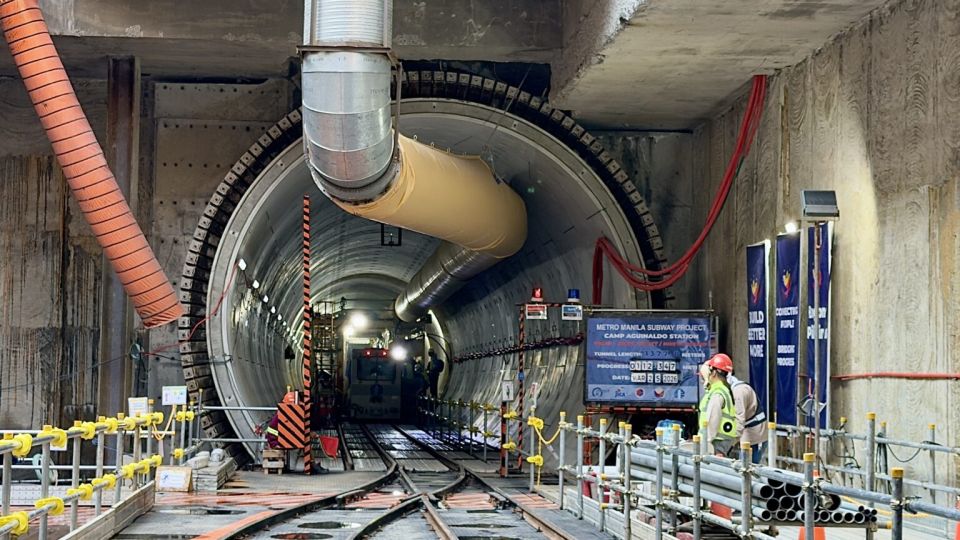
Ricky Salenga, construction manager for tunneling works at Sumitomo Mitsui Construction, which handles Contract Package 103 covering the Anonas and Camp Aguinaldo stations of the Manila Metro Subway Project (MMSP), told reporters on Wednesday that diesel shortages and higher prices could affect progress if supplies are interrupted.
“Since this is a construction project and we use heavy machinery, the price of oil and the quantity of oil… will affect progress,” Salenga said during a media tour organized by the Japanese embassy in Manila, highlighting projects funded through Japan’s official development assistance.
The MMSP is the Philippines’ first underground rail line, planned to stretch roughly 33 kilometers from Valenzuela City in the north to the Ninoy Aquino International Airport area in Pasay City, with multiple stations serving key urban districts.
Salenga noted that the project hauls nearly 1,000 cubic meters of earth and construction waste daily, requiring about 5,000 liters of diesel.
“We expect no delay… Most of the heavy equipment runs on diesel. Although our tunnel boring machines are powered by electricity, we also need excavators, cranes, and dump trucks,” he said.
Diesel prices in the Philippines have more than doubled, from around ₱60 per liter to about ₱123, Salenga said, but he added that current stocks and incoming deliveries have prevented immediate disruptions.
“There is always coordination between us and the Department of Transportation (DOTr) about this. As of this moment, there is no instruction to stop or suspend operations,” he said, adding that the situation depends on how the conflict evolves.
Salenga said the segment is currently 30 percent complete.
READ: DBM: Marcos orders release of over P60B for infrastructure projects
Meanwhile, other major railway projects appear less exposed to fuel price fluctuations.
The Shimizu-Fujita-Takenaka-EEI Joint Venture (SFTE-JV), responsible for Contract Package 101 of the MMSP, said most key components have already been secured.
The package covers three underground stations along Quirino Highway, Tandang Sora, and North Avenue, as well as a depot in Valenzuela City.
“We have already received the most important things, like the sheet piles and structures. Maybe only the electro-mechanical components, so there’s no issue on any delays,” said Station Deputy Civil Manager Antonio Aganon Jr.
He added that the last tunnel boring machine for the project is expected to arrive at North Harbor between April 4 and 6.
The transportation department expects the subway to be completed by 2032.
Moreover, a Japanese-Philippine consortium led by Taisei Philippine Construction Inc. and DM Consunji Inc. is building the depot for the North-South Commuter Railway (NSCR) in Valenzuela City.
The NSCR is a 147‑kilometer rail line under construction by the DOTr, connecting New Clark City in Tarlac to Calamba in Laguna via Metro Manila.
READ: JICA reaffirms support to DOTr for NSCR land acquisition drive
Deputy Project Manager Gerardo Ancheta said the joint venture has secured the majority of materials for Contract Package 01, which covers four stations in West Valenzuela, Meycauayan, Marilao, and Bocaue, as well as the Malanday Depot.
“We have some materials that are still outside of the country. We are coordinating properly with our manufacturers and suppliers… For now, we have not heard issues or problems,” he said.
The construction of this package is reportedly 85 percent complete, with most imported materials already shipped before the conflict began.
In a Department of Budget and Management statement on Monday, the agency said it had released ₱44.17 billion to the DOTr to fast-track the MMSP Phase I and NSCR System.
The funds, approved through Special Allotment Release Orders, cover critical loan requirements for projects financed through the Japan International Cooperation Agency and the Asian Development Bank.
“These are projects that Filipinos have waited decades for. By order of the President, it cannot be delayed any longer. We are making sure that funding is not the bottleneck — so these projects can move faster and deliver real relief to commuters,” DBM Secretary Rolando Toledo said in the statement.