

January 12, 2026
SEOUL – North Korea stepped up pressure on South Korea over the weekend, claiming that South Korean drones had been flown over its territory — an allegation immediately denied by Seoul, which has been seeking a breakthrough in stalled inter-Korean dialogue.
The exchange followed Pyongyang’s claim early Saturday that South Korea had infringed on its sovereignty through drone incursions in September and again in the past week. South Korea’s Defense Ministry rejected the accusation, saying the drones in question were not models operated by the South Korean military.
On Sunday, Kim Yo-jong, North Korean leader Kim Jong-un’s sister and vice department director of the ruling Workers’ Party of Korea, reiterated the accusation, stressing that Pyongyang views the alleged drone intrusion as a provocation regardless of political leadership in Seoul.
Kim described Seoul’s initial response as a “wise choice,” but made clear it did not alter North Korea’s assessment of the incident.
She said it was “irrelevant whether the act occurred under the Yoon administration or the current Lee government.“ She also rejected Seoul’s argument that the drone may have been operated by civilians, saying the essence of the issue lay not in “who operated the drone but in the violation of North Korea’s airspace itself.“
Her remarks, also published in the Rodong Sinmun, the official newspaper of the Workers’ Party, were followed by Cheong Wa Dae’s statement that the Seoul government once again confirms that it has no intention of provoking or irritating the North Korean side.
Cheong Wa Dae said a joint military-police investigation would be conducted in addition to the military’s initial probe and pledged to swiftly release the results. The government added that it would “continue efforts to ease tensions and build trust between the two Koreas.”
President Lee Jae Myung warned that if civilians were found to have operated drones that infiltrated North Korean territory, it would constitute a “serious crime” threatening peace on the Korean Peninsula and national security.
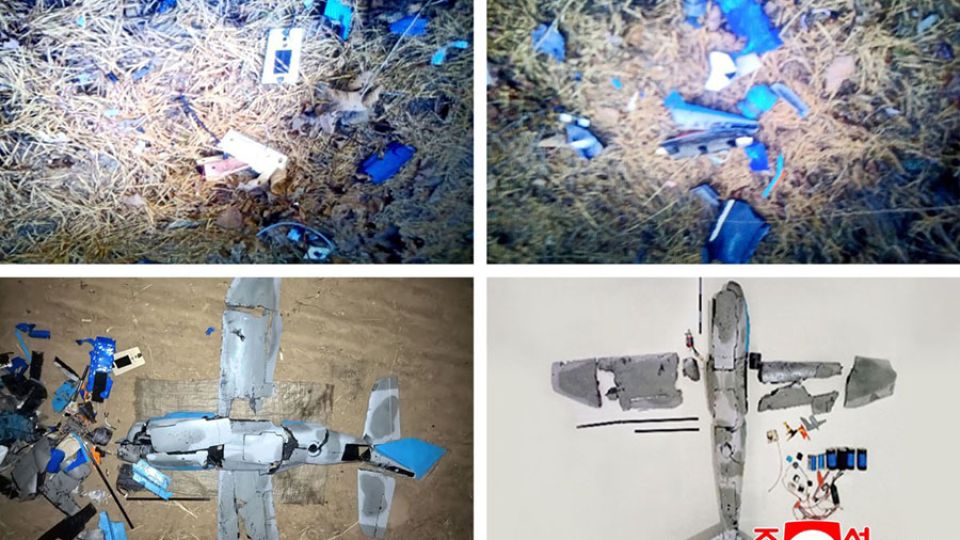
According to the Korean Central News Agency, North Korea claimed its military tracked aerial targets entering its airspace from the South on multiple occasions — including on Jan. 4 this year and in September last year — and neutralized them using electronic warfare assets. Pyongyang said the drones carried recorded footage of what it described as sensitive facilities, including uranium-related sites, border posts and the inter-Korean Kaesong Industrial Complex.
Seoul has dismissed the accusations, reaffirming that it did not conduct drone operations on the dates cited by Pyongyang and reiterating its commitment to restoring inter-Korean relations.
The Defense Ministry said Saturday that it does not possess the type of drone shown in photos released by the North and did not operate any uncrewed aerial vehicles during the time periods specified.
In an interview with Yonhap News Agency, Defense Minister Ahn Gyu-back also dismissed North Korea’s claims as “completely unfounded,” adding that President Lee had ordered a thorough investigation and instructed authorities to disclose the findings transparently.
The incident, which some observers pointed out could be Pyongyang’s attempt to reinforce domestic sentiment against the South, has sparked immediate debate among local political parties and experts.
The main opposition People Power Party criticized both the Lee administration’s response and Pyongyang’s claims, arguing that North Korea has no grounds to accuse others of violating sovereignty as the regime continues to carry out missile tests and its nuclear armament program.
Rep. Park Sung-hoon, senior spokesperson of the People Power Party, said that if the ruling Democratic Party’s past argument — that the Yoon administration had deliberately provoked the North to justify martial law — were applied consistently, “President Lee himself could also become subject to accusations of external aggression.”
Rep. Choi Bo-yun of the People Power Party criticized Lee’s response, saying, “President Lee should have exercised greater caution, as even conditional remarks — such as suggesting that the drones may have been operated by civilians — risk amplifying Pyongyang’s narrative when based on unverified North Korean claims.”
The ruling Democratic Party of Korea dismissed the criticism as political maneuvering.
Party spokesperson Rep. Kim Hyun-jung said the opposition’s claims “amount to an implicit acknowledgment that the former Yoon government sought to provoke North Korea,” accusing conservatives of recklessly escalating political confrontation.
The drone controversy first surfaced in October 2024, when North Korea accused Seoul of flying drones over Pyongyang. After the short-lived martial law in December that year, the issue fueled allegations that the Yoon administration had sought to provoke the North to justify the martial law scheme — a claim the then-opposition Democratic Party actively pressed.
Some have also raised skepticism about the impact the Lee government’s response could have.
“Facts have yet to be fully established, but the government has already signaled a lack of intent to confront North Korea,” said Nam Sung-wook, a professor of unification, diplomacy and security studies at Korea University.
Nam added that while the Lee administration has sought to improve inter-Korean relations, excessive caution in its response could place Seoul in a position of constantly reacting to Pyongyang rather than setting its own terms.
“If Seoul moves to preemptively restrain itself every time North Korea raises an accusation, it could encourage similar tactics in the future,” he said.
“In some cases, the possibility that such incidents may involve provocation or manipulation by the North itself cannot be ruled out.”