

January 6, 2026
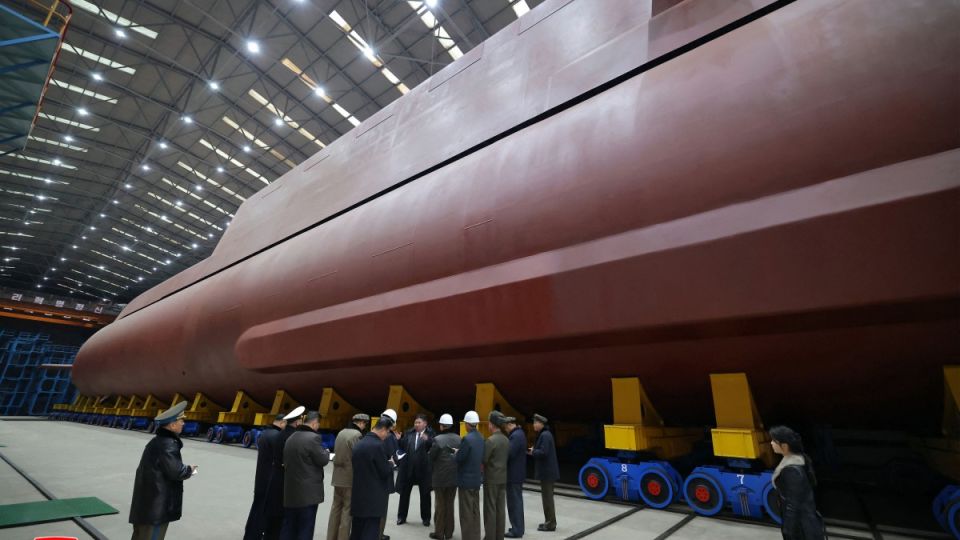
SEOUL – North Korean state media have recently drawn attention by frequently reporting shows of force. On Dec. 25, the media released photographs of North Korean leader Kim Jong-un visiting a shipyard where a nuclear-powered submarine is reportedly under construction. The submarine shown in the images was described as a large vessel of around 8,700 tons, an image sufficiently intimidating to amplify perceptions of threat. According to the reports, Kim emphasized that South Korea’s plan to build a nuclear-powered submarine constitutes a serious security challenge that North Korea must respond to.
There is little doubt that North Korea’s military demonstrations are highly provocative. They undermine the atmosphere of peace on the Korean Peninsula and obstruct efforts to improve inter-Korean relations, making them legitimate targets of condemnation. Nevertheless, how South Korea should respond remains a matter of debate. From the perspective of diplomatic message management, it is necessary to reflect public sentiment in the short term, but it is equally important to consider the long-term strategic consequences.
Conservative critics who advocate a hard-line response argue that the government of President Lee Jae Myung has been excessively passive, allegedly out of concern about North Korea’s reaction, and has failed to issue sufficiently strong condemnation. They warn that such restraint could lead Pyongyang to misinterpret Seoul’s response as acquiescence, encouraging further provocations. To assess this criticism fairly, it is worth examining the Lee administration’s actual response. The government would reject this characterization. In response to North Korea’s series of military demonstrations, South Korea’s Ministry of National Defense stated through its spokesperson that such actions “undermine peace and stability on the Korean Peninsula. … North Korea should respond to the South Korean government’s good-faith efforts to resume dialogue for peaceful coexistence and cooperate in maintaining stability on the peninsula.” Is it appropriate to interpret this response as timid or overly deferential to North Korea?
There is some logic to calls for a tougher stance, but such arguments are ultimately dangerous because they fail to account for South Korea’s geopolitical realities. Messages in the realm of diplomacy and national security must be crafted through strategic calculation that reflects geopolitical conditions. Ignoring careful deliberation and relying on one-dimensional reactions is not strategic response but simplistic reflex. Diplomatic messaging, among all forms of strategic communication, demands the highest level of prudence. In an environment of hostility with North Korea, prudence requires balance in three key areas: between strategic clarity and ambiguity; between short-term and long-term interests; and between the image of winning negotiations and the reality of compromise.
The Lee administration’s North Korea policy aims at denuclearization of the Korean Peninsula and the long-term foundation for reunification. More immediately, however, it seeks to move inter-Korean relations out of an excessively hostile posture toward one that allows for peaceful coexistence and shared growth. This recalibration reflects the consequences of unnecessarily deteriorated relations following the inauguration of the Yoon Suk Yeol administration in May 2022, which pursued an overly confrontational approach toward Pyongyang. Findings from the special investigation into former President Yoon’s insurrection indicate that he deliberately sought to escalate inter-Korean military tensions as a pretext for illegally imposing martial law. It has also been confirmed that, under his administration, South Korea’s drone command flew drones over Pyongyang in operations that risked provoking military retaliation. Under such conditions, diplomatic messaging cannot be determined by simple arithmetic.
The first guiding principle is balancing strategic clarity and ambiguity. From Seoul’s perspective, North Korea’s military demonstrations are undeniably provocative, and opposition to them must be clearly articulated. In that sense, the Defense Ministry’s statement represents a clear expression of position. Whether stronger language would be appropriate, however, requires additional review. It is well known that North Korea uses military demonstrations both as external intimidation and as a tool for internal political consolidation. Pyongyang publicly announced its intention to build a nuclear-powered submarine five years ago and has repeatedly exposed aspects of the project since then. There is no need to play into their narrative and propaganda.
A second balance must be struck between short-term and long-term interests. From a short-term perspective, North Korea’s nuclear submarine program is undeniably a threat and warrants condemnation, which the South Korean government has already issued in standard diplomatic language. The problem is that condemnation alone is unlikely to improve the situation when weighed against the urgent task of restoring communication channels with Pyongyang. While military demonstrations should be criticized, it is equally important to calculate that resuming dialogue and fostering shared understanding of peaceful coexistence and shared growth will be more effective in addressing the challenges posed by North Korea’s nuclear submarine ambitions over the long term.
The third balance concerns whether to emphasize the image of winning negotiations or to seek solutions through compromise. Compromise with an external counterpart necessarily involves mutual concessions, even if their scale differs. Such concessions often create a perception of weakness domestically, which is why diplomats frequently face criticism at home. Choosing between victory and compromise is difficult, but with a well-designed negotiation strategy, it is possible to exchange roughly equivalent concessions while managing the narrative so that one’s own side appears to have prevailed.
From this perspective, the Defense Ministry’s response to North Korea’s nuclear submarine threat can be evaluated as a standard reaction. It incorporated a degree of strategic clarity, reflected long-term interest calculations, and preserved the possibility of resolving the issue through compromise. Labeling this approach as appeasement or excessive caution would push the Lee administration to mirror the confrontational posture of the Yoon government, further worsening inter-Korean relations, destabilizing the peninsula, and heightening South Korea’s security anxiety. Resolving problems through dialogue and negotiation should not be dismissed as appeasement. Rather, it should be understood as a creative exercise in diplomacy’s greatest strength: expanding the space for cooperation to achieve peaceful coexistence and shared growth. An obsession with projecting toughness, without solving underlying problems, is not a strategic approach but a simplistic one.
Wang Son-taek
Wang Son-taek is an adjunct professor at Sogang University. He is a former diplomatic correspondent at YTN and a former research associate at Yeosijae. The views expressed here are the writer’s own. — Ed.