

June 17, 2026
SEOUL – For Kim Min-ji, 34, the Seoul Queer Parade is a holiday, much like Seollal or Chuseok.
“Compared with when I first came here, I have many friends I can meet at the event now,” Kim said while browsing booths at the parade in central Seoul on Saturday.
“More importantly, this is a place where I can be myself, including dressing the way I want.”
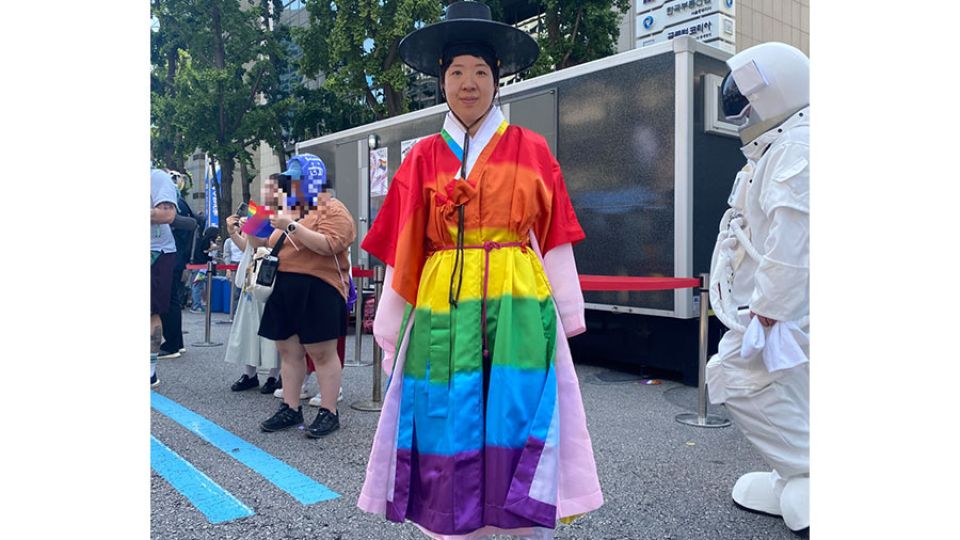
An eight-year attendee of the annual event, Kim wore a gat and dopo, traditional garments associated with Korean noblemen of the past. The dopo was decorated in rainbow colors, a symbol of diversity and pride in the LGBTQ+ community.
Now in its 27th year, the Seoul Queer Culture Festival’s parade is one of few large public events where LGBTQ+ people in Korea can openly express their identities, despite persistent social prejudice and limited legal recognition.
Yet the event has increasingly become more than a gathering for sexual minorities alone, expanding into a place for other groups struggling for visibility in Korean society.
This year’s booths and participants included migrant communities, labor groups, farmers, people with disabilities and other minorities, turning the festival into a broader celebration of diversity and inclusion.
A place to be oneself
The venue around Euljiro 2-ga began filling up even before the official opening at 11 a.m. By 2 p.m., with the parade approaching, the roughly 200-meter stretch of the five-lane road was packed with participants, with organizers estimating attendance at 50,000.
Participants carried flags and goods representing a wide range of sexual and romantic identities, reflecting the way the event extends beyond the groups commonly associated with the LGBT initials. Others attended dressed as cartoon characters, astronauts and fantastical creatures.
“We’re both queer and they’re in the show, they’re canonically together,” said a 32-year-old participant identifying as Twin, referring to Sailor Uranus and Sailor Neptune, who are portrayed as a couple in the Japanese anime “Sailor Moon.” Twin, who has lived in Korea for seven years, attended the event with another participant, Six, dressed as the two anime characters.
“We made people happy, and that’s what we wanted to do. We just wanted to see people smile,” Twin said.
Twin was among many foreign residents who attended the event. Another longtime resident, Nick, stressed the importance of visibility for queer people in Korea.
“I think it’s important to show Korea that there are gay people and queer people here,” said Nick, 39, who has lived in Korea for more than a decade. “It’d also be really great if people realized that being queer doesn’t affect other people’s lives, just mine and other queer people’s.”
Expanding solidarity
Allies outside the queer community were also a common sight at the event, with some attendees arriving alongside their partners and young children.
One of them was Baek So-young, 38, a clinical psychologist who described herself as a longtime ally and participant.
“We participated in this event 12 years ago when we were dating, but I have seen little improvement in social recognition in Korea,” Baek said. “We thought it would be better to join as a family.”
Embassies that have traditionally taken part in the event were again present this year. The Korea Disease Control and Prevention Agency also operated a booth promoting awareness of sexually transmitted infections and prevention efforts.
The event also attracted groups and individuals not traditionally associated with queer advocacy.
Several participants said their interest in queer issues grew during the protests that followed former President Yoon Suk Yeol’s declaration of martial law in December 2024 and his subsequent impeachment. During those demonstrations, queer groups maintained a visible presence, carrying rainbow flags and openly identifying themselves during public speeches.
A Korean Women Peasants Association official cited the December 2024 Namtaeryeong protest, where farmers, queer activists and others rallied together at a key gateway to Seoul, as a turning point in building broader solidarity.
The official said the experience encouraged more civic groups to take part in the parade and noted that the association itself has participated for the past two years.
Participating groups said the expanding coalition reflects how the event has increasingly come to encompass a broader range of diversity beyond sexual orientation and gender identity, citing the 2026 theme, “Intersection: Connecting Differences.”
“I think the word ‘queer’ is expanding to embrace a wider range of identities and experiences,” said Noh Joo-hyun, secretary-general of Gyeonggi Bukbu Peace Action, which operated a joint booth supporting former camptown women and survivors of Japan’s wartime sexual slavery.
“This event can serve as a public square where issues affecting minorities, people with diverse identities and victims of discrimination can be discussed together, leading to broader solidarity.”
Backlash strong, but efforts continue
Despite the LGBTQ+ community’s sustained efforts and growing solidarity with nonqueer groups, participants said such changes have yet to translate into broader acceptance in Korean society, with public attitudes toward sexual minorities remaining largely the same.
According to a 2025 survey of 1,000 adults by Hankook Research, 14 percent of respondents said they held favorable views of LGBTQ+ people, while 48 percent expressed unfavorable views. Compared with the previous year, favorable responses fell by 2 percentage points while unfavorable responses rose by 5 percentage points.
This year’s event also faced sizable counterdemonstrations, as it has in previous years. Organizers of a conservative Christian rally held near Seoul City Council said about 30,000 people participated.
“We do not hate or dislike them,” said Lee, 76, a participant in the counterdemonstration. “I just hope they receive guidance from Jesus and live a normal life.”
However, LGBTQ+ advocates said such a social environment continues to take a toll on mental health.
According to data cited by the National Human Rights Commission of Korea in April, sexual minorities were four times more likely to experience symptoms of depression than the general population and were also significantly more likely to report severe symptoms.
Facing such circumstances, participants said they would continue advocating for diversity and inclusion, describing opposition as a long-standing challenge rather than a reason to stop.
“We always face opposing posters and complaints whenever our student council participates in the Queer Parade under its own name,” said Jeong Eun-hye of Ewha Womans University’s student council.
“But we make such decisions through seminars and discussions, following a democratic process. Our goal is to create a campus where no one feels marginalized and where everyone can belong.”