

June 23, 2026
SEOUL – South Korea’s Ministry of National Defense on Monday said North Korea’s recent installation of barriers near the Military Demarcation Line constitutes a violation of the two nations’ armistice agreement.
The remarks followed reports that North Korean troops had been installing fences close to the MDL. The de facto border has separated the two Koreas since the 1953 armistice suspended active hostilities in the Korean War.
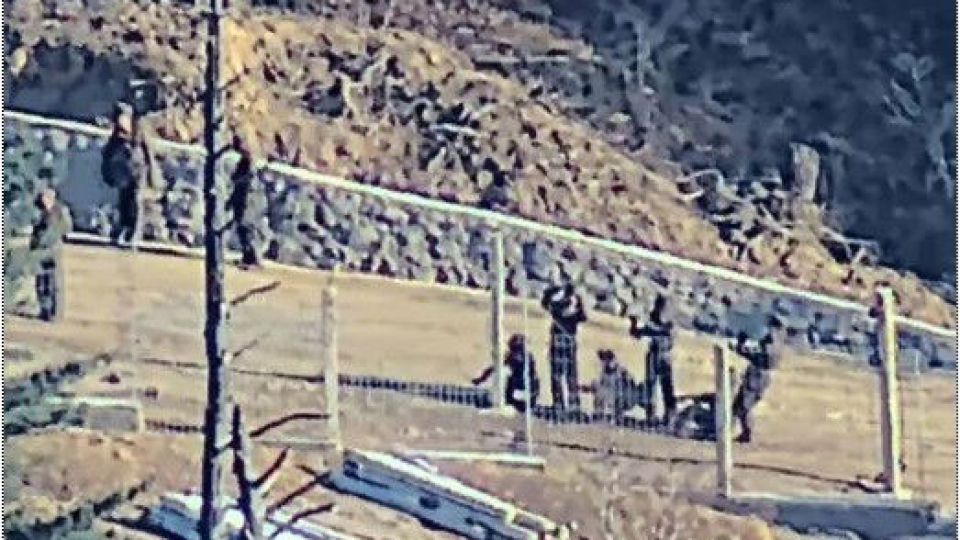
According to reports, North Korea has installed barbed-wire fences in some areas as close as 80-90 meters from the MDL. Land-clearing work, believed to be a preliminary step for laying mines, has also reached points just 5-10 meters from the line.
It is the first time that North Korean fences have been confirmed to have been built within 100 meters north of the MDL.
“The North Korean military’s installation of obstacles near the MDL is a clear violation of the armistice agreement,” ministry spokesperson Chung Binna said during a regular briefing.
Chung said the South Korean military is closely monitoring North Korean activities near the MDL and will continue to respond in close cooperation with the United Nations Command.
This is the first time the Defense Ministry has publicly characterized North Korea’s border fortification work as an armistice violation since the Lee Jae Myung administration launched over a year ago.
The ministry said its position was based on the armistice agreement, which established the Demilitarized Zone as a buffer zone to prevent incidents that could lead to the resumption of hostilities.
Under the 1953 armistice, the DMZ extends 2 kilometers north and south of the MDL. The zone was designed to separate opposing forces and prevent renewed fighting after the 1950-53 Korean War.
In late 2023, North Korean leader Kim Jong-un declared the two Koreas to be “two hostile states” and ordered steps to fortify the border. North Korea has been increasingly carrying out work north of the MDL since April 2024, including land clearing, tactical road construction, barbed-wire fence installation and mine-laying.
North Korea has also increased the number of troops mobilized for the work. Roughly 5,000 troops were mobilized in the first half of 2026, compared with about 1,000 during the same period last year.
At the current pace, the military assesses that North Korea could complete its border fortification and severance measures within two to three years, faster than an earlier estimate of more than four years.
Such activity has raised concerns in Seoul that North Korea may be seeking to militarize much of the northern half of the DMZ and create the effect of pushing the MDL southward in practice by installing fences based on its own understanding of the line.
Meanwhile, the UNC, which oversees the maintenance of the armistice, took a more cautious stance, saying construction or defensive measures inside the DMZ do not automatically amount to a violation.
“Activities within the DMZ must be understood in their full context and are assessed based on the specific facts, circumstances, and applicable provisions of the Armistice Agreement and subsequent agreements,” the command said in a statement.
“Construction, fortification and other defensive measures do not automatically constitute Armistice Agreement violations,” it added.
The UNC said it addresses armistice-related concerns through established mechanisms when appropriate and remains committed to preserving peace and stability on the Korean Peninsula.
The Defense Ministry declined to comment on why the UNC had not made the same determination, saying only that Seoul would continue consultations with the command.