

April 14, 2026
SEOUL – South Korea is stepping up efforts to secure safe passage through the Strait of Hormuz, dispatching a special envoy to Tehran and monitoring potential US-led maritime operations, as Washington moves to enforce a blockade targeting Iran-linked shipping Monday.
Seoul’s special envoy to Iran, Chung Byung-ha, has met senior officials in Tehran to discuss the situation surrounding the Strait of Hormuz — where South Korean vessels and seafarers remain stranded — as well as broader bilateral issues, a Korean Foreign Ministry official who requested anonymity said in an afternoon closed-door briefing.
Chung, who arrived over the weekend, is expected to convey Seoul’s position on ensuring the safety of South Korean nationals and securing passage through the strait, while holding consultations with Iranian counterparts. His meetings are likely to include talks with Iranian Foreign Minister Abbas Araghchi, though details have not been disclosed.
“(Chung) will deliver our position on the bilateral relations with Iran, ensuring the safety of South Korean nationals in Iran and the passage of the Strait of Hormuz, and consult with them on those matters,” the Foreign Ministry official said.
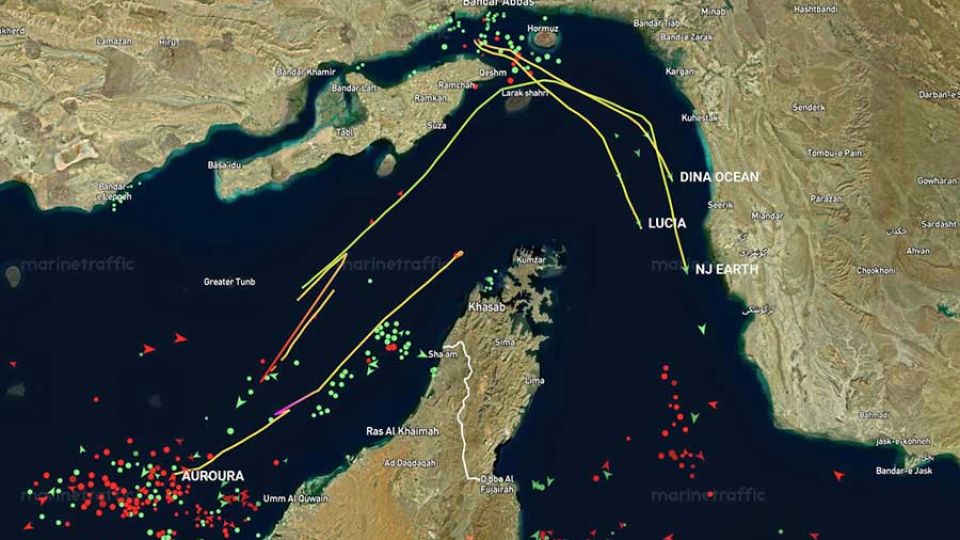
The envoy’s trip comes as 26 vessels linked to South Korea remain stranded in the Strait of Hormuz under Iranian control. Tehran has indicated it may allow passage in coordination with its military, but has warned that ships attempting to transit without prior approval could face attacks.
Regarding the planned blockade, the presidential office “is closely watching developments,” according to an official at Cheong Wa Dae.
“The safety of international maritime routes and freedom of navigation serve the interests of all countries and are protected under international law. Based on these principles, we hope the global maritime logistics network will return to normal as soon as possible,” the official added.
Separately, the Defense Ministry said Seoul has not received any formal request from Washington, as of Monday afternoon, to participate in maritime operations in the region, despite remarks by US President Donald Trump suggesting that some countries are deploying mine-clearing vessels.
“To our knowledge, there has been no official request made to the military so far,” Defense Ministry spokesperson Chung Binna said during a regular briefing.
She added that safe navigation through the Strait of Hormuz remains a critical issue for South Korea and the broader international community from both security and economic standpoints, noting that Seoul is closely monitoring developments and maintaining communication with relevant countries.
The stepped-up diplomatic outreach comes as the US prepares to begin blockading ships entering and exiting Iranian ports, following the breakdown of weekend talks in Pakistan between Washington and Tehran.
US Central Command said the measure, set to take effect 11 p.m. Monday, would apply to all maritime traffic entering or leaving Iranian ports, while allowing vessels transiting to and from non-Iranian ports to continue passage.
The move marks what analysts describe as a “selective blockade,” targeting Iran-linked shipping rather than fully closing the strategic waterway through which roughly a fifth of global oil supply passes.
However, for Seoul, the distinction may offer little immediate relief.
South Korea-related vessels have already faced difficulty transiting the strait amid Iran’s own restrictions, raising concerns that the US measure could effectively reinforce existing bottlenecks.
“First, the primary aim is to block ships docking at Iranian ports. In addition, vessels engaged in trade with Iran — for example, some Chinese ships carrying Iranian oil — would also be targeted,” said Park Won-gon, a professor of international studies at Ewha Womans University.
“In other words, the intent is to block only ships related to Iran, while allowing others to continue transiting.”
“But in practice, this inevitably results in a dual blockade,” he added. “Iran is already restricting passage, allowing essentially only vessels linked to Iran or considered nonhostile. So even if the US says it will allow transit, other ships — such as the 26 Korean-linked tankers — are still unable to move. They are effectively stuck, unable to go either way.”
From a military perspective, the move reflects Washington’s attempt to assert operational control without fully shutting down the waterway.
“The US’ naval blockade can be understood in direct connection with the concept of sea control in naval strategy,” said Yu Ji-hoon, a research fellow at the Korea Institute for Defense Analyses and a former Navy commander.
“Sea control refers to the ability to ensure that one’s own and allied ships, aircraft and military forces can operate freely in a given maritime area, while at the same time restricting or, if necessary, denying the adversary’s ability to operate there.”
Yu stressed that the measure is less about stabilization than leverage.
“This declaration of a naval blockade should be seen less as a stabilizing measure aimed at ending the conflict, and more as a high-intensity maritime pressure tool designed to enhance Washington’s negotiating leverage,” he said.
“For South Korea, this should not be viewed merely as a military measure between the US and Iran, but rather as an economic security variable with direct implications for transit through the Strait of Hormuz, as well as crude oil and liquefied natural gas imports and broader maritime logistics.”
Yu said the measure falls short of a full closure, describing it as a limited form of sea control.
“The US is selectively restricting Iran-related maritime activity while maintaining freedom of navigation for itself and its allies,” he said, adding that Washington is effectively applying “asymmetric” control — targeting Iran-linked access while keeping the broader shipping lane open.
Still, for countries like South Korea, which rely heavily on stable maritime routes for energy imports, the distinction between a full and partial blockade may offer limited reassurance.
The US move follows Iran’s growing use of the Strait of Hormuz as leverage, with restrictions on traffic contributing to rising global oil prices and inflation concerns ahead of US midterm elections in November.
Tehran has signaled it will not back down. Iranian Parliamentary Speaker Mohammad Bagher Ghalibaf said the country would not yield to US pressure following the announcement.
“If they fight, we will fight, and if they come forward with logic, we will deal with logic,” he said, according to AFP.
“We will not bow to any threats, let them test our will once again so that we can teach them a bigger lesson.”
Earlier, Trump said the US Navy would move to blockade vessels attempting to enter or exit the Strait of Hormuz, after weekend talks in Pakistan between Washington and Tehran failed to produce an agreement.