

April 1, 2026
SEOUL – As large outdoor LED billboards continue to proliferate across the capital, the Seoul Metropolitan Government on Tuesday announced the nation’s first comprehensive guidelines to curb excessive screen brightness.
The city said it has set new daytime brightness limits and adjusted nighttime standards based on screen size and time of day. The recommendations apply to displays measuring 30 square meters or larger and take effect on April 1.
The guidelines follow a survey of 52 major billboards across the city conducted between January and March. Using a reference display area of 225 square meters, the city categorized screens into medium (30-225 square meters) and large (over 225 square meters).
According to the survey, daytime brightness levels varied widely. Measured in candelas per square meter (cd) — a unit of luminous intensity — brightness ranged from 1,448 to 14,000 candelas per square meter, with a median of about 7,000 candelas per square meter.
After comparing the findings with international standards and consulting industry experts, the city set the new daytime brightness recommendation at 7,000 cd or lower.
Officials said the level is sufficient for outdoor visibility while curbing unnecessary glare.
Nighttime measurements showed brightness levels ranging from 100 to 1,500 cd, with a median of about 400 cd.
Under the new rules, medium-sized billboards must remain below 500 cd from one hour after sunset until midnight, and 400 cd after midnight. Large billboards must stay under 400 cd until midnight and 350 cd thereafter.
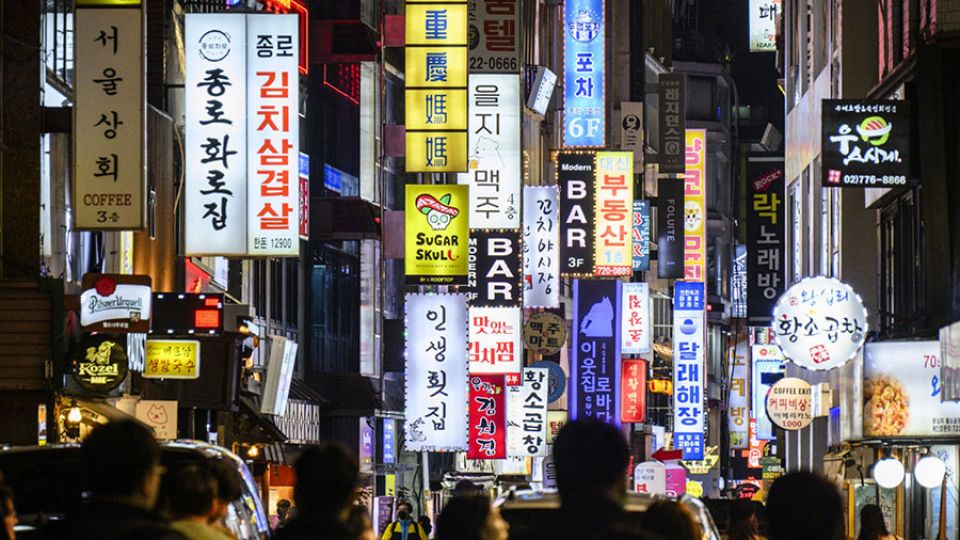
These adjustments lower the current legal ceiling of 1,500 cd to as little as one-third of the existing limit, a move aimed at reducing glare for pedestrians and improving nighttime road safety.
The guidelines also introduce measures to reduce visual fatigue from digital content. The city advises minimizing high-brightness white backgrounds in static images, using lower-luminance color schemes, and applying gradual transitions instead of abrupt brightness changes. Repetitive flashing and intense strobe effects should be avoided, it added.
City officials said the new standards are expected not only to improve the urban landscape and reduce discomfort but also to yield energy savings of about 15 percent.
Analysis of the 52 surveyed billboards showed that reducing peak daytime brightness from about 10,000 cd to below 7,000 cd could significantly cut power consumption.
“This is not a blanket regulation but a targeted adjustment to curb excessive brightness,” said Choi In-gyu, head of the city’s design policy division. “It balances advertising visibility with reduced visual strain for residents while improving energy efficiency.”
The recommendations come as large-format digital billboards become an increasingly prominent feature of Seoul’s landscape, particularly in areas such as COEX, Gwanghwamun Square and Myeong-dong, which have been designated as free advertising zones.