

January 26, 2026
BHIMAVARAM – Shrimp ponds extend as far as the eye can see in Bhimavaram, India’s shrimp export hub in the southern Indian state of Andhra Pradesh, but there are uneasy ripples under the surface.
Since US tariffs made shrimp 50 per cent more expensive, shrimp farmers and exporters have been anxious about the future.
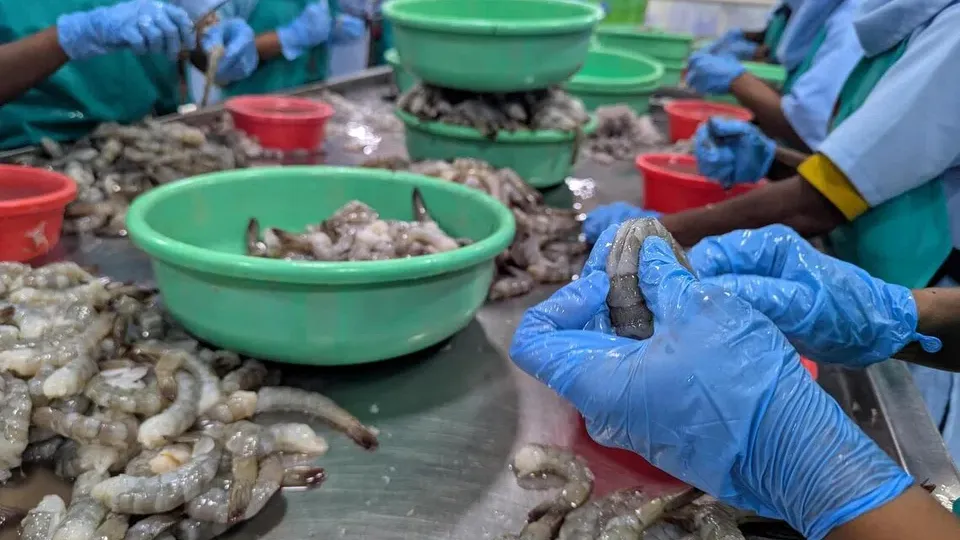
Factories usually bustling with workers de-veining, cleaning and freezing shrimp register only a murmur of activity. Most machines and freezers have been switched off.
“We have been working at half the capacity in the past three months, when the US tariffs began to shrink our orders,” said Mr Anand Kumar Uddaraju, director of Ananda Group, a 35-year-old family-run company that is one of India’s biggest shrimp exporters.
India is the world’s second largest producer of shrimp after Ecuador, rearing around 1.1 million tonnes of shrimp a year, the majority of it for export. Shrimp accounts for two-thirds of India’s seafood exports, making the shellfish the backbone of Indian marine trade.
Andhra Pradesh, with its long coastlines and irrigated farms, dominates shrimp production in India, 60 per cent of which is exported to the US.
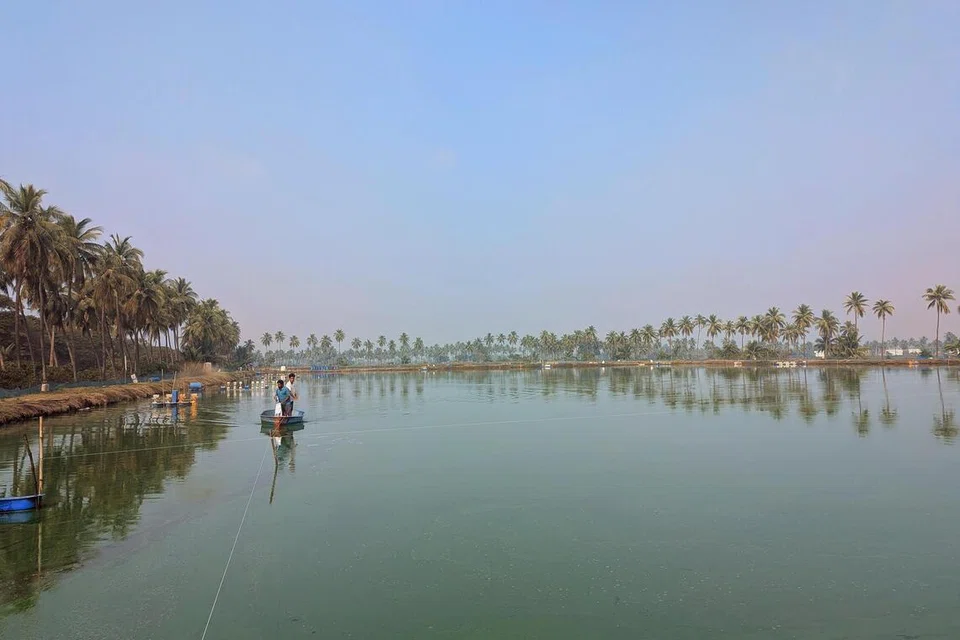
Workers, many of them migrants from other states, throwing feed into a shrimp pond in Bhimavaram, India’s shrimp export hub in the Andhra Pradesh state. PHOTO: THE STRAITS TIMES
In Bhimavaram today, the apprehension is palpable. The small town, whose plush apartments, international schools, engineering colleges, sport utility vehicle showrooms, shopping arcades and three-decades-old prosperity rose on the back of the little curly shellfish, is now at a crossroads.
India is America’s biggest supplier of frozen shrimp, and the US is also India’s largest market.
Ecuador is the second biggest supplier to the US, but demand for its frozen, head-on shrimp – not the first choice of American consumers – comes mainly from China.
In the financial year ending in March 2025, India exported US$4.88 billion (S$6.2 billion) worth of frozen shrimp globally, with the US buying 48 per cent of it, followed by China at around 30 per cent.
India’s shrimp sector has been shaped over 25 years by the dominance of the US market. Producers primarily grow the Pacific whiteleg or vannamei species that American palettes prefer and factories process it in ways preferred by American households and restaurants.
The cosy business relationship has been on the rocks since May 2025, when US President Donald Trump imposed a 25 per cent tariff on Indian imports, with an additional 25 per cent as a penalty for buying Russian oil. Along with countervailing duties of 5.77 per cent and anti-dumping duties of 2.49 per cent, the effective tariff on US shrimp exports from India is a prohibitive 58.26 per cent.
American orders have been dropping, and in October 2025, for which the latest data is available, exports to the US fell by 26 per cent.
Worried exporters have responded creatively by sailing their shrimp to new shores and developing high-end processed products, like breaded or butterflied shrimp, to offset the loss of volume with higher prices.
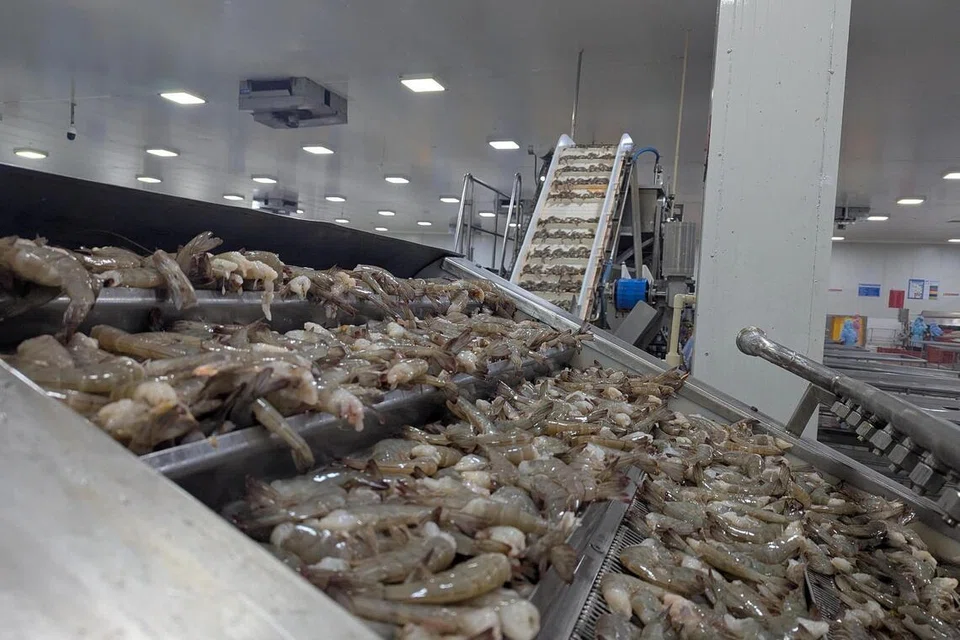
India’s shrimp sector has over 15 years been shaped by American consumer preferences for the Pacific whiteleg or vannamei species that are de-headed, de-veined with the tail on, cleaned, partly cooked and frozen. PHOTO: THE STRAITS TIMES
Throughout 2025, value growth outpaced volume, driven by a gradual tilt towards these higher-value products and markets that have firmer prices, observed a December 2025 report by trade consultancy Shrimp Insight.
But, unable to make up for the loss of the huge US market, shrimp producers are losing steam and hope as the India-US deal continues to languish in limbo.
Survival tactics
In January, the Ananda Group’s three shrimp processing units in Bhimavaram were partially running, with a small group of staff. With little need for production, Mr Anand said he is using the low period to carry out plumbing renovations in one unit and basic processing in another, while he hopes for good news from the diplomatic process.
“The order pipeline is weak. We’ll see the real effect of the US tariff by the end of January,” said Mr Anand.

Ananda Group’s shrimp processing units in Bhimavaram are running on slim capacity. Instead of a capacity of 500 tonnes, the company is only producing around 2 tonnes, or 1500kg. PHOTO: THE STRAITS TIMES
In 2025, the hit to Indian shrimp exporters was limited, because US importers honoured their existing orders.
Buyers did not immediately turn to other suppliers like Ecuador, China and Indonesia, which do not produce shrimp the way the US wants it: frozen, de-headed but tail-on, peeled and de-veined, for a cooked-to-order look and time-saving cooking. But they eventually could.
“In 2026, we believe our competitors will catch up to US needs, displacing us (Indian shrimp) mainly because of the huge price gulf,” Mr Pawan Kumar, president of the Seafood Exporters Association of India, told The Straits Times.
The US tariff on Ecuador is 15 per cent, while Indonesia’s is 19 per cent, both below India’s 58.26 per cent.
Limited growth potential in new markets
Indian exporters have also sped up their previous attempts to diversify to places including China, Vietnam and European markets.
This bore fruit in late 2025. Processed frozen shrimp exports to Europe increased by 37 per cent in 2025, and 79 per cent in October 2025 alone. Unprocessed shrimp exports to China grew by 6 per cent, and to Vietnam by an enormous 93 per cent, countries that are reprocessing hubs for Indian shrimp.
While the India-European Union Free Trade Agreement is not finalised yet, the Indian government said that recent EU approvals for 102 new Indian seafood processing units to be added to the total list of 604 establishments could be a major relief for Indian shrimp exporters.
But some shrimp producers believe the growth potential in the new markets is limited, for various reasons.
“Europe has non-tariff trade barriers like antibiotic screening. China buys mostly head-on shrimp that (spoil faster than headless ones and so) require wider cold chain facilities near the factories that India doesn’t have in scale,” said Mr Ravi Kumar Yellanki, president of the All India Hatcheries Association.
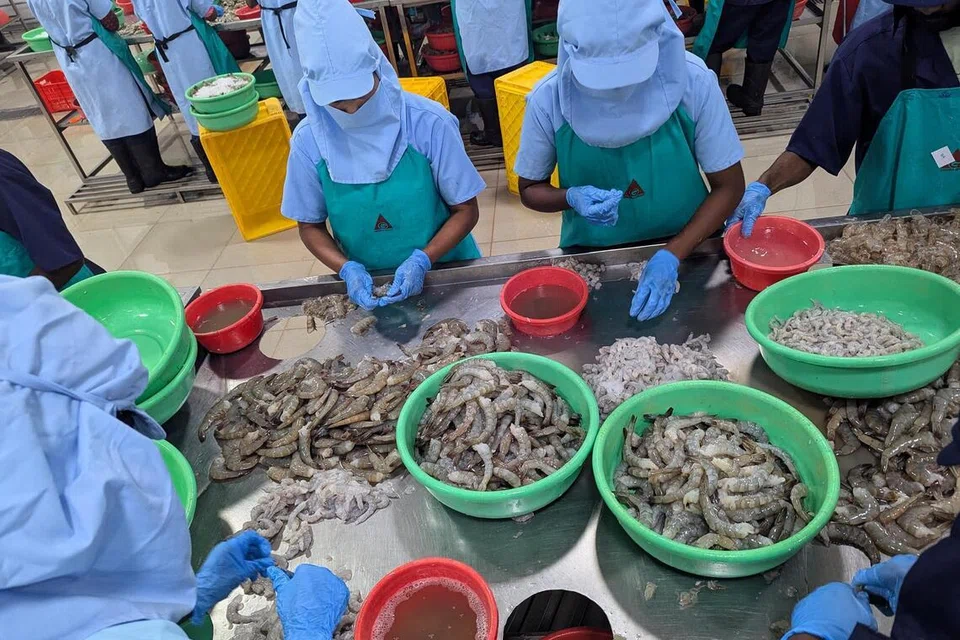
While Indian exporters sped up attempts to diversify to other markets, shrimp producers believe their growth potential is limited. PHOTO: THE STRAITS TIMES
Mr Anand said his company may have to explore South-east Asia and China too, but the price realisation on those is lower.
“We’re trying to sell more to Canada and Europe, but it is time-consuming and volumes are smaller,” he said.
“Other markets such as Russia, Australia, and South Korea whose total market is 50,000 to 60,000 tonnes each compared with the US’ 5.5 million to 6 million tonnes, don’t have much potential,” Mr Yellanki said.
All through 2025, exporters were waiting for the Indian and US governments to finalise a trade deal that would relax the tariff or exempt shrimp like they did pharmaceuticals and electronics.
They hope Mr Trump will be convinced by the tariff’s impact on Americans. US customers are paying 21 per cent more for wholesale peeled and tail-on shrimp, at around US$6.25 per pound, following the import tariffs on India, as per a Financial Times report. The National Fisheries Institute in the US noted in October 2025 that local shrimp fishermen in Louisiana and Florida cannot replace the roughly 90 per cent of US shrimp supply that is farmed overseas.
“We have run out of options now. From 2026, the real trouble starts, unless the tariff goes,” Mr Kumar.
Downstream distress
Farmers in Andhra Pradesh fear that they may be in for a shock in March, when the new batch of shrimp is harvested.
“Exporters may not buy all the material, or may buy it at 100 rupees instead of 250 rupees per kilo, which won’t even cover my cost,” said Mr Krishna Raju, 53, who grows shrimp in 150 acres, and spends around 100,000 rupees per acre of shrimp.
Acres of shrimp ponds with spinning aerators slowly replaced paddy fields in the region 35 years ago when agriculture failed to yield a sustainable income. Shrimp export changed the fortune of the locals.

To save on costs and use the time during the market downturn to revive the soil, shrimp farmer Krishna Raju, 53, has drained some of his 150 acres in Kolamuru village in East Godavari district in Andhra Pradesh. PHOTO: THE STRAITS TIMES
Mr Venkatapathiraju Penmesta, 34, a second-generation shrimp entrepreneur who manages 800 acres of shrimp ponds, said: “If farmers don’t get a fair price, we may not go for the second crop season because of the losses.” The second crop in Andhra Pradesh usually lasts from June to October.
While shrimp farming is a “high-risk, high-profit investment” because of how sensitive the shrimp are to disease and temperature fluctuations, he said “the US tariff is as unexpected as an earthquake”.
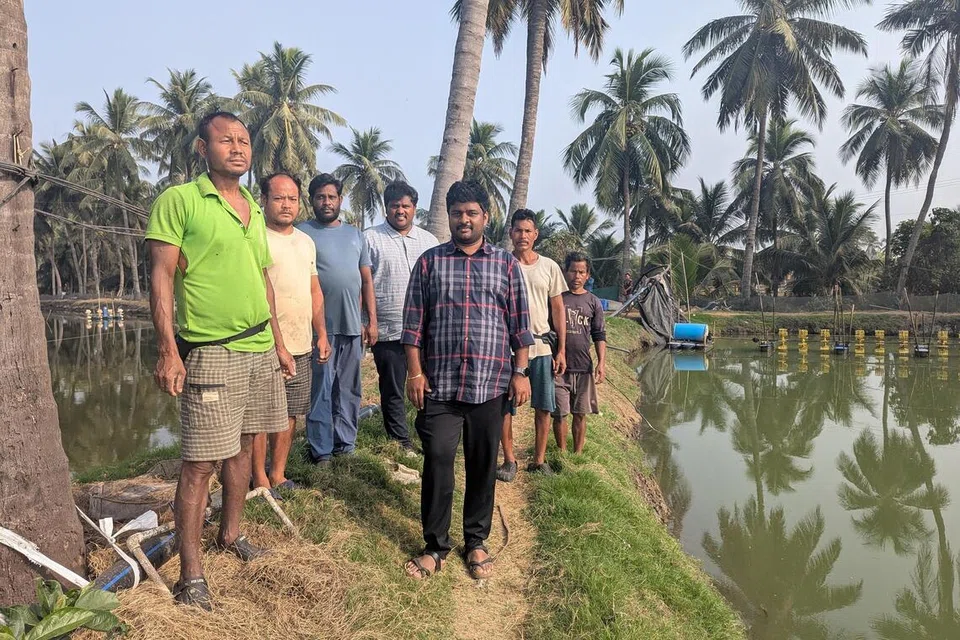
Mr Venkatapathiraju Penmesta (second from left) employs nearly 200 workers on his shrimp farms in Andhra Pradesh, many of them migrants from Assam in north-east India. By March, if he is not able to get good prices, he will have to send them home. PHOTO: THE STRAITS TIMES
Farmers hoped that the government would help them with electricity subsidies or rate stability, but everyone across the shrimp sector was praying in unison for a trade deal with the US.
“Aquaculture is all I know,” the sfarmer Raju said. Behind him, acres of drained shrimp farms lay bare open to the sun, waiting for certainty.