


December 30, 2025
SINGAPORE – From an eventful general election that saw the PAP returned to power with a higher vote share, to the conclusion of a high-profile court case involving Leader of the Opposition Pritam Singh, 2025 was a standout year for Singapore politics.
With tectonic shifts in the world of work and ongoing geopolitical uncertainties, all eyes are on the Government’s plans to refresh Singapore’s longer-term economic strategy, while meeting Singaporeans’ bread-and-butter concerns over jobs, housing and cost of living.
Here is what to expect in the political space in 2026, and a round-up of the biggest news in 2025.
1. S’pore’s updated economic blueprint takes shape
The five committees reviewing the country’s economic strategy are expected to begin making policy recommendations soon, with the Government’s annual Budget season around the corner in February.
Chaired by the newer political office-holders, the Economic Strategy Review (ESR) committees were formed in August to ensure that the city-state stays globally competitive in the long run, and to secure good opportunities for its businesses and workers.
The ESR reports to the Singapore Economic Resilience Taskforce chaired by Deputy Prime Minister Gan Kim Yong.
The committees’ review covers five areas: global competitiveness; technology and innovation; entrepreneurship; human capital; and managing the impact of restructuring.
In November, Acting Transport Minister and Senior Minister of State for Finance Jeffrey Siow said the five committees will release a mid-term update in tandem with Budget 2026, so that early proposals can be discussed and funding secured for them.
For instance, the Republic must find ways to capture investment flows in artificial intelligence to power its economic growth over the next decade, said Mr Siow, who co-chairs the committee on global competitiveness.
The ESR will issue a final report with its recommendations by mid-2026.
Expect Prime Minister Lawrence Wong’s Budget statement, which will be delivered on Feb 12, to further flesh out Singapore’s economic repositioning plans, including ways to help Singaporeans cope with rapid technological disruption.
2. Parliament to discuss WP chief Pritam Singh’s conduct
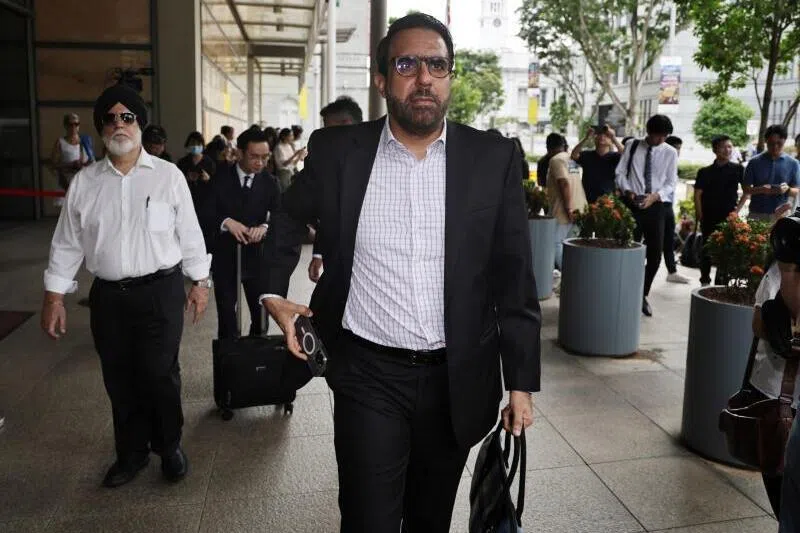
WP chief Pritam Singh was convicted of lying to a parliamentary committee. PHOTOS: THE STRAITS TIMES
Parliament’s first sitting on Jan 12 will see the House discuss the actions of Workers’ Party chief Pritam Singh , who was convicted of lying to a parliamentary committee.
The case arose after then WP MP Raeesah Khan was investigated for lying in Parliament in August 2021. Following a 13-day trial in 2024, Mr Singh was found guilty of two charges and fined $14,000 in February.
The conviction was upheld in the High Court on appeal, with Justice Steven Chong saying in December that Mr Singh’s actions showed he would have “let sleeping dogs lie” if the matter was already buried.
Leader of the House Indranee Rajah said on Dec 17 that the courts’ findings meant it was necessary for Parliament to deliberate on an appropriate response to Mr Singh’s actions and convictions.
Noting that lying under oath is a serious matter, Ms Indranee said Singapore cannot accept a standard whereby leaders who have broken the law escape legal or political consequences.
While it is unclear what the consequences will be, they could range from a formal censure to removal of Mr Singh from his position as Leader of the Opposition.
In a subsequent statement, Ms Indranee said the court judgments in Mr Singh’s case also have implications for WP chair Sylvia Lim and vice-chair Faisal Manap, and that this will also be discussed when Parliament reconvenes.
On Dec 28, the WP said some of its cadres had requested a special meeting to be held by its top decision-making body on Mr Singh’s conviction. The party had earlier said that it had initiated “internal processes” following the High Court judgment.
3. Cost of living, housing remain on the agenda
With the general election in the rear view, Singaporeans will be looking at how the Government intends to deliver on its election promises, using the Budget and other levers in its fiscal and policy toolbox.
For instance, while inflation has come down and support schemes such as CDC and utilities vouchers have alleviated cost pressures, the cost of living remains a perennial source of anxiety for many people.
The PAP has pledged to continue supporting households here through such schemes for as long as necessary, while parents will enjoy expanded parental leave and lower pre-school fees.
It has committed to reinforcing social safety nets such as ComCare and Silver Support to help the most vulnerable Singaporeans, enhance Workfare for lower-wage workers, and to extend the Progressive Wage Model to more sectors.
The situation with home ownership, a cornerstone of Singapore’s social compact, has also stabilised, with more new Build-To-Order (BTO) flats coming on stream and shorter waiting times for some projects.
In its election manifesto, the ruling party said it will explore more public housing options for higher-income couples and singles, while acting decisively when needed to keep the property market stable and sustainable.
In August, Minister for National Development Chee Hong Tat said the Government will be “building more and building faster” to meet demand and keep flat prices affordable.
HDB will launch around 55,000 BTO flats from 2025 to 2027 , which is 10 per cent more than its original target of 50,000 flats for the period.
The authorities are also looking at whether the minimum age of 35 for singles to buy BTO flats can be lowered and, separately, HDB will review the income ceiling for BTO flats at an appropriate time, Mr Chee added.
4. 38 Oxley Road gazetted, eyes on what’s next
The state’s decision on Dec 12 to gazette 38 Oxley Road – founding prime minister Lee Kuan Yew’s home – as a national monument has resolved a decade-long dispute over the site, but opened new questions about its future.
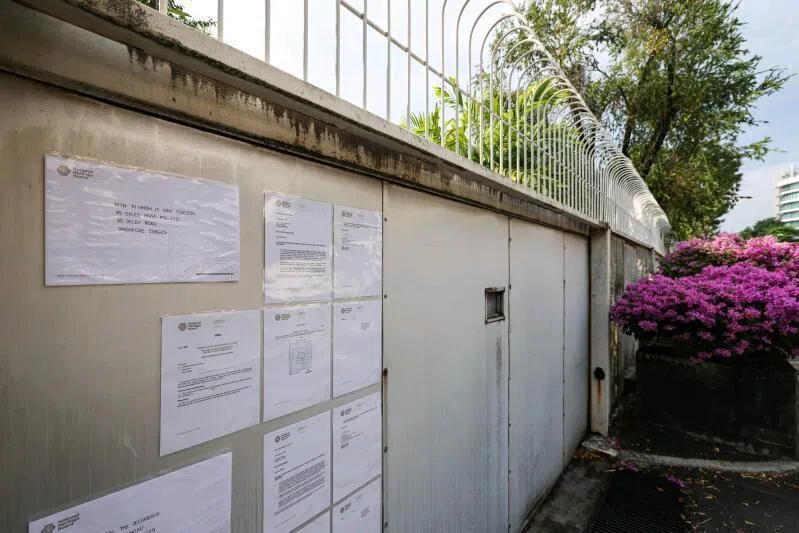
Notices of the gazette announcement on the gates of 38 Oxley Road on Nov 4. PHOTOS: THE STRAITS TIMES
Describing the site as a “unique and foundational part of the story of Singapore’s independence”, the Ministry of Culture, Community and Youth and the National Heritage Board said preserving it will allow current and future generations of Singaporeans to reflect upon significant events in the nation’s history that took place there, and the ideals and values that have shaped Singapore.
It was in the Oxley Road bungalow’s basement dining room that the founding members of the People’s Action Party began meeting in the 1950s to consider the feasibility of forming a political party.
The state has said it intends to acquire the site from its current owner, Mr Lee Hsien Yang, who had sought demolition and objected to the preservation.
The Government intends to convert the site into a public space, with one possible outcome being a heritage park.
However, it has also committed to respecting Mr Lee Kuan Yew’s wish for his private living space to be demolished or removed. This means that the authorities have to find a way to preserve the site’s historic significance, even as personal spaces such as bedrooms will be reconfigured or removed.
The Government said it will consider all options and come to a decision “well within” this current term.
A look back at 2025
1. GE2025: A milestone election
The 2025 General Election on May 3 marked the first electoral test for PM Wong’s leadership, amid global uncertainty and trade wars.
The ruling PAP secured 65.57 per cent of the national vote , a commanding swing from its 61.24 per cent share in the 2020 General Election.
It also won 87 of 97 seats, including the hotly contested Punggol GRC, Tampines GRC, East Coast GRC, West Coast-Jurong West GRC and Jalan Kayu SMC. Marine Parade-Braddell Heights GRC was uncontested – the first walkover at a general election since 2011.
PM Wong called the results “a clear signal of trust, stability and confidence” from Singaporeans in their government.
The PAP fielded its largest batch in decades of 32 fresh faces, while key ministers including deputy prime minister Heng Swee Keat, senior minister Teo Chee Hean and defence minister Ng Eng Hen retired.
The WP defended its strongholds in Hougang SMC and Aljunied and Sengkang GRCs , and increased its Parliament presence from 10 to 12 members, including two Non-Constituency MP (NCMP) seats.
The other opposition parties failed to win any constituencies or send any candidates to Parliament as NCMPs. These include the Progress Singapore Party, which did not manage to retain or convert its two NCMP seats.
2. Identity politics at the polls
Identity politics emerged as a contentious issue during the May general election, sparked by comments from a Singaporean self-styled preacher and several foreign politicians.
The issue was first spotlighted when, during the hustings, the authorities blocked a number of Facebook posts for attempting to influence Singapore’s election.
The authorities also flagged online messages by Singaporeans that they said contained racial and religious undertones.
Among them was Mr Noor Deros, a Malaysia-based Singaporean who said in several Facebook posts that the WP was the only political party to take seriously the concerns of the Malay/Muslim community.
He also criticised then Minister-in-charge of Muslim Affairs Masagos Zulkifli for not doing enough, and called on Tampines voters to “do the right thing”.
Midway through the hustings, PM Wong asked political parties to clarify their stance on two fundamental principles: that identity politics has no place in Singapore, and that religion and politics should not mix.
The issue was aired more fully in October when Coordinating Minister for National Security and Minister for Home Affairs K. Shanmugam delivered a ministerial statement in Parliament, where he took issue with the WP for not immediately and unequivocally calling out Mr Noor.
In response, WP chief Singh accepted that his party’s statement on Mr Noor could have been clearer, but said he had been loath to draw attention to a “nobody” who had “gatecrashed” a meeting between WP’s Malay candidates and Muslim religious leaders.
As it turned out, Mr Noor had been invited to the meetings by a religious teacher, a point Mr Singh later clarified in the November Parliament sitting.
2. Identity politics at the polls
Less than three weeks after the May general election, PM Wong announced his first full Cabinet with six ministries helmed by new ministers, and new office-holders in all 15 ministries.

Prime Minister Lawrence Wong taking his oath of office at the Istana on May 23. With him were President Tharman Shanmugaratnam (centre) and Chief Justice Sundaresh Menon. PHOTOS: THE STRAITS TIMES
The changes were significant but, inevitably, attention was focused on his choice of deputies. There was an expectation that he would appoint more than one deputy prime minister – as was the case for many previous terms of government – and thereby elevate one of his fourth-generation (4G) peers.
Bucking the trend, PM Wong appointed only Mr Gan to the role.
He also appointed three new coordinating ministers: Mr Shanmugam as Coordinating Minister for National Security, Mr Chan Chun Sing as Coordinating Minister for Public Services, and Mr Ong Ye Kung as Coordinating Minister for Social Policies.
Together, they form the core of his team that would advise him as well as provide guidance and mentorship to the new and younger ministers, PM Wong said at a May 21 press conference.
Political observers said this broader leadership team would allow more 4G leaders to take on bigger roles at the same time, in the interest of preparing the team for renewal.
At the PAP convention on Nov 9, PM Wong said: “We now have a Cabinet made out largely of 4G ministers, with some 3G veterans. Before too long, it will be a 4G Cabinet with a few 5G ministers.”
If all goes according to his plan, the PAP’s 5G team will start to take shape at the next general election, which has to be called by 2030.
4. Building a ‘we first’ society
The concept of a “we first” society was introduced by PM Wong at the National Day Rally in August.
Positioning it as an invitation for collective action rather than a retreat of government responsibility, he said this philosophy is how he and his team intends to lead – by doing things with Singaporeans, rather than just for Singaporeans.
If everyone does their part by looking out for the next person, then the individual will thrive and flourish too. This approach will also build stronger trust, deeper ownership and a greater sense of common purpose, he added.
Beyond volunteering and civic participation, he emphasised co-creating solutions with government agencies and community partners.
In his address at the opening of the 15th Parliament in September, President Tharman Shanmugaratnam also called on Singaporeans to embrace this mindset.
He said the Government will work with community leaders to expand “networks of care” and promote ground-up initiatives. He also urged people to measure success not just by personal achievement, but also by contribution to the common good.
In 2026, Singaporeans can expect to see more avenues for them to be heard and to get involved – not just to give feedback or share ideas, but empowered to execute them to improve their communities.