

May 26, 2026
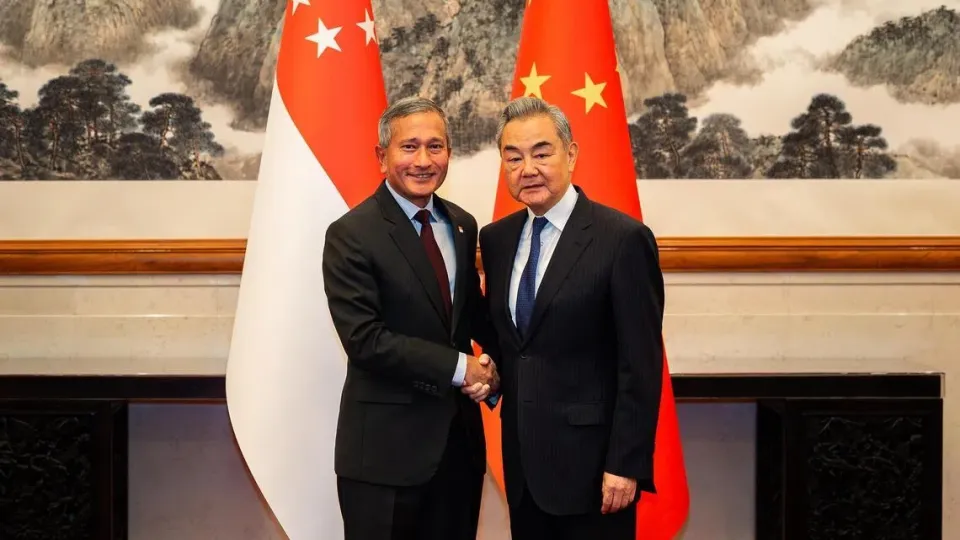
SINGAPORE – Singapore and China urged an immediate ceasefire in the Middle East and an end to the blockade of the Strait of Hormuz as their top diplomats met in Beijing on May 25.
Singapore Foreign Minister Vivian Balakrishnan and his Chinese counterpart Wang Yi also reaffirmed their countries’ shared commitment to regional stability and the rules-based international order.
“We agreed on the need for an immediate ceasefire in the Middle East. We emphasised the importance of resuming maritime traffic flows through the Strait of Hormuz and commended Pakistan’s mediation,” Dr Balakrishnan said in a Facebook post after the talks with Mr Wang as part of his working visit to Beijing from May 24 to 26.
The foreign ministers’ meeting took place amid an intense period of diplomacy in Beijing, as Chinese President Xi Jinping received Russian President Vladimir Putin and United States President Donald Trump in recent weeks for talks that underscored China’s central role in a rapidly evolving global order.
Singapore leaders are also frequent visitors to China, with Senior Minister Lee Hsien Loong concluding a week-long trip to the Guangxi autonomous region and Shanghai on May 22.
In a statement on May 25, Singapore’s Ministry of Foreign Affairs said the two ministers agreed on strengthening bilateral cooperation in emerging areas, including the green and digital economies and supply chain resilience. They also held wide-ranging discussions on regional and international developments.
Mr Wang said China places high importance on its relations with Singapore and is keen to “sustain strong high-level exchanges, deepen practical cooperation across sectors, and strengthen people-to-people ties”, according to a statement issued by the Chinese Foreign Ministry.
He noted that while China and Singapore “differ in size”, both countries “serve as stabilising forces” in the international system.
Amid a turbulent global environment, they both firmly uphold multilateralism, support free trade and advocate an international order centred on the United Nations, Mr Wang said.
Dr Balakrishnan and Mr Wang also affirmed the longstanding relationship between Singapore and China, under what both sides described as an “all-round high-quality future-oriented partnership”.
On regional matters, Dr Balakrishnan welcomed China’s continued engagement with ASEAN, with both ministers expressing support for closer ASEAN-China cooperation. Singapore takes on the ASEAN chairmanship in 2027.
The ministers reaffirmed the importance of international law, including the UN Convention on the Law of the Sea, and underscored the right to freedom of passage in international waterways. They agreed that ships and aircraft should enjoy unimpeded transit passage through straits used for international navigation.
The Strait of Hormuz, a key global energy and shipping route, has been effectively closed since the US-Israel war on Iran broke out on Feb 28.
The US and Iran on May 25 played down hopes for an imminent breakthrough in efforts to end the three-month-old war, with America’s top diplomat Marco Rubio saying Washington will either get a good agreement or deal with Iran in “another way”.
On cross-strait ties, Dr Balakrishnan reiterated that Singapore has a longstanding and consistent “one China” policy, and is opposed to Taiwan independence and any unilateral moves to change the status quo. The Republic will continue to support the peaceful development of cross-strait relations, according to the Singapore Foreign Ministry’s statement.
Dr Balakrishnan also met Mr Liu Haixing, Minister of the International Department of the Communist Party of China’s Central Committee. At their meeting, they welcomed regular government-to-government, people-to-people and party-to-party exchanges.
The Beijing meetings mark the first leg of the Singapore minister’s working visits to China, North Korea and South Korea from May 24 to 28.
Dr Balakrishnan, who is accompanied by officials from the Ministry of Foreign Affairs, will leave Beijing for North Korea on May 26.