

June 5, 2026
SINGAPORE – Suffering from diabetes and high blood pressure that caused her kidneys to fail in 2021, Azliza Aman found it difficult to hold down a full-time job.
“I was working at a call centre for the travel industry, but because Covid-19 disrupted the industry, I became unemployed for about two years. When I managed to secure a job at another call centre in 2023, I had to give it up after more than a year,” the 57-year-old told The Straits Times.
By then, Azliza had started dialysis, which meant she had to undergo treatment three times a week, with each session lasting four hours.
“I had picked the last session, which starts at 5.30pm, but the company was unable to let me leave early as work ended at 6pm,” she said.
Like Azliza, dialysis patients typically undergo treatment three times a week, with the sessions taking up about 12 hours per week. It is this life-saving treatment that makes it a struggle for them to keep their jobs and makes potential employers hesitate to hire them.
For some, the hardest part of dialysis is the gradual feeling of being excluded from normal life and the workforce.
To help, the National Kidney Foundation (NKF) and five other dialysis providers here have come together on a shared platform to work with employers and advocate for greater understanding, workplace inclusion and employment opportunities for around 10,000 dialysis patients in Singapore.
The shared platform comprises DaVita, Diaverum, Kidney Dialysis Foundation, NKF, SATA CommHealth and Tzu Chi Foundation (Singapore).
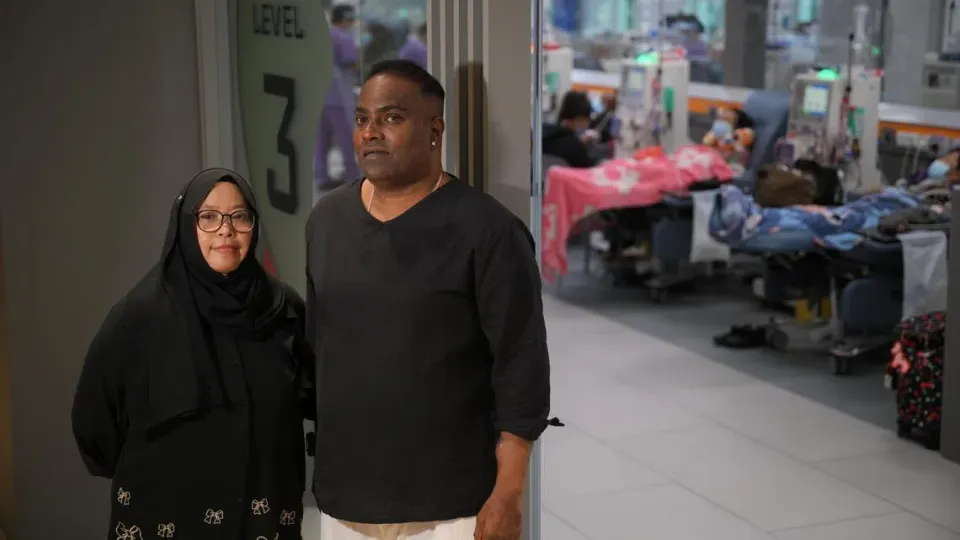
The challenges faced by dialysis patients are familiar to N. Nantahkumaran, 45, whose health took a serious turn when he experienced severe fluid retention and swelling in his body.
“I literally felt like a water bottle with my body full of fluid.
“I felt really bloated, and there was no way I was able to get rid of the excess fluid,” he said.
It was after a series of other medical issues that his condition progressed to kidney failure, and he eventually began dialysis in 2023.
“It was traumatising – changing from an active person managing events to not being able to do anything. I felt lost and helpless. I had to stop work completely for four years because of this sudden change in my life,” Nantahkumaran said.
NKF chairman Ang Hao Yao said no single organisation can address the employment challenges faced by dialysis patients alone.
“We brought together the major dialysis providers because this is an issue that affects all dialysis patients, regardless of where they receive care.
“By uniting the sector, we hope to send a strong and collective message that dialysis patients are capable, resilient and able to contribute meaningfully to the workforce when given the opportunity.
“Ultimately, this is about putting patients first and creating a more inclusive society,” he said.
Tzu Chi Foundation (Singapore) chief executive Low Swee Seh said: “Every individual deserves the opportunity to live with dignity, purpose and hope. For many dialysis patients, employment is more than a job. It is a source of self-worth, independence and social connection.
“By coming together as a dialysis community, we hope to inspire more employers to look beyond medical conditions and recognise the strengths, resilience and contributions that dialysis patients can bring to the workplace.”
DaVita Singapore general manager Seow Yong Tong agreed, saying that people living with kidney disease can work successfully in many roles.
“With some flexibility around treatment schedules, they can perform effectively and reliably. We hope employers will focus on ability and potential and be open to creating more inclusive workplaces,” he said.
Chronic kidney disease is no longer only a healthcare issue but a national challenge that increasingly affects many individuals and families across Singapore, NKF’s chairman said.
“Beyond the medical realities lies another challenge we must confront together – the social and economic impact of kidney failure… Despite the demands of dialysis treatment, (the patients) continue striving to live purposefully, contribute meaningfully and pursue the things that matter to them,” he added.
Ang was speaking at the NKF Partners Connect Symposium 2026, held at the NKF Centre on June 3.
Senior Parliamentary Secretary for Manpower Shawn Huang, who was the guest of honour, revealed that his ministry was also embarking on efforts to enhance support for workers to maintain or re-enter employment after experiencing a serious injury or health-related setback.
This, he said, is one of the areas of focus for the new Alliance for Action on Safety and Health for Employment Longevity, or AfA-SHEL.
“Through the AfA-SHEL, we will partner with industry to co-create innovative and scalable solutions to support workers’ return to work.
“Solutions could include new job redesign approaches that allow workers to maximise their strengths while accounting for their health needs, or new partnership models to match workers to jobs that suit their functional capabilities,” said Huang, who is also Senior Parliamentary Secretary for Finance.
AfA-SHEL will be launched later in 2026 by the Ministry of Manpower, the National Trades Union Congress and the Singapore National Employers Federation.
NKF jobs programme
Since 2015, NKF has been helping patients secure jobs through its Patient Employment Rehabilitation Programme.
In 2016, 61 patients were employed by NKF in positions such as patient relations officers, exercise assistants and administrative assistants.
Seventy per cent of NKF patients are aged 61 and above; about 1,100 of its patients are looking for jobs but face challenges.
Now known as the EMPower+ Programme, it reaches out to and educates employers on patients’ needs and challenges, while partnering with them to provide suitable career opportunities.
One initiative is Kaki Corner, a cafe and vocational rehabilitation programme at the NKF headquarters manned by dialysis patients. Through professional training as baristas, they can go on to work at participating food and beverage partner outlets.
This was where Azliza learnt to be a barista in 2024 before she landed a part-time job with speciality tea bar 1872 Clipper Tea, “where my employers and colleagues are very understanding”.
In return, whenever the cafe is short-handed, Azliza often steps in to help, reflecting a strong spirit of mutual support and give and take. She also serves as a mentor at Kaki Corner, helping to guide new trainees once or twice a week.
For Nantahkumaran, regular dialysis treatment allowed him to return to the work he loves in the entertainment industry. He now works as a freelance sound engineer, providing professional sound and lighting set-up for events and concerts.
Currently, he is further strengthening his technical expertise through a refresher course with Mediacorp in sound engineering, audiovisual production and video editing.
Nantahkumaran is also looking forward to marrying his fiancee, a nurse educator whom he met while having his dialysis treatment, in May 2027.
“She stood by me through thick and thin, despite everything,” he added.