

February 13, 2026
SINGAPORE – Singapore will provide more support for firms to stay competitive and make a national push to tap the potential of artificial intelligence (AI) as part of its plans to navigate an uncertain and fractured world.
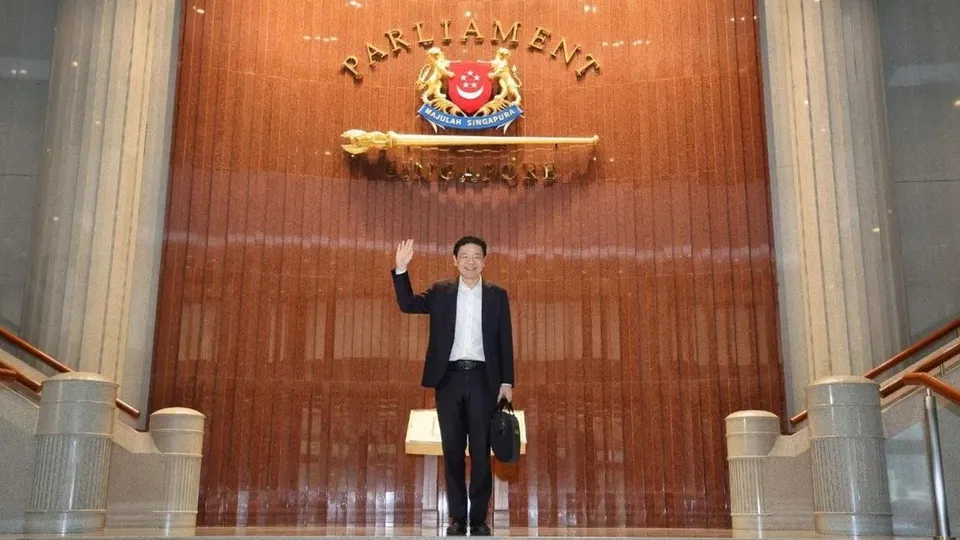
Families and individuals will also receive more help under a broad suite of measures announced by Prime Minister Lawrence Wong on Feb 12, when he unveiled a record $154.7 billion Budget.
The Budget is the first step in refreshing the country’s strategies to meet the challenges ahead, said PM Wong, who devoted a section of his speech to new policies covering businesses, workers and students to harness AI as a strategic advantage.
He also set out measures such as improvements to schemes for lower-wage and mid-career workers, additional payouts to lower-income families and CDC vouchers to help with cost pressures.
These social policies contribute to an ever-growing Budget, which is projected to be $11.4 billion more than the one in the previous financial year. It takes up 18.4 per cent of Singapore’s gross domestic product, inching closer to the projected trends for government spending to hit about 20 per cent of GDP by 2030.
PM Wong, who is also Finance Minister, announced updates to foreign worker policies as well. The minimum qualifying salaries for skilled foreign workers and levies for basic-skilled workers in certain sectors will be increased, to ensure that Singaporeans remain firmly at the centre of the nation’s workforce even as it stays open to skills and talent that strengthen the economy.
Budget 2026 comes at a time of profound global change, said PM Wong.
He noted that Singapore’s past success alone will not carry it forward, and it cannot afford to wait for conditions to turn more favourable or fall back on strategies designed for a previous era.
“We therefore have a full agenda in this term of Government to refresh our strategies and strengthen our social compact,” he said.
He told the House that while Singapore managed better-than-expected growth of 5 per cent in 2025, a more moderate outlook is expected for 2026, with growth projected at 2 per cent to 4 per cent.
“Despite these uncertainties, we can move forward with confidence – confidence grounded in fundamentals,” said PM Wong.
The Government is beginning its term on “firm fiscal footing”, he said.
It expects revenues and expenditures to continue rising, and will manage this increase carefully and in line with its objective of maintaining a balanced Budget over the medium term, he added.
A surplus of $8.5 billion is expected in the 2026 financial year, a dip from the higher-than-expected surplus of $15.1 billion in 2025, which was driven partly by the country’s economic performance.
“Our sound public finances give us the ability to act decisively and to invest where it matters most,” said PM Wong.
On the economic front, he intensified efforts to help Singapore companies venture abroad by enhancing a suite of existing measures that help firms access new markets, have more flexibility in their financing needs and pursue overseas ventures that need more capital outlay, among others.
At home, the authorities will help to build leadership in key growth clusters such as semiconductors, aerospace and biomedical sciences.
“Our investments must be disciplined, focused and strategic – directed at areas where Singapore has clear strengths, and where our efforts can make a real difference,” he added.
The Budget puts together a comprehensive approach that will strengthen Singapore’s enterprise ecosystem, said PM Wong.
“This will create more opportunities for Singaporeans to secure good jobs and grow their careers.”
One key area of opportunity is in AI, and Singapore’s advantage lies in the nation being able to deploy it effectively, responsibly and at speed, said PM Wong.
Acknowledging the deep concerns that have arisen from the rapid advancement of AI, he said Singapore must confront the anxieties squarely and invest in it deliberately and with discipline.
He announced that he will chair a new National AI Council to drive the country’s AI agenda, and outlined programmes to encourage more companies to move decisively on AI transformation.
The authorities will also do more to improve AI literacy of students in institutes of higher learning
and incentivise Singaporeans to learn and pick up AI-related skills through SkillsFuture courses and other tools.
These moves will help the Singapore workforce adapt and progress amid technological change, said PM Wong.
He also rolled out other initiatives to help local employees, including changes to schemes that will increase the salaries of lower-wage workers and the allowance given to mid-career workers who undergo training.
Turning to support for families, PM Wong said they will receive another $500 in Child LifeSG Credits for each Singaporean child aged 12 or below, while the income threshold for means-tested pre-school subsidies and student care fee assistance will be raised.
To further strengthen retirement support, the Government will provide a Central Provident Fund top-up of up to $1,500
for Singaporeans aged 50 or older above who have not reached the Basic Retirement Sum.
It will also roll out a new investment option for people who are keen to take more risks with their CPF savings to generate potentially higher returns. The Government will help to shape and develop this new scheme by requiring fees to be kept low and providing some time-limited support to kick-start it, said PM Wong.
More broadly, he also announced a Cost-of-Living Special Payment for eligible Singaporeans, more U-Save rebates to help with utilities expenses, and $500 in CDC vouchers to be issued to all Singaporean households in January 2027.
Read More:
Recap: Key announcements from Singapore PM Wong’s Budget 2026
Budget 2026: 5 measures to help Singapore businesses, from tax rebates to going international
Singapore Budget 2026 calculator: Check your benefits and estimated tax
Budget 2026: Goodies Singaporeans will get – from CDC vouchers to LifeSG credits for children